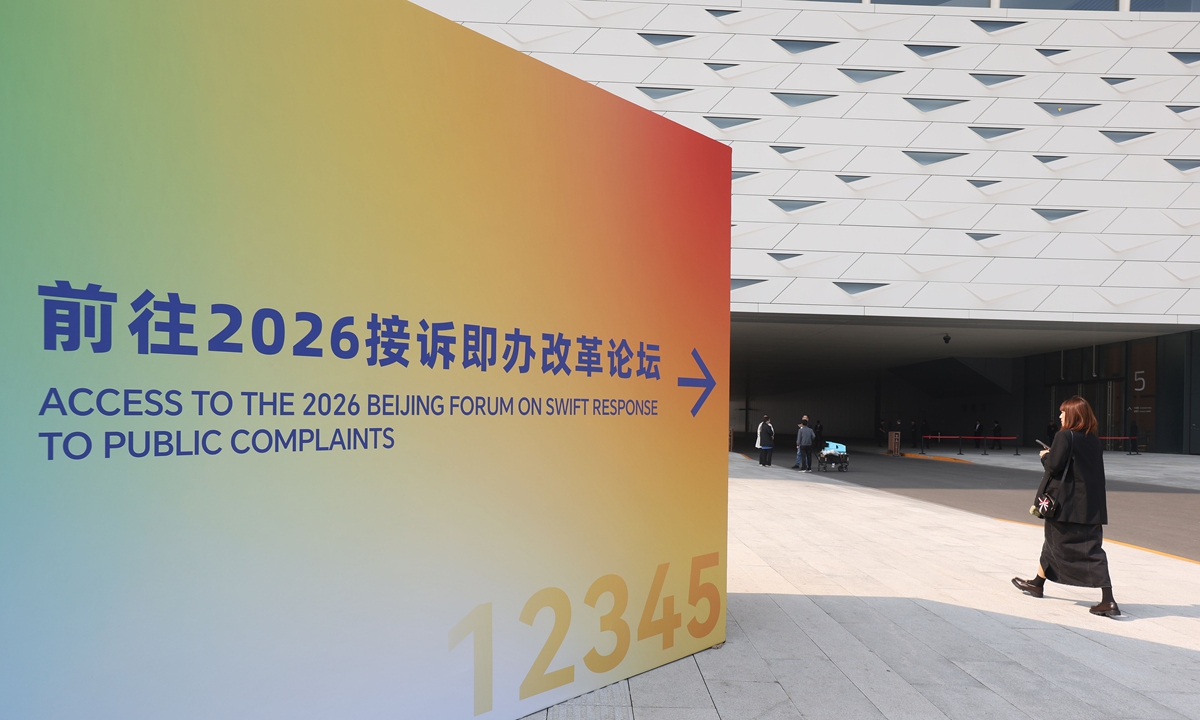
A visitor walks past a sign for the 2026 Beijing Forum on Swift Response to Public Complaints in Beijing on October 12, 2026. The forum opened that day under the annual theme "Digital Intelligence Era and People's City." Photo: VCG
The 2026 Beijing Forum on Swift Response to Public Complaints opened in Beijing on Monday under the annual theme "Digital Intelligence Era and People's City."
International guests were invited to observe frontline operations, including big-data dispatching, AI-generated work orders, multilingual services for foreign-related inquiries and accessible services using sign language.
Some also tried the Jing Tong mobile app, according to the Xinhua News Agency.
"What I saw there, it's like a real democracy, because it's the people for the people and by the people," Argentine scholar Jorge Gonzalo Fiore Viani told the Global Times on Monday after having visited Beijing's 12345 citizen service hotline, praising a governance mechanism he says other cities could learn from.
"I think that is a very interesting mechanism to copy in different cities, in other cities, because you can solve the problems of the people quickly and very efficiently," Fiore Viani, a scholar affiliated with Argentina's National Scientific and Technical Research Council (CONICET), said after having observed how the hotline handles public complaints and requests.
Fiore Viani also told the Global Times that he had visited the hotline center two years earlier and noticed the improvements, particularly in the use of technology and AI.
The experience offered a firsthand look at a system designed to turn residents' everyday concerns into actionable government responses. Since the reform began in 2019, Beijing's 12345 hotline has handled about 200 million requests from residents and businesses, with both the resolution rate and satisfaction rate remaining above 97 percent, according to official figures.
The reform is not only about processing calls, but also about changing how government departments and communities work together to address public concerns, experts said.
Yang Shoutao, a professor at the Party School of the Beijing Municipal Committee of the Communist Party of China, said one of the biggest changes in Beijing's governance in recent years has been the gradual shift from government officials handling complaints largely on their own to mobilizing a broader range of participants.
Under the approach, stakeholders, people concerned about particular issues and those with relevant expertise are increasingly encouraged to contribute to solutions, Yang said. As governance becomes more proactive, participants also include grid-based community workers and various consultation mechanisms.
The transition from officials working alone to a more collaborative model of problem-solving is still underway and will require further efforts, Yang said.
The approach is also reflected in the efforts to address specific needs among vulnerable groups. Du Hongyue, deputy district head of Beijing's Xicheng district, said authorities had shortened the service radius for elderly residents seeking meal services to a 10-minute walk after having received complaints that existing facilities were too far away. In response to difficulties with care at home, the district has also expanded home-based care beds and age-friendly home renovations.
Digital tools are another part of Beijing's effort to improve urban governance, particularly in public health, where the size and density of the city can magnify risks.
Wang Hufeng, a professor at the School of Public Administration at Renmin University of China and director of the university's health care reform research center, said health governance in a megacity like Beijing faces three major challenges: the concentration of a large population, imbalances in the distribution and use of health resources, and the need for coordination across different government departments.
Failures in any one area can be amplified by the scale of the city, Wang said. Technologies ranging from smart wristbands and integrated community health devices to air-quality sensors and water-quality monitoring terminals can help authorities identify problems and improve their responses.
For Beijing, the 12345 hotline provides a channel for residents to voice their concerns, enabling authorities to address immediate problems and improve policies over the longer term.
RELATED ARTICLES