China sanctions Paraguayan, Belizean ministers over Taiwan question, delivering explicit warning of ‘no bargaining over one-China principle’
By Published: Oct 12, 2026 10:13 PM

China's Foreign Ministry
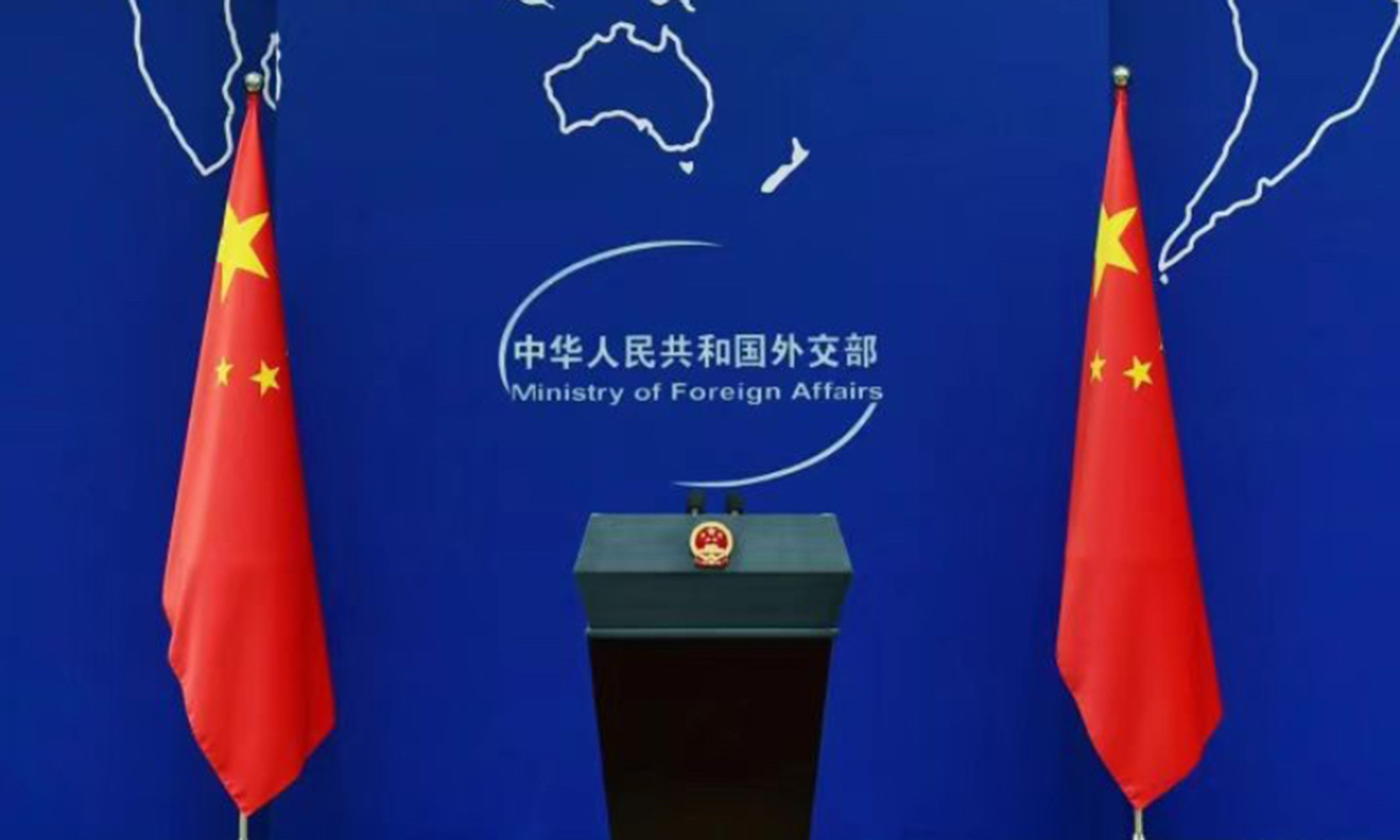
The Chinese Foreign Ministry on Monday announced a series of countermeasures against Paraguayan and Belizean ministers over Taiwan-related issues. In both releases, the ministry said that "certain anti-China politicians" in Paraguay and Belize, out of self-serving interests, stubbornly backed their countries' maintenance of the so-called "diplomatic ties" with China's Taiwan region, while making a string of "egregious remarks and actions" on China-related issues, harming China's core interests.
Gustavo Emigdio Villate Samaniego, Paraguay's minister of information and communication technologies, and Francis Fonseca, Belize's minister for foreign affairs, foreign trade, education, culture, science and technology, are denied visas or entry into China, including its Hong Kong and Macao special administrative regions, according to the ministry.
All organizations and individuals within China shall be prohibited from engaging in transaction, cooperation and other activities with them, the ministry added.
Both countermeasures rest on the same legal basis, citing Articles 3, 4, 6, 9 and 15 of the Anti-Foreign Sanctions Law of the People's Republic of China. The decision shall take effect on Monday.
Pawn of secessionists
In response to questions related to the sanctions, Chinese Foreign Ministry spokesperson Mao Ning said at a press conference on Monday that certain politicians from Paraguay and Belize have acted as "chess pieces" for the DPP authorities in their pursuit of independence by soliciting external support.
Their visits to Taiwan island and reception of "Taiwan independence" separatist forces in their countries constitute severe interference in China's internal affairs. They also attacked and smeared China by spreading the "Chinese cyber attack" disinformation, causing egregious impact in the world, the spokesperson said.
For diehard supporters of "Taiwan independence" separatist forces, China will take all necessary punitive measures to firmly safeguard national sovereignty and territorial integrity, Mao said.
The Global Times found that the two sanctioned officials from Belize and Paraguay both maintain close collusion with the DPP authorities.
Two days before China announced the sanctions, Villate of Paraguay posted on the X platform to congratulate the Taiwan region on its self-claimed "national day." Citing Paraguayan media ABC Color, Taiwan-based media udn.com reported that Villate was included on the guest list for DPP leader Lai Ching-te's inauguration in May 2024.
According to udn.com, Belize's Fonseca also took part in Lai's inauguration in 2024. Before that, he visited the island in March of 2022.
In September this year in Belize, Fonseca met with Lin Chia-lung, head of "external affairs" authority of Taiwan island. During the meeting, Fonseca reaffirmed support for the island's so-called "international participation" and voiced optimism over prospects for expanded "bilateral trade," per the udn.com.
Taiwan-based media noted that the latest sanctions marked the first time the Chinese mainland has imposed sanctions against officials from the island's so-called "diplomatic allies."
Xin Qiang, director of the Taiwan Studies Center at Fudan University, told the Global Times on Monday that previously China's sanctions mainly targeted politicians from Western countries who back secessionists. Extending sanctions to officials from Taiwan's so-called "diplomatic allies" sends a clear and strong signal.
With DPP authorities seeking the so-called international space, internationalizing the Taiwan question, and the rising provocation to the one-China principle especially from the island's "allies," China's countermeasures are necessary, said Xin, adding that China's policy and legal toolkit is growing, offering more tools to penalize foreign politicians provoking trouble over the Taiwan question.
"This round of sanctions once again demonstrates that the one-China principle brooks no violation. The Chinese government will not turn a blind eye and will mete out punishment to any country or individual that violates this principle," Zhang Wensheng, deputy dean and a professor at the Taiwan Research Institute at Xiamen University, told the Global Times on Monday.
Explicit warning
Besides their multiple visits to Taiwan island, the two sanctioned officials boast backgrounds in technology and trade.
Citing Paraguay's La Nación, the udn.com reported that Villate has over 20 years of experience in the private tech sector and is a founding partner of tech firm E-Services.
In June this year, according to the udn.com, Villate discussed cooperation plans on AI computing power centers with visiting officials from the Taiwan region. As early as March 2024, he made a visit to Taiwan island to inspect its semiconductor industry.
According to Taiwan-based media Tai Sound, Belize's Fonseca also inked a
"memorandum of understanding" with visiting DPP authorities' officials in late September.
Zhang noted that the two sanctioned officials' economic and tech backgrounds show the two nations hope to reap dividends from the semiconductor sector, while the Taiwan authorities seek to lure them with its semiconductor strengths.
Echoing Zhang, Xin said that as the traditional tactics have borne limited fruit, the DPP authorities have thus stepped up collusion with external forces in tech and trade, leveraging its relative edge in chips. Those most provocative officials have naturally become key targets of China's countermeasures.
In addition, observers said the sanctions carry representative significance. Both targeted officials are from Latin American and Caribbean nations, and seven of Taiwan authorities' 12 so-called "diplomatic allies" belong to this region
"Such targeted sanctions also serve as an explicit warning to politicians in other Latin American and Caribbean nations who collude with the DPP authorities and attempt to reap gains across the Taiwan Straits that there is no room for bargaining on the one-China principle," said Zhang.
Xin said Latin America and the Caribbean once formed a core stronghold for the Taiwan authorities to maintain their so-called "diplomatic relations." In recent years, multiple countries including Honduras, Nicaragua and Panama have severed ties with the Taiwan authorities and established diplomatic relations with the Chinese central government, causing the collapse of the foothold.
"This shows that abiding by the one-China principle better serves their long-term development interests," said Xin. "China will take countermeasures against any provocation from the few remaining nations [that have ties with Taiwan authorities], yet it welcomes them if they can get back on the right track."
"We also advise the few remaining so-called 'diplomatic allies' of the Taiwan authorities not to be repeatedly manipulated and exploited by secessionists. Tying themselves to such separatist forces leads to no future. They will only miss development opportunities and become isolated from the international community," Mao Ning said on Monday.
RELATED ARTICLES