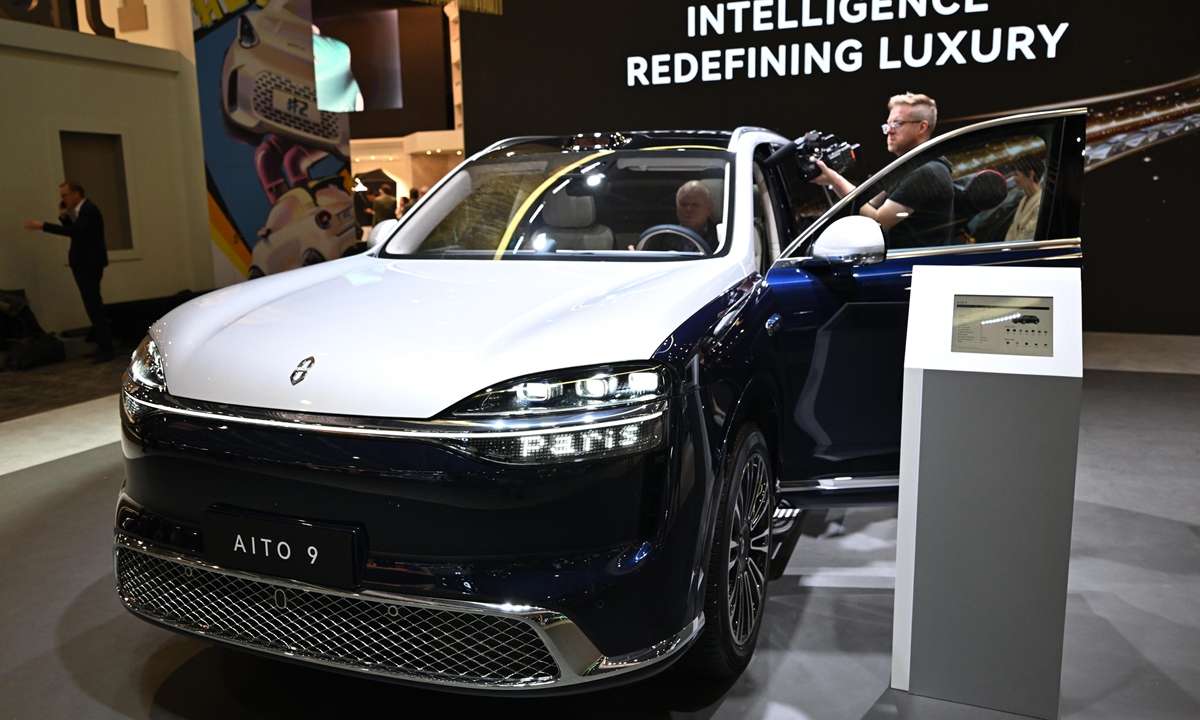
An Aito 9 SUV electric vehicle with programmable LED lighting reading "Paris" on the opening day of the Paris Motor Show in Paris, France, on Monday, Oct. 12, 2026. Photo: VCG
While the Élysée Palace may "close the door" on Chinese companies at the dinner, it cannot "shut out" Chinese vehicles and technologies from global markets. The "no entry" sign it hangs on Chinese exhibitors epitomizes how France, and Europe at large, are struggling on the industrial track. It is hoped that France can truly play a leading role as a "locomotive" within the EU, rather than saying one thing to China's face and doing another behind its back, which would hardly reflect the statesmanship expected of a major power.France is often portrayed as a nation of romance and warmth. However, the closed-door dinner at the Élysée Palace on the eve of the Paris Motor Show came as a shock. On the evening of October 11, local time, the night before the show's opening, the Élysée Palace held a high-profile dinner reception. While welcoming European exhibitors, it shut the door on Chinese automakers who had traveled far to attend. The Élysée Palace specifically noted that no Chinese exhibitors would be attending the dinner. Such a stark contrast in hospitality sits uneasily with the world's oldest auto show and runs far counter to France's self-proclaimed "great-power aspirations."
The dinner was convened for players across Europe's automotive industrial chain to discuss an industrial policy centered on "European preference" and "Made in Europe." Put plainly, it gathered European exhibitors to deliberate on how to tackle the "challenge" posed by China's auto industry. But here is the question: Can Europe's vulnerabilities, exposed amid industrial competition, be fixed over a single dinner? Consumers judge products by their quality, pricing and services, not by who sits beside whom at a banquet table. If the Élysée Palace wants to project a "tough stance" through such a childish "tantrum," it is simply absurd. This gesture inflicts zero harm on Chinese enterprises, yet brings great humiliation to France.
This "guest-screening" dinner creates a thought-provoking dissonance with the Paris Motor Show of which it is a part. As a bellwether for the global automotive industry, the Paris Motor Show has always prided itself on openness and competition. In this edition alone, 16 Chinese companies brought more than 20 brands to exhibit. Their representation outnumbers the combined brands from France and Germany, and their exhibition space accounts for one-third of the entire show floor, making China the undisputed major exhibitor. This offers a vivid snapshot of the Chinese auto industry's growth speed, scale and international market appeal.
Clearly, while the Élysée Palace may "close the door" on Chinese companies at the dinner, it cannot "shut out" Chinese vehicles and technologies from global markets. The "no entry" sign it hangs on Chinese exhibitors epitomizes how France, and Europe at large, are struggling on the industrial track.
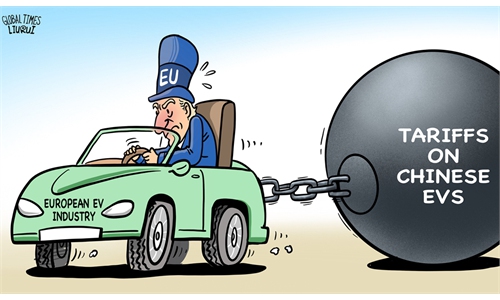
The car industry has long been viewed as a pillar of France's national manufacturing. Its relative decline has undoubtedly dented French confidence. To ease its strategic anxiety, France has, to some extent, emerged as the standard-bearer of European trade protectionism against China. The European Commission's decision two years ago to impose anti-subsidy tariffs on Chinese electric vehicles (EVs) was pushed forward with French involvement. France has revised its car purchase subsidy rules, introduced carbon footprint accounting, and leveraged the EU's proposed Industrial Accelerator Act. It seeks to restrict Chinese firms' investment and access to public procurement in Europe, tighten its foreign investment screening regime, and raise compliance costs for Chinese products through EU green trade barriers. These moves lay bare France's strategic anxiety and expose a growing cognitive dissonance within Europe.
However, decoupling from the Chinese economy is neither realistic nor logical. China has become a major global manufacturing hub and innovation center for batteries, EVs, charging infrastructure and intelligent vehicles, with deeply intertwined interests with renowned European automakers and suppliers such as Volkswagen, BMW and Bosch. Europe has more than a century of automotive history and is home to numerous iconic global brands. Its commitment to manufacturing excellence and product quality offers valuable lessons for Chinese companies. Likewise, Chinese firms' experience in rapid advances in new energy vehicles, battery components and the application of intelligent technologies offers valuable experience for European industry peers to draw upon.
At the government level, China has always welcomed foreign enterprises to invest and thrive in its market. Tesla's factory in Shanghai and Volkswagen Group's increased investment in the Chinese market demonstrate an approach that promotes cooperation through openness and drives innovation through competition. This is perhaps something Europe would do well to learn from.
In fact, there is only one fundamental question that France, and Europe as a whole, needs to answer: Does it want an automotive industry that embraces open competition and succeeds on its own merits, or one that survives in a protected greenhouse, sheltered by government policies and insulated from outside competition? Faced with increasingly fierce international competition, it is understandable that Europe's automotive industry is under pressure and that European companies are seeking to join forces. But if the purpose of such actions is not to pool resources for technological breakthroughs and develop new vehicles that can compete in the market, but instead to erect trade barriers against China, the outcome is hardly difficult to predict. History has the answer.
Europe has already fallen far behind China and the US in the digital economy. Unless it addresses this weakness in high technology, Europe's manufacturing sector, including its automotive industry, will inevitably face accelerating decline.
What Europe needs is open and candid dialogue with China. Not long ago, the second meeting of the China-EU trade and investment consultation mechanism concluded, with the two sides reaching consensus on a list of 16 outcomes. Further communication is needed to explore concrete ways to properly manage differences within the framework of World Trade Organization rules. These positive political signals will contribute to the healthy development of China-EU economic and trade relations. It is hoped that France can truly play a leading role as a "locomotive" within the EU, rather than saying one thing to China's face and doing another behind its back, which would hardly reflect the statesmanship expected of a major power.
RELATED ARTICLES