Taiwan Lai Ching-te Illustration: Liu Rui/GT
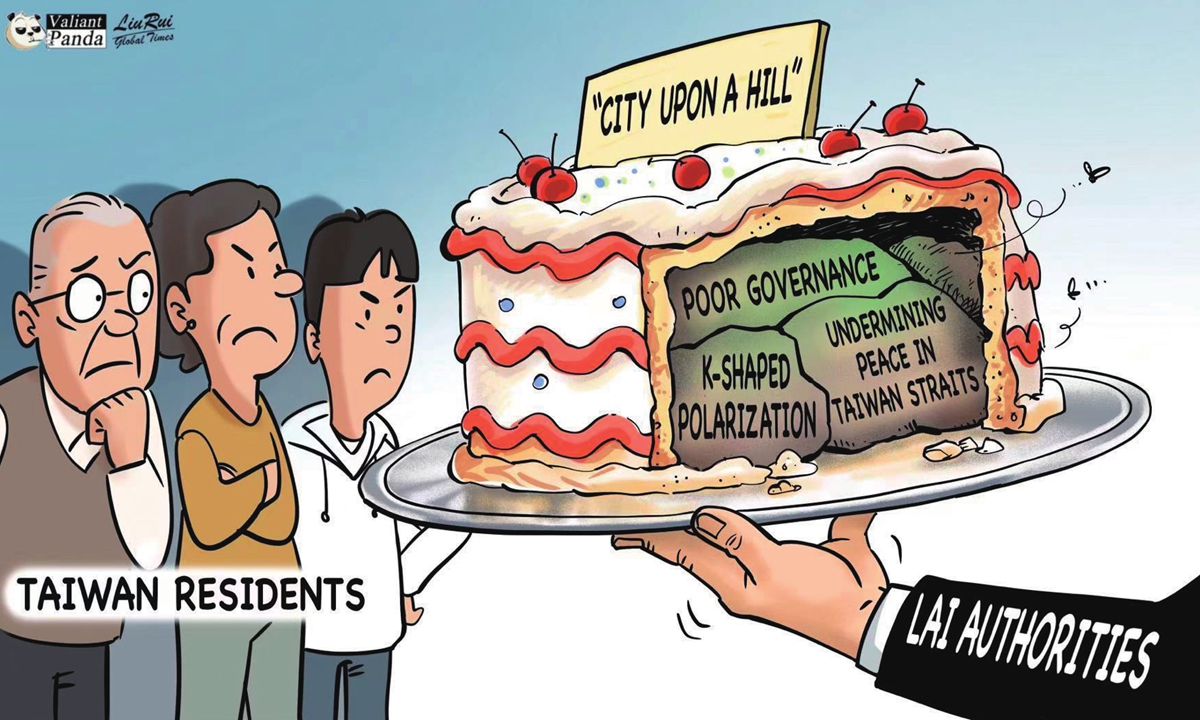
On Saturday, Taiwan regional leader Lai Ching-te delivered his "Double Ten" speech titled "Taiwan's Future: A City upon a Hill, the Salt and Light of the World," claiming that Taiwan region "must become a 'city upon a hill,' built with courage and confidence." This was Lai's third "Double Ten" speech since taking office, and it presented the most systematic and deceptive exposition of his "Taiwan independence" narrative to date.
The phrase "city upon a hill," originating in a Puritan sermon, carries connotations of moral example and public responsibility. It was later repeatedly invoked in US political discourse to project a distinctive moral mission and the image of leading the world, becoming an important spiritual source of American exceptionalism. Yet once the polished rhetoric is stripped away, a very different picture is revealed by Lai's speech: a seriously distorted economic structure, a risky and confrontational cross-Straits policy, deep domestic livelihood and governance problems, and an attempt to rely on external forces to seek separatism.
In his speech, Lai repeatedly highlighted what he described as Taiwan region's "impressive" economic performance. However, Lai's selective presentation avoided the broader reality and cannot conceal the risks posed by Taiwan region's distorted industrial structure and livelihood pressures. He used a handful of impressive macroeconomic indicators to gloss over governance failures, while ignoring the deep imbalance in the industrial structure, the weakness of livelihood-related sectors, long-term wage stagnation and the difficulties facing traditional industries, tourism, the cultural and creative sector, healthcare workers, farmers, and other grassroots groups. In doing so, he deliberately overlooked the uneven distribution of the benefits of "economic prosperity," the imbalance among industries and the real pressures felt by ordinary households.
Second, Lai claimed in his speech that the purpose of "increasing investment in national defense" is not to "provoke" but to "deter war," and argued that "strengthening self-defense" does not mean "abandoning dialogue." Yet this rhetoric stands in stark contrast with his long-standing moves of seeking "Taiwan independence" through military buildup, relying on external forces and promoting an anti-mainland, pro-independence agenda. His essential role as a destroyer of peace, maker of crises and instigator of war has not changed.
Since taking office, Lai has established the "Whole-of-Society Defense Resilience Committee," continued to promote the "Han Kuang exercises" and civil-military integrated drills, and brought US and Japanese military personnel into related activities. He has also planned to turn numerous civilian facilities into purported "wartime response centers," raised defense spending and stepped up arms purchases from external sources, pushing Taiwan region ever closer to a dangerous situation of military confrontation.
If peace is truly the ultimate goal pursued by the Taiwan authorities, then they should face cross-Straits relations squarely and handle them properly. Their political positioning, defense buildup and external security cooperation should all be judged by whether they reduce miscalculation, maintain communication and lower the risk of conflict, while making genuine efforts to preserve peace and stability across the Taiwan Straits and ease tensions. Instead, Lai deliberately amplifies a narrative of the continued "war and authoritarian expansion," while sidestepping the tensions in the Taiwan Straits that his own policies have created. This political strategy of mobilizing support through fear and diverting domestic contradictions through confrontation is precisely what threatens peace in the Taiwan Straits and exposes how fragile the foundations of the "city upon a hill" are.
Taiwan's value does not lie in any particular mountain, city or industry, nor derive from how important it is to outsiders. Rather, Taiwan region has since ancient times been an inseparable part of the Chinese nation, Chinese culture and Chinese territory. A true "promised land" should not be built on ever-deepening confrontation. Nor should a true "city upon a hill" need to prove itself by placing itself on a moral pedestal. The people's aspiration for a better life, democracy as an expression of good governance and the Taiwan Straits as a symbol of peace between the two sides of the Straits are the issues that Taiwan authorities should truly consider.
The fundamental way forward for cross-Straits relations lies in replacing the mind-set of hostility with the understanding that people on both sides are "one family," replacing confrontation with consultation and, on the political foundation of the one-China principle and the 1992 Consensus, rebuilding a shared spiritual home rooted in Chinese culture, strengthening identity through greater mutual understanding, protecting the common homeland through peaceful development and building a stronger sense of community for the Chinese nation. This is not only a fundamental guarantee for peace across the Taiwan Straits, but also an important path toward the complete reunification and great rejuvenation of the Chinese nation.
The author is an associate professor at the School of Politics and International Studies of Central China Normal University. opinion@globaltimes.com.cn