Philippine VP warns Marcos' China remarks threaten national security; weaponizing China ties for domestic gains 'destined to backfire': expert
By Published: Oct 13, 2026 08:25 PM

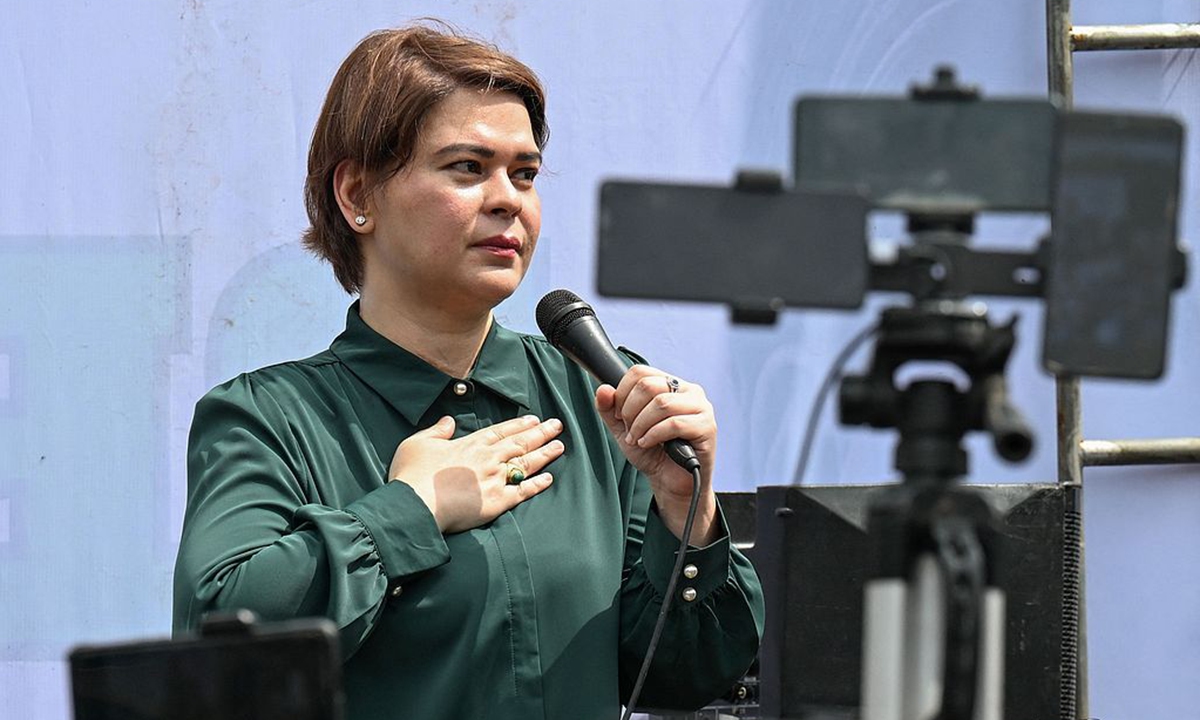
Philippine Vice President Sara Duterte Photo: VCG
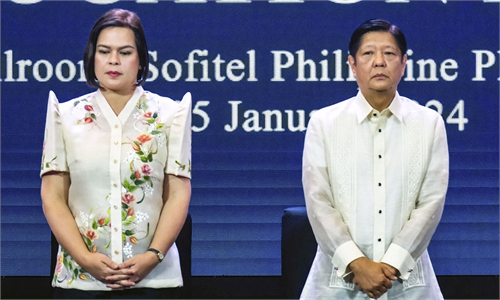
Philippine Vice President Sara Duterte said on Monday that recent remarks by President Ferdinand Marcos Jr pose threats to the Philippines' national security, China-Philippines ties, and regional stability, after Marcos linked the vice president to "funding from China," amid the recent impeachment trial against Duterte.
A Chinese expert warned that weaponizing bilateral ties with China for domestic political gains is a short-sighted gambit destined to backfire. It may also further drive the Philippines away from the mainstream of ASEAN-China cooperation and into deeper self-isolation.
According to media outlet Philstar.com, Marcos on Sunday claimed that it could be a national security threat "at the highest level" if the company linked to Duterte and her husband Manases Carpio did receive funds from China.
Marcos' remarks come as Duterte is facing impeachment proceedings. On Tuesday, the Philippine prosecution panel informed the Senate impeachment court that it was dropping three of the four charges against Duterte, retaining only the allegation of unexplained wealth.
In response to Marcos' latest accusation, Duterte said in a Monday statement issued by the Office of the Vice President of Philippines on Facebook that the Marcos administration is using "all its power, including intelligence agencies and law enforcement agencies" to suppress and undermine her.
"Marcos' statement clearly states that for him, doing business with China is a threat to the security of the Philippines. This carries the connotation of a warning to Filipino businessmen doing business in China," she said.
She also described Marcos' remarks as a bold and dangerous challenge to China, as it is accusing China of interfering in the internal affairs of the Philippines that lacks sufficient justification. "This is serious. And it could have a serious impact on our relationship with China," she added, the media reported.
Chen Xiangmiao, a researcher at the National Institute for South China Sea Studies, told the Global Times that Marcos' move aims to label Duterte, who holds relatively pragmatic stances, as "pro-China" to court support from the country's right-wing and pro-US blocs and consolidate his political base.
Chen added that a sitting president personally smearing China amid domestic factional infighting undermines the dignity and stature befitting a head of state, and reflects the Philippines' increasingly radical China policy.
Defending Duterte, her spokesperson Paolo Panelo said on Monday that the Philippines cannot demonize Beijing for political propaganda, maintaining that relations with China should not be driven by political attacks, according to NewsWatch Plus PH.
Hyping China-related issues to harvest domestic political gains has become a path dependency for some Philippine politicians, Chen said. "This practice inflicts severe damage on bilateral ties. Such short-sighted, high-risk political opportunism will inevitably come with a price," Chen noted.
Politically, it will continue to poison the bilateral atmosphere, stoke public antagonism between the two peoples, marginalize moderate voices, erode the popular foundation of bilateral ties and substantially raise the cost for future Philippine administrations to reset relations, Chen said.
Economically, China-related tourism, goods, trade, investment, infrastructure and livelihood projects in the Philippines may face disruptions or even suspension, Chen noted. "In the long run, Philippines' energy security, industrial upgrading, agricultural modernization, new-energy transition and digital economy may suffer spillover damage for its China policy… The risks incurred will ultimately be borne by Filipino people and succeeding administrations."
In the Facebook statement, Duterte said that Marcos' remarks were intended to divert attention from what she described as his failure to properly address the territorial dispute between the Philippines and China. She warned that the issue could have implications beyond the Philippines, potentially affecting security and stability in the ASEAN region.
Echoing Duterte, Anna Malindog-Uy, a columnist with The Manila Times, criticized the Marcos government in an X post on Tuesday, saying that the Philippines is playing an increasingly disruptive role in Southeast Asia under the current administration.
"While many ASEAN countries pursue pragmatic diplomacy, economic cooperation, and strategic balance in their relations with China, the Marcos administration appears determined to turn the Philippines into the frontline of Washington's geopolitical confrontation with Beijing," she wrote.
As China's comprehensive national strength and regional influence grow, ASEAN states see great potential in working with China, forming tightly linked industrial networks covering infrastructure, AI, digital economy, green sectors and cross-border trade, Chen said.
"Against this backdrop, Manila's persistent tilt toward the US increases the risk of decoupling from ASEAN's China cooperation trend and self-isolation, and has become a regional destabilizer," said Chen, adding that weaponizing bilateral ties with China for domestic political gain is a short-sighted gambit destined to backfire.
RELATED ARTICLES