Marcos’ remarks on oil, gas talks with China viewed by Philippine media as hinting at a reset in ties; co-op door remains open for right moves on major issues: Chinese expert
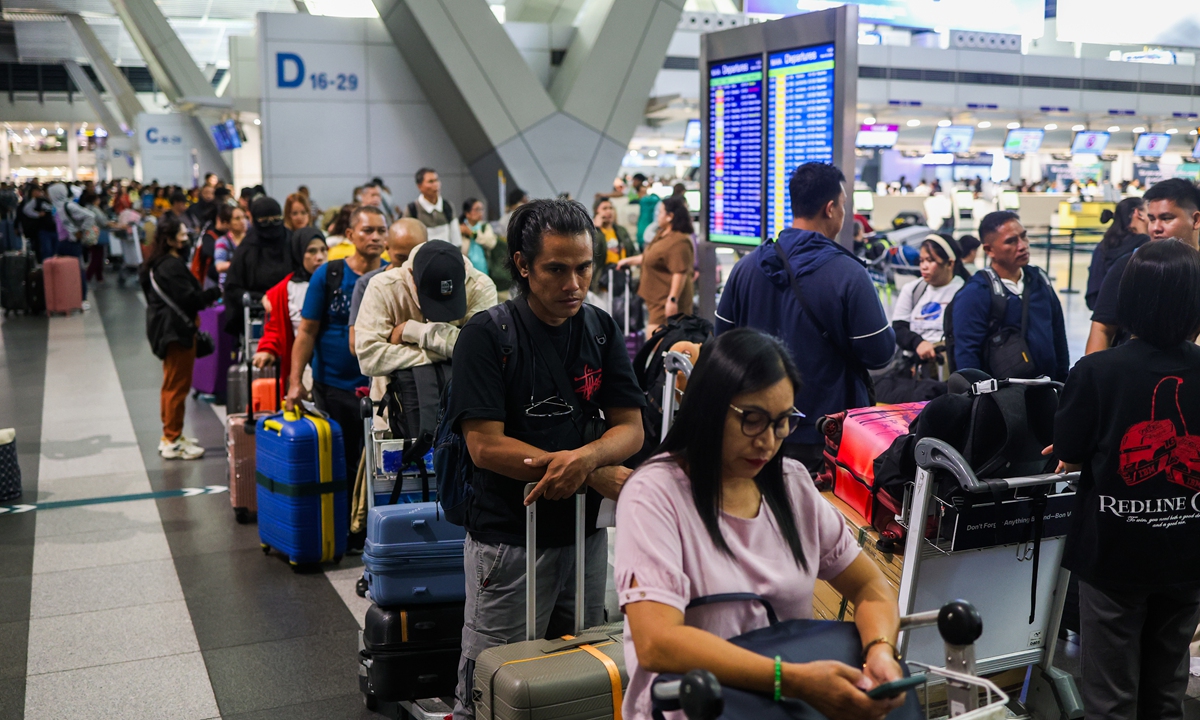
International passengers queue up for check in inside the Ninoy Aquino International Airport, after Philippines President Ferdinand Marcos Jr. declared a state of national energy emergency, in Metro Manila, Philippines, on March 25, 2026. Photo: VCG
Amid the energy crisis triggered by the Middle East conflict, Philippine President Ferdinand Marcos Jr. has expressed willingness to resume discussions with China on a joint oil and gas project in the South China Sea, a gesture that has been interpreted by Philippine media as suggesting a "reset" of China-Philippine relations. A closer look at his remarks, however, reveals that Marcos claimed that territorial disputes should be differentiated from the two countries' trade arrangements. A Chinese expert said that the core of getting bilateral relations back on the right track lies in whether the Philippines returns to a rational and proper approach on issues involving China's major interests.Marcos' latest remarks came during an interview with Bloomberg Television's Haslinda Amin on Tuesday at the presidential palace in Manila. In the roughly eight-minute video released by Bloomberg, his responses covered issues ranging from his country's economic development and relations with China to the ongoing Iran war.
When asked whether there needs to be a "reset" in the Philippines' relationship with China amid geopolitical tensions, Marcos said "It's certainly going to happen," local media the Inquirer reported on Wednesday.
"Maybe this [conflict in the Middle East] provides impetus for both sides to come to an agreement," he added, per the report.
The president also mentioned talks with China on fuel and fertilizer, claiming that China has been very "helpful" with fertilizers, per Bloomberg.
The term "reset" appeared repeatedly in Philippine media coverage of the interview, which sees Marcos' remarks as a hint that tensions in the Middle East could spur renewed energy talks with China.
Philippine media outlet Philstar.com stated that with the Middle East crisis pushing the Philippines into a state of national energy emergency, "Marcos conceded that it may be time to reset the Philippines' relationship with China."
Titled "Marcos sees 'reset' in PH-China ties amid global shifts," the Philippine News Agency reported that "a 'reset' in Philippine-China relations may be inevitable as global geopolitical dynamics continue to shift, while reiterating Manila's position against war amid the ongoing Middle East conflict."
In a post on X on Wednesday, Philippine media outlet The Philippine Star raised the question of a "Philippines-China reset?" as it revisited the long-running dispute between China and the Philippines, along with the Hague-based arbitration that China has never accepted, before reposting Marcos' remarks in the Bloomberg interview.
Ding Duo, director of the Research Center for International and Regional Studies at the National Institute for South China Sea Studies, told the Global Times on Wednesday that Marcos' remarks are linked to the energy shortage currently plaguing the Philippines.
The current situation in Middle East lays bare the nature of the US that places its own interests above all else and disregards the interests of its allies when it matters most, Ding noted, referring to the energy crisis.
The Philippine News Agency reported on Tuesday that Marcos declared a state of national emergency to address potential disruptions in fuel supply and to stabilize the country's energy sector.
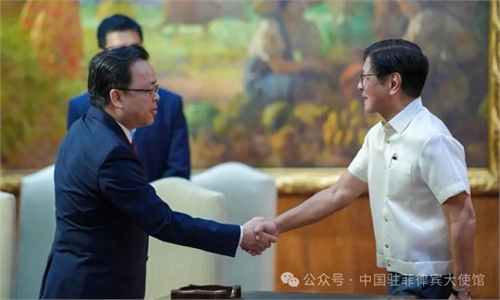
Prior to the Philippines' declaration of a state of emergency, China had engaged in communications with Philippine officials. Chinese Ambassador to the Philippines Jing Quan held separate meetings with Philippine Energy Secretary Sharon Garin and Philippine Agriculture Secretary Francisco P. Tiu Laurel Jr. on March 17, exchanging views on cooperation in the energy and agricultural sectors, according to the official WeChat account of the Chinese Embassy in the Philippines.
When asked whether China is already in talks with Southeast Asian countries such as the Philippines, Laos and Vietnam on fertilizer supplies and how China plans to help them address the fertilizer shortage problems, Chinese Foreign Ministry spokesperson Lin Jian said on Monday that the situation in the Middle East has dealt a blow to global energy and trade security. Relevant countries should immediately stop military operations and prevent the regional turmoil from causing a greater impact on global economic growth, Lin added.
Li Kaisheng, vice president of the Shanghai Institutes for International Studies, told the Global Times on Wednesday that China has always kept the door open for cooperation and adhered to the policy of "setting aside disputes and pursuing joint development."
However, the core of getting bilateral relations back on the right track has always lain in the Philippines returning to a rational and proper approach on issues involving China's major interests, Li added.
Throughout the interview, Marcos repeatedly brought up the two nations' disputes in the South China Sea, rendering his stated willingness to cooperate appearing insincere, observer noted.
Talking about the possibility of discussions with Beijing, Marcos said "That's something we've been talking about for a great deal, but territorial disputes are getting in the way of that," Bloomberg reported.
Marcos also claimed that the Philippine side has always tried to "differentiate territorial disputes from trade arrangements," per the report.
Li said that although the Philippines has been compelled to adopt a conciliatory and cooperative stance toward China due to crises such as the energy crunch, its original position on major issues including the South China Sea has not undergone any substantive change, as it remains deeply bound up with the interests of a small number of political groups.
Amid the energy shortage, the Philippines has not stopped its provocations in the South China Sea. Over the past week, the Chinese People's Liberation Army (PLA) has separately expelled illegally intruding Philippine aircraft in China's territorial airspace over Huangyan Dao and the airspace over waters adjacent to Meiji Jiao of China's Nansha Qundao.
The willingness to cooperate should be reflected in concrete actions, Li said, adding that for the Philippines, the top priority is to cease its provocations in the South China Sea and engage in sincere negotiations and cooperation.
How can China perceive the Philippines' sincerity if it keeps provoking China on major issues, the expert said.
RELATED ARTICLES