Paris should lead Europe toward a rational, balanced and pragmatic understanding of China
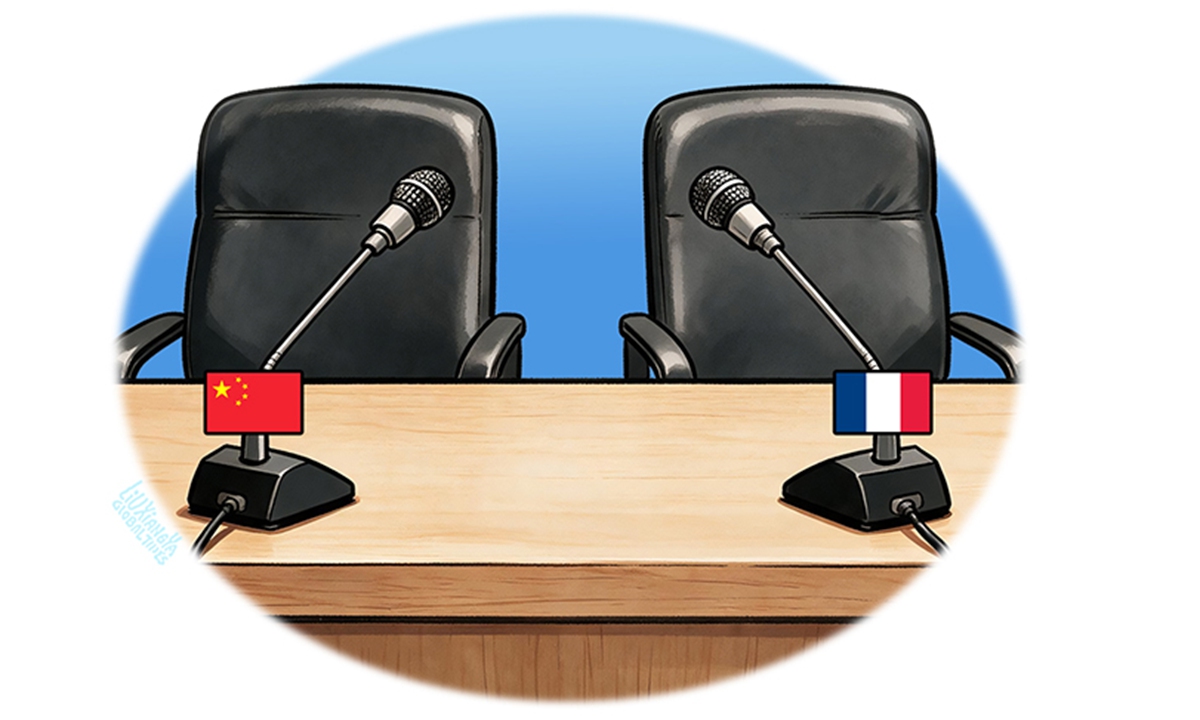
China-France. Illustration: Liu Xiangya/GT
French President's Diplomatic Adviser Emmanuel Bonne visited China from October 9 to 13, during which he co-chaired a new round of China-France Strategic Dialogue with Wang Yi, a member of the Political Bureau of the CPC Central Committee and director of the Office of the Central Commission for Foreign Affairs. Bonne's second visit to China in just six months highlights the importance that both China and France attach to maintaining strategic communication through key high-level channels. The visit also underscores the significance of strategic coordination not only between the two countries but also between China and the EU.France has long played a distinctive role in shaping and developing China-Europe relations. This role is closely linked to France's strategic position in Europe and the wider world, reflecting the country's long-standing strategic thinking and national interests. After World War II, France was unwilling to accept a subordinate or marginalized role in a world divided by the Cold War. Instead, it sought to strengthen Europe through integration and strategic autonomy while expanding its own room for maneuver in international affairs. These ideas have significantly influenced France's approach toward China, with Paris attaching great importance to developing bilateral ties as a means of expanding its strategic space.
Throughout the development of China-Europe relations, France - along with Germany - has served as one of the two major engines of the EU and has also played an important role in shaping the EU's China policy. Head-of-state diplomacy has been vital in fostering China-France relations, and both sides have placed considerable importance on high-level strategic dialogue. Bonne's latest visit to China continues this tradition of high-level communication. Such channels can play a unique role in the next stage of China-France and China-Europe relations by building consensus, deepening mutual understanding and helping both sides properly manage differences on issues of shared concern.
This round of China-France strategic dialogue came at an important moment for China-Europe relations, as well as for the political and economic development of France and Europe more broadly. In the economic and trade sphere, China-EU relations have recently become increasingly complex. The EU has continued to emphasize arguments about "unsustainable imbalances" and "unfair competition," laying the political and public-opinion groundwork for new trade protectionist instruments and further pressure on China.
At home, meanwhile, France is facing growing scrutiny from international investors over the sustainability of its public finances and the credibility of its sovereign debt. Recent protests among high school students have also highlighted deeper structural social and economic problems that pose challenges to governance. The competition among different political forces ahead of next year's presidential election has also raised concerns across Europe and beyond about France's future development path, its international role and the potential impact on the EU's own development and external relations.
Under such circumstances, both China and France need to maintain a stable, predictable and constructive relationship, while broadening the scope for cooperation between China and Europe. Such a relationship will help create a more favorable external environment for each side's domestic development agenda and economic growth. Following the latest dialogue, both sides further reaffirmed the historical foundations and strategic tradition of China-France relations. They also acknowledged the progress made through the China-EU trade and investment consultation mechanism, and reached consensus on how China-EU relations should be defined and positioned.
At a time of mounting global turbulence, closer strategic communication between China and France can help expand the constructive and cooperative dimensions of both China-France and China-Europe relations. Looking ahead, Paris should play an active role in calling on Europe to form a rational, balanced and pragmatic understanding of China, reassess the practical logic and long-term interests underpinning China-EU relations, and prevent differences from overshadowing the broad space for cooperation. This would not only contribute to a more stable China-EU relationship, but would also serve France's own interests.
The author is an associate research fellow at the Academy of International and Regional Studies of Beijing Language and Culture University. opinion@globaltimes.com.cn
RELATED ARTICLES