ARTS / CULTURE & LEISURE
As humanoid robots grow more capable, what sets human performers apart?
When robots dance
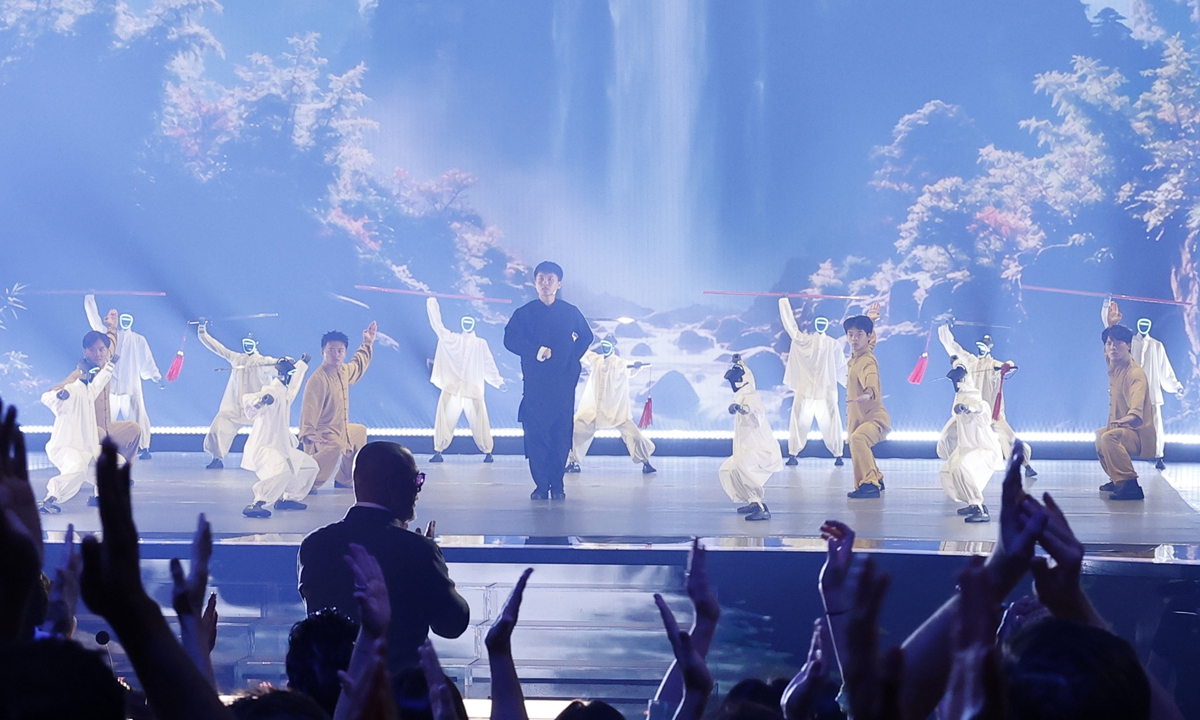
Humanoid robots perform alongside Chinese street dancer Wu Yufei (center) during the quarterfinal of America's Got Talent. Photo: VCG
Recently, humanoid robots rolled across the stage, flipping long flowing sleeves into the air alongside Chinese street dancers against the background of an ink-wash landscape of mountains and rivers. The performance came during the finale of America's Got Talent, during which Chengdu-based Dance Home became the first Chinese team in its 21-season history to reach the final.The eight robots showcased an impressive range of movements: Unitree Robotics' G1-W wheeled-leg robots executed sliding turns, while the G1 performed a series of challenging moves, including kneeling, rolling and front flips.
For 27-year-old Wu Yufei, one of the crew's members, the performance was more than a showcase of robotic agility. Wu described the experience in the US as deeply rewarding.
Together with the crew's choreographer, Fang Zhenghua, he saw the performances as an opportunity to showcase not only advances in humanoid robotics, but also how young people envision the future relationship between technology and humanity. The audience response, he added, was remarkably "enthusiastic."
"Robots are not merely technological achievements, but can also become creative partners on stage and a new medium for artistic expression," Fang told the Global Times.
As technology advances, humanoid robots are becoming increasingly fluid and capable in their movements, opening up new possibilities for dance.
The Global Times spoke with members of Dance Home and other Chinese dancers who draw inspiration from robotic movements to explore how these advances are shaping dance and what the future holds for performers.
New 'partners'
Wu, from Chengdu, Southwest China's Sichuan Province, has been dancing for 13 years. In his early days, he imitated the jerky, stuttering movements of old-fashioned robots. But in the performance on America's Got Talent, the relationship was reversed: Instead of dancers imitating machines, the robots were learning to move alongside them.
At their audition, Wu performed alongside machines that danced and flipped in time with the music. The act received a unanimous yes from all four judges. Wu recalled the audience's explosive reaction when the robots first appeared on stage. During the initial audition, he walked out alone to introduce himself before the robots joined him.
By the quarterfinals, Wu and the robots were performing martial arts alongside human dancers, kicking and flipping across the stage. The team spent three months preparing performances. The robots were able to move on and off the stage and change formations autonomously, posing major challenges for stability, heat dissipation and motor performance. As the entire competition was broadcast live, the robots had to meet particularly high standards of reliability, according to Xie Shiyu, Unitree Robotics marketing manager.
For Wu, one of the most striking differences between human dancers and robots lies in their ability to reproduce movements.
A human dancer may struggle to execute a move in exactly the same way every time. A robot, by contrast, can repeat a programmed sequence with remarkable consistency. Once a movement has been taught to one robot, it can also be replicated by others, allowing an entire group to perform in close synchronization.
Advances in artificial intelligence (AI) are further accelerating the process. "Robots can learn certain movements through AI training in a week or two, reaching a level that approaches professional performance," Wu said.
Yet he does not see this development as a threat to human dancers. Instead, he sees robots as "partners."
"I don't need to worry about its limitations or how far it can go. Basically, anything I can imagine, it can do. It's more like a tool that helps us create," he told the Global Times.
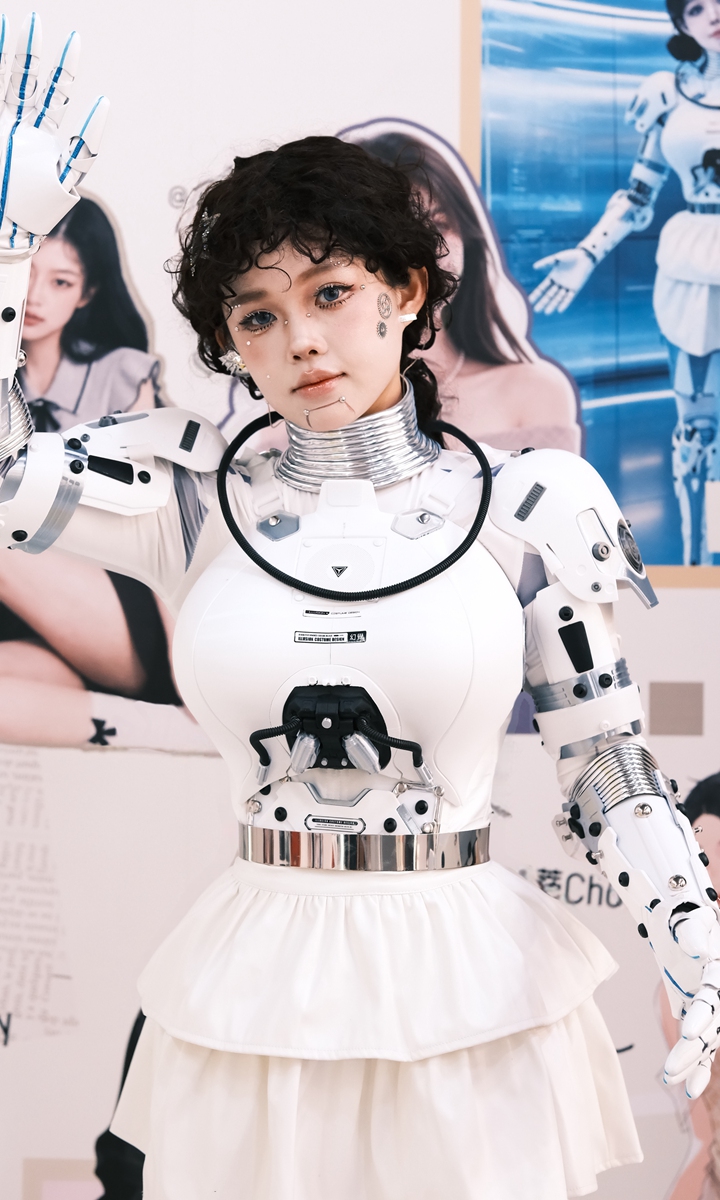
Chinese dancer Barbin.ili Photo: Courtesy of Barbin.ili
Preserving a human touchThat relationship between robots and human performers has a longer history in dance itself. Before robots began appearing alongside human performers, dancers were already drawing inspiration from the mechanical movements of machines.
Barbin.ili, a dancer with 4.75 million followers on Douyin, the Chinese version of TikTok, began with popping, a street dance style characterized by sharp muscle contractions and controlled movements.
Her childhood fascination with animation and stage effects later drew her to animation dance, which incorporates robot-like gestures and exaggerated movements to evoke animated or mechanical figures.
When she first explored the style, few dancers in China specialized in it. Since then, she has built an online following with performances that bring robotic movements to life. Today, she also shares videos of herself dancing alongside robots, expanding her performances to incorporate human-robot collaborations.
For her, the relationship between humans and robots is not simply a matter of machines learning to imitate people. Most robots today rely heavily on human motion capture and programmed movements, she said, but future technological advances could allow them to develop greater creative capabilities.
Even so, she said she does not believe that more fluid or technically accomplished robots would make human dancers any less valuable.
Dance draws inspiration from observing everyday life and the world around us. Even if robots eventually execute movements more smoothly than humans, technical proficiency is only one part of artistic expression. The ability to perform a movement and the reasons for choosing it are not necessarily the same thing, she said.
She also questions the idea that dancers who work with robots should be defined as "robot dancers."
In her view, robots are elements of a performance, not labels that define an artist. Just as people draw on diverse influences, incorporating robots does not mean a dancer must build an entire artistic identity around them.
She said that, even in an age when robots can perform an ever-wider range of tasks, robot-inspired dance will continue to find an audience, just as cultural traditions and retro aesthetics remain popular alongside emerging trends.
For her, the key is to discover something that genuinely sparks joy and pursue it wholeheartedly.
"You never know which moment something you love might also light up someone else," she said.
RELATED ARTICLES