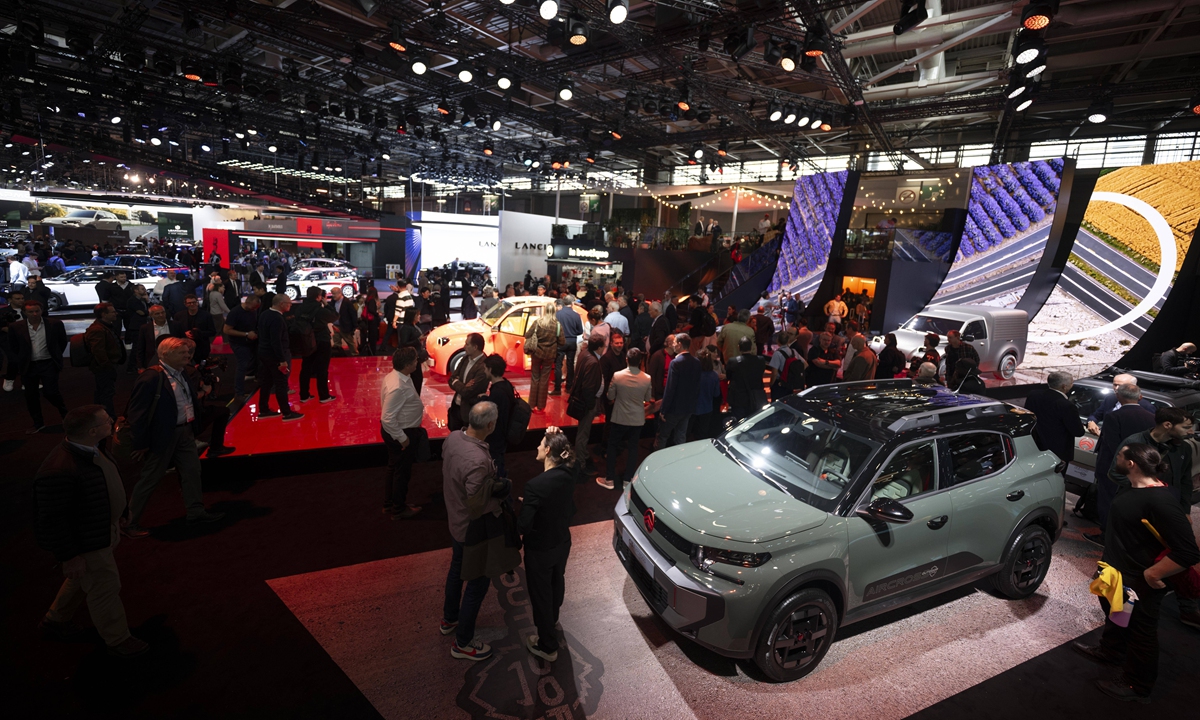
The Paris Motor Show runs October 12-18, 2026 in Paris, France. Photo: VCG
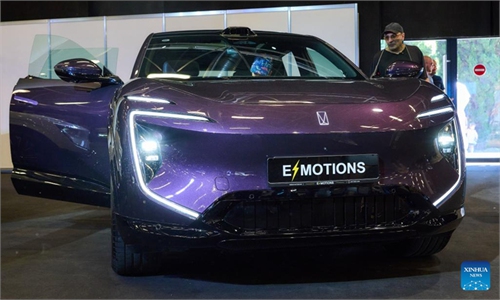
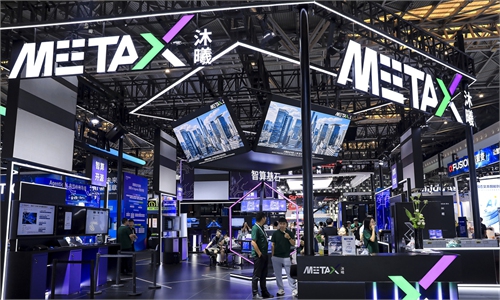
Such a scale of participation from Chinese carmakers would have been almost unimaginable a decade ago, yet it is now very much a real scene in the exhibition halls of the Paris Motor Show. Behind this lies the rapid rise of Chinese automakers globally.
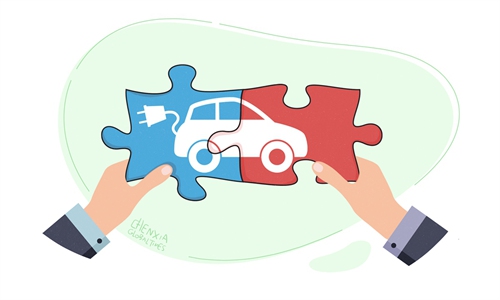
The Paris show has long served as a reliable barometer of the global auto industry, and this year's edition sent an unmistakable signal: China-Europe electric vehicle (EV) cooperation is moving from simple trade to deeper industrial integration.
Compared with the previous show, Chinese brands' recognition, user base and market foothold in Europe have grown noticeably, and their development path has gradually shifted from pure vehicle exports toward deep localization, with production bases, research and development (R&D) centers, distribution networks and after-sales systems being established across Europe.
For a long time, some in Europe have viewed Chinese carmakers through a zero-sum lens, framing normal market competition as a "shock" to local industries. This year's Paris Motor Show, however, makes clear that framing such cooperation simply as a threat no longer holds against the increasingly diverse and pragmatic reality in China-Europe cooperation.
Chinese carmakers are using flexible approaches such as joint plant construction and joint development to revitalize existing local capacity, drive employment and supply chains, and offer European consumers more cost-effective models. This model is not zero-sum but complementary.
For instance, Stellantis and China's Leapmotor announced plans in May to start joint car production in Europe, with two models to be built in Spain, deepening their tie-up beyond distribution into manufacturing. This is a win-win arrangement, as European companies need such cooperation to raise productivity, while Chinese automakers need a localized foundation to take root in the market.
Europe's vehicle industry stands at a critical stage of electrification, and Chinese carmakers' strengths in batteries, electronic controls and intelligent systems align neatly with Europe's robust manufacturing base and brand heritage. Joint plants shorten construction cycles and reduce policy risk, while joint development shares R&D costs and speeds up product iteration. This is not one side swallowing the other, but making the cake bigger together.
An increasing number of European industry bodies, local partners and ordinary consumers are recognizing the real value of this cooperation. The jobs created, technology spillovers and industrial increments brought by Chinese brands cannot be overlooked. For example, BYD plans to expand its European workforce to more than 40,000 people by 2030, a target that would place the Chinese carmaker among the largest non-European automotive employers in the region, according to Bloomberg. This tangible market dividend is far more persuasive than any protectionist slogan.
From a broader perspective, the deepening of China-Europe EV cooperation is also a microcosm of the transformation of the global car industry. For decades, the division of labor in the global automotive sector remained relatively fixed, and China was long a latecomer playing catch-up.
But in the wave of electrification and intelligence, China has built distinct advantages in batteries and intelligent driving, while Europe retains profound accumulated strengths in traditional areas. Cooperation is a two-way journey where each side brings its own strengths to jointly define new products.
Recognizing these new signals of cooperation does not mean the road ahead is smooth. China-Europe EV cooperation still faces multiple challenges, from geopolitical noise to protectionism. Chinese automakers need to adapt to changing market trends in Europe. Europe, for its part, must let reason overcome prejudice, respect facts, and treat Chinese carmakers fairly in line with WTO rules.
The Paris Motor Show this time may be witnessing the arrival of a new era of industrial collaboration: the automotive industries of China and Europe can make the cake bigger through open cooperation and forge a path that benefits industry, companies and consumers alike.
RELATED ARTICLES