Xi calls for decisive progress in Healthy China advancement
Stronger disease prevention and control system highlighted at national meeting on health
By and Li Yu Published: Oct 14, 2026 12:11 AM
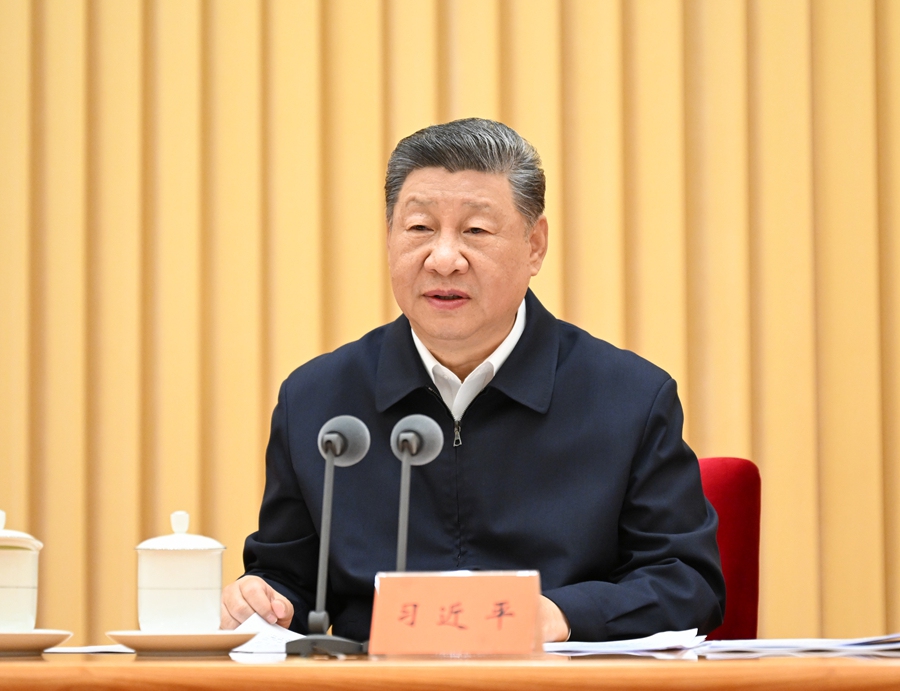
Chinese President Xi Jinping, also general secretary of the Communist Party of China Central Committee and chairman of the Central Military Commission, delivers an important speech during a national meeting on health in Beijing. The meeting was held in Beijing on October 12 and 13, 2026. Photo: Xinhua
Chinese President Xi Jinping has called for efforts to firmly follow a path with Chinese characteristics in developing the country's health programs, to secure decisive progress in the Healthy China Initiative over the 15th Five-Year Plan period (2026-2030).
Xi, also general secretary of the Communist Party of China (CPC) Central Committee and chairman of the Central Military Commission, made the remarks at a national meeting on health held in Beijing on Monday and Tuesday, according to the Xinhua News Agency.
Xi stressed that people's health is a key benchmark of a nation's prosperity and strength.
The meeting comes as China begins implementing its national health plan for the 15th Five-Year Plan period, which sets out a roadmap for improving healthcare accessibility, strengthening disease prevention and accelerating medical innovation over the next five years.
Under the plan released by the State Council in July, China aims to raise its average life expectancy to 80 years by 2030, from 79.25 years in 2025, while bringing its major health indicators in line with those of high-income economies.
The plan also underlines major tasks to optimize all-round life-cycle health services for all people, shore up robust health safeguards, build an integrated, high-quality medical network, cultivate new growth engines for the health sector, and advance health-centered governance in the sector.
Since the 18th CPC National Congress in 2012, the Party has made a major decision to launch the Healthy China Initiative, promoting the establishment of the world's largest systems of medical services, traditional medicine, disease prevention and control, and healthcare security, said Xi, noting that the country has achieved historic accomplishments and made all-round progress in healthcare.
He said the goal is to build a Healthy China, where health services are ensured in a balanced, inclusive, high-quality and efficient manner.
Prevention, he said, is the most cost-effective and efficient approach to protecting public health. He called for greater emphasis on foundational health work, addressing risks at their source, and encouraging the public to adopt a sound understanding of health and take an active role in managing their own well-being.
The emphasis on prevention reflects a shift in China's approach to public health, from treating diseases after they occur toward addressing health risks at their source and promoting well-being across society, medical and health policy professionals noted.
Cui Xiaobo, a professor at the School of Public Health, Capital Medical University, told the Global Times that putting prevention first means moving the focus of healthcare further upstream, reducing health risks before diseases develop rather than relying primarily on treatment after illness occurs.
Looking ahead, Cui said a key priority should be making healthcare services more equitable and accessible by strengthening primary healthcare, improving the distribution of medical resources and building a stable medical workforce, particularly in rural and underserved areas.
These priorities are also central to China's efforts to translate its long-term Healthy China 2035 vision into concrete improvements during the next five years.
Zeng Guang, former chief epidemiologist with the Chinese Center for Disease Control and Prevention, told the Global Times that the 15th Five-Year Plan period will be crucial for strengthening China's healthcare system.
"Whenever new public health challenges emerge, we must be able to respond effectively," Zeng said, stressing the importance of addressing weaknesses and building a more resilient healthcare system.
Beyond improving access to healthcare, Zeng pointed to the potential of artificial intelligence and smart healthcare technologies to enhance medical diagnosis and healthcare delivery.
Health beyond borders
Efforts will also be made to actively promote the building of a global community of health for all, work with other countries to address major challenges in the health sector, and continuously improve the health and well-being of people around the world, Xi said.
Such international engagement has been reflected in more than six decades of Chinese medical teams working in other developing countries, particularly across Africa, where Chinese doctors have provided treatment, shared medical expertise and helped train local healthcare professionals.
Since China dispatched its first overseas medical team to Algeria in 1963, approximately 30,000 Chinese medical workers have served in 76 countries and regions, treating around 290 million patients, according to Xinhua figures published in August.
China's medical cooperation is increasingly focused on leaving behind lasting capabilities rather than providing treatment alone.
Since 1963, Chinese medical teams have trained more than 100,000 local healthcare workers, while Chinese and African hospitals have developed partnerships and jointly established specialized medical centers.
Beyond providing medical treatment, China's overseas medical assistance has increasingly focused on helping developing countries build their own healthcare capacity, particularly through technology transfer and the training of local medical professionals.
Sun Hui, a member of China's third medical team dispatched to Kiribati, told the Global Times on Tuesday that one of the most significant changes in more than six decades of China's overseas medical assistance has been the shift from treating patients to cultivating local medical expertise.
During his assignment at Tungaru Central Hospital in Kiribati, Sun found that the lack of gastrointestinal endoscopy equipment made it difficult to diagnose many digestive diseases.
To address the challenge, the Chinese medical team introduced gastrointestinal contrast-enhanced ultrasound techniques, helping local doctors diagnose conditions including tumors and biliary tract abnormalities.
More importantly, the team provided hands-on training to local ultrasound technicians, enabling them to apply the technology independently. The Chinese doctors also conducted medical outreach visits to outer islands and offered remote guidance on clinical cases.
The efforts have continued with subsequent Chinese medical teams. China's fifth medical team arrived in Tarawa, Kiribati, in December 2025. As of August 19, 2026, the team had handled 3,150 outpatient and emergency visits, treated 1,650 inpatients, performed 756 surgeries and administered anesthesia in 850 cases, the Global Times learned from the fifth team on Tuesday.
Beyond hospital-based treatment, the team conducted six medical outreach missions to outer islands, providing much-needed healthcare services to more than 2,000 residents. It also organized or participated in nine free medical clinics in Tarawa, extending healthcare services to more local communities, the team revealed.
"We hope to take home only our luggage while leaving behind medical expertise, and to take home memories while leaving behind a medical team capable of continuing to serve the local people," Su Bing, a member of the fifth Chinese medical team said.
In the Solomon Islands, the China-aided Comprehensive Medical Center at the National Referral Hospital in Honiara opened in June 2025, providing facilities for specialist care and clinical training. Chu Liangzhao, head of the fifth Chinese medical team to the country, told the Global Times that his team had added neurosurgery and breast surgery to its specialties after taking over in March 2026. Chinese and local doctors work together in consultations, operations and ward rounds, combining patient care with practical training.
Internationally, the five-year health plan released in July also calls for establishing health cooperation hubs based at leading domestic hospitals to advance global collaboration in clinical research, the application of cutting-edge medical technologies and international healthcare services.
It also underscores the need to deepen health cooperation under the Belt and Road Initiative, while expanding overseas medical assistance in areas such as public health and traditional medicine.
Chen Hong, director of the Asia Pacific Studies Center at East China Normal University, told the Global Times that China's medical cooperation with Pacific island countries is designed to address their practical healthcare needs, rather than simply provide short-term assistance. "For people in these island countries, China's friendship is not an abstract diplomatic commitment. It is reflected in their ability to receive medical treatment, undergo surgery and have their lives saved," Chen said.
More broadly, Chen said China's efforts to share medical technologies, resources and development experience reflect its commitment to promoting a more equitable and inclusive global public health system.
RELATED ARTICLES