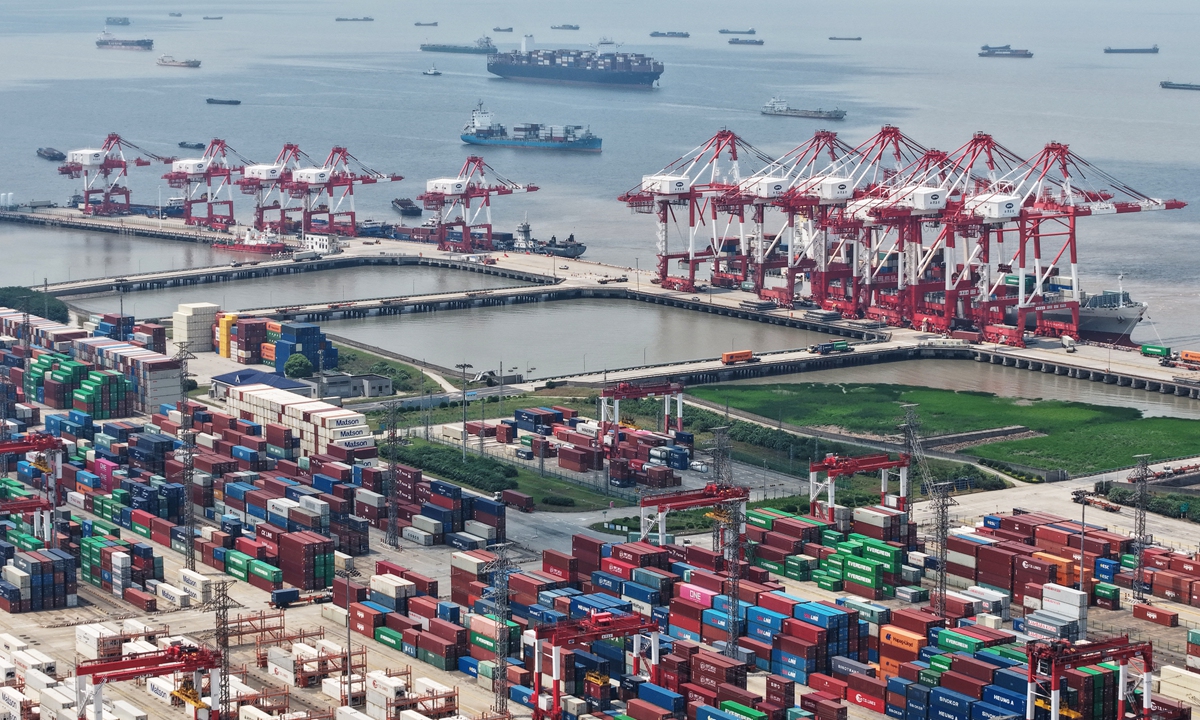
A busy scene at the Port of Shanghai on July 24, 2026 Photo: VCG
The international discussions on the positioning of China's development are an acknowledgment of China's developmental achievements and its responsibilities as a major power. However, we must be vigilant against certain narratives that deliberately obscure China's developmental stage, impose obligations that exceed its current phase of development, constrict China's developmental space, and create rifts between China and other developing countries, therefore putting China in a difficult position.The Wall Street Journal recently published an article saying that China is on the cusp of becoming a high-income country by the World Bank's classification. "China doesn't want to join the ranks of the world's developed countries," the article claimed, arguing that China benefits from its current status in international groups as "developing." In fact, being a high-income country is not the same as being a developed country. By conflating the two concepts, the Wall Street Journal article attempts to exert public pressure on China to shoulder international obligations that go beyond its current level of development.
According to World Bank estimates, China's gross national income (GNI) per capita stood at $14,230 in 2025, slightly below the high-income threshold of $14,375. It is worth noting that this World Bank classification is based solely on GNI per capita, rather than a comprehensive assessment of a country's level of modernization, industrial development and public services. In recent years, countries such as Chile, Uruguay, Panama and Costa Rica have crossed the World Bank's high-income threshold. However, they are still widely regarded by the international community as developing countries or emerging economies, rather than automatically being classified as developed countries simply because they have reached the high-income threshold.
As Chinese modernization steadily advances, China has made historic achievements in economic and social development, with its GDP firmly ranking second in the world. However, multiple indicators show that China's status as a developing country remains unchanged. For example, there is still a significant gap in per capita GDP compared to developed economies like those in Europe and the US, regional development imbalances have not yet been fundamentally resolved, and disparities persist between urban and rural areas.
By contrast, the development process of Western developed countries is a comprehensive state formed after highly mature industrialization, urbanization, and modernization. This is reflected not only in the scale of their economies but also in various dimensions such as per capita wealth, social security systems, public service capacity, and scientific and technological innovation systems.
The international discussions on the positioning of China's development largely stem from the rapid pace of China's growth and its significant contributions to the global economy, which have long surpassed the conventional narrative framework for traditional developing countries. These discussions are an acknowledgment of China's developmental achievements and its responsibilities as a major power.
However, we must be vigilant against certain narratives that deliberately obscure China's developmental stage, impose obligations that exceed its current phase of development, constrict China's developmental space, and create rifts between China and other developing countries, therefore putting China in a difficult position.
For China, its status as a developing country carries special political significance. China has always been a member of the Global South. This "South" is not merely a geographical or economic concept but an identity formed by emerging market countries and developing nations based on similar historical circumstances, current stages of development, common developmental goals, and shared political aspirations. Those who are eager to label China as a "developed country" are not truly seeking China's "graduation," but rather its "exclusion," aiming to detach China from the Global South camp. In this regard, China is very clear-minded and will not fall into this trap.
To assess a country's international responsibilities, one should not only consider whether it has been labeled a "developed country," but rather whether it is genuinely promoting global common development. China's average annual contribution to global economic growth has long been around 30 percent. China is the largest contributor of peacekeeping personnel among the permanent members of the UN Security Council, and its four global initiatives offer Chinese wisdom,solutions and strength for global governance.
China's contributions to building an open, inclusive, clean and beautiful world that enjoys lasting peace, common security, and common prosperity have already surpassed those of many developed countries. However, China will always be a member of the developing world; this is not modesty, but a reflection of sobriety and a sense of responsibility.
RELATED ARTICLES