Chinese PLA Navy sends Liaoning carrier group to Western Pacific for training; move shows shift toward ‘far-sea blade’
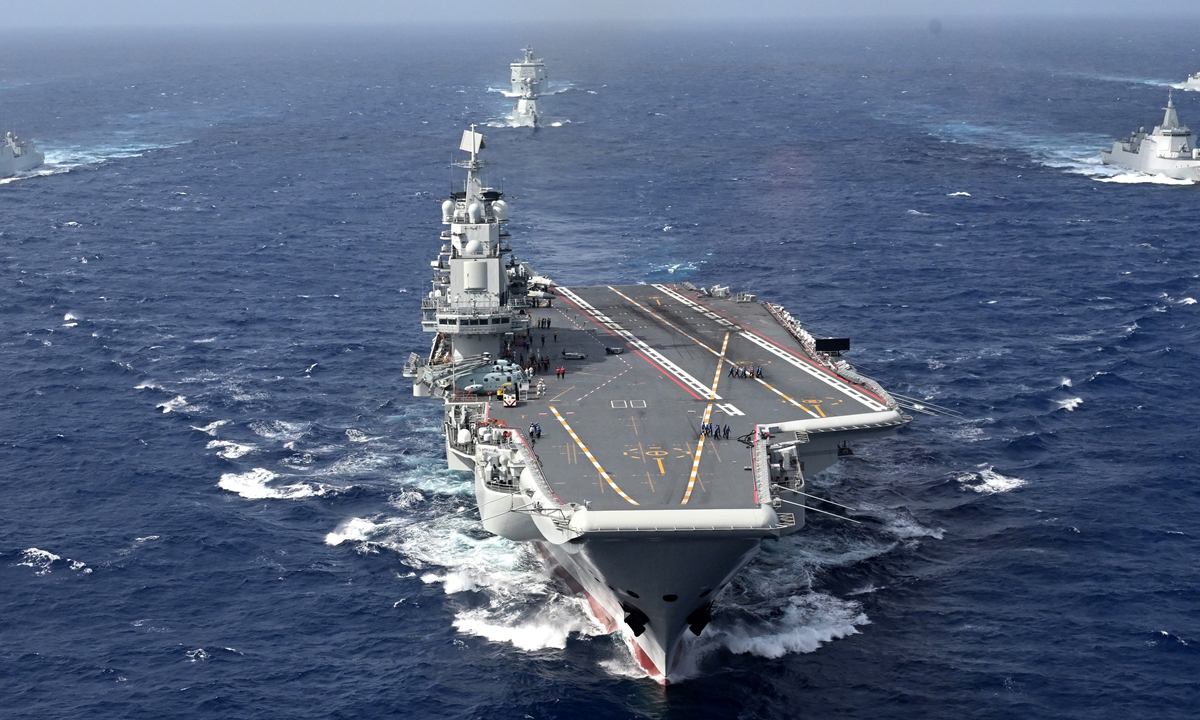
The Liaoning aircraft carrier participates in a dual-aircraft-carrier formation drill on October 21, 2024. Photo: VCG
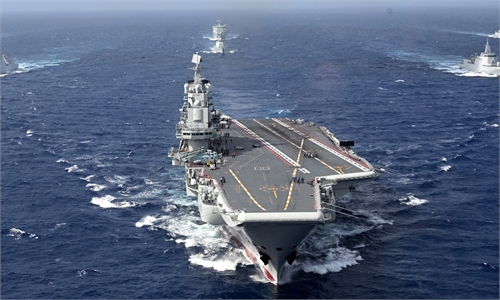
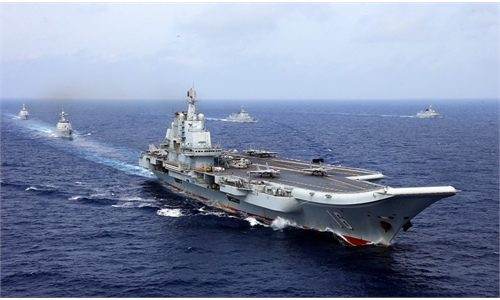
The Chinese PLA Navy sent the Liaoning carrier task group to the Western Pacific on Wednesday for training. This is the Liaoning's second far-sea training deployment to the Western Pacific this year, which also marks the 10th anniversary of its first such deployment in late December 2016, after the carrier entered service.
Military experts told the Global Times that the Liaoning's decade of far-sea operations tells the story of its transformation from a "coastal pathfinder" to a "far-sea blade," and mirrors the Chinese Navy's strategic shift from near-sea defense to far-sea defense.
The latest training is organized in accordance with annual routine training plan, aiming to test and improve the group's realistic training level and continuously enhance the capabilities to execute missions. The move is in compliance with relevant international law and practices and not directed against any specific country or target, the PLA Navy said in a statement.
On Wednesday evening, Japan’s Ministry of Defense claimed that it had spotted a total of four vessels, the Liaoning, two Type 055 large destroyers Anshan (Hull 103) and Wuxi (Hull 104), and Type 052D guided-missile destroyer Huainan (Hull 123), transiting southeast through the waters between Okinawa's main island and Miyako Island, heading toward the Pacific Ocean.
Carrier-based fighter aircraft from the Liaoning were seen taking off and landing in waters approximately 250 km south of Ishigaki Island, Japan's Defense Ministry claimed in a statement.
Then on Thursday, Japan's Defense Ministry kept up its close surveillance, releasing new image showing the carrier group leaving the Western Pacific and heading toward the South China Sea.
Zhang Junshe, a Chinese military affairs expert, told the Global Times that PLA warships, including aircraft carriers, regularly conduct far seas exercises in the Western Pacific, but Japan frequently hypes such activities.
These far seas exercises conform to the international law and common practices, and the Japanese side should not hype such legitimate activities, Zhang said.
In response to the Liaoning's current far-sea training with two Type 055 large destroyers, Zhang said this "dual 055" formation is designed to comprehensively test and enhance the carrier group's far-sea integrated combat capability, an inevitable reflection of the PLA Navy's combat-oriented training and evolving tactics.
Zhang said the dual-055 formation serves three purposes. First, it allows for tactics validation and formation optimization. The Liaoning has previously deployed with two Type 055s, such as in December 2022 and June 2025.
"This shows the dual-055 coordination tactic has been verified multiple times and is gradually becoming standard for carrier groups, helping optimize coordinated operations and capabilities," Zhang said.
Second, the model enables complementary combat roles. The Western Pacific has complex sea conditions, and far-sea carrier training faces severe environmental challenges. Two Type 055 destroyers can form a "one offense, one defense" posture: one moves ahead of the formation to "clear the way" and conduct long-range strikes, while the other operates behind or on the flank to provide close-range air and missile defense for the carrier. Meanwhile, the carrier provides fighter cover and early warning aircraft support for the forward-deployed 055, achieving integrated air-sea coordination.
Third, the model strengthens system integration. By organizing integrated training between different Type 055 destroyers and the carrier, it can comprehensively test command, communication, information sharing and firepower coordination between the ships and the carrier, accumulating real-world experience for building more complex carrier strike groups in the future.
In recent years, the Liaoning's far-sea training in the Western Pacific has become routine. Aside from 2023, when it underwent upgrades and maintenance, the Liaoning conducted two "island chain" transits in 2021, 2022, 2024 and 2025. In June 2025, the Liaoning and the Shandong conducted the Chinese Navy's first dual-carrier combat-oriented training in the Western Pacific.
"Two far-sea deployments a year shows that Chinese carrier groups' Western Pacific training has become institutionalized and combat-oriented. More deeply, it reflects the steady improvement of the PLA Navy's far-sea defense capabilities and its growing ability to monitor distant waters," Zhang said.
According to the expert, after over a decade of far-sea training, the Liaoning has grown from a training platform into the core of far-sea system-based operations. Its carrier group now possesses integrated far-sea offensive and defensive capabilities.
Zhang noted two key capabilities. First, it has all-weather, round-the-clock carrier-based aircraft operational capability. The Liaoning's carrier aircraft takeoff and landing capabilities have achieved a qualitative leap, breaking through night and complex weather limitations to gain all-weather, round-the-clock combat capability.
With the J-35 stealth carrier-based fighter undergoing shipboard testing, the Liaoning is transitioning from fourth-generation to fifth-generation aircraft, forming a high-low mix and a three-dimensional firepower network that significantly boosts air superiority and air-to-sea and air-to-land strike effectiveness, he said.
Second, Zhang said, it has system-based joint operational capability. The formation possesses strong regional air defense, anti-ship, anti-submarine and long-range land-attack capabilities, and can achieve information interconnection with shore-based aviation, the PLA Rocket Force and early warning aircraft, forming system-based far-sea combat capability.
RELATED ARTICLES