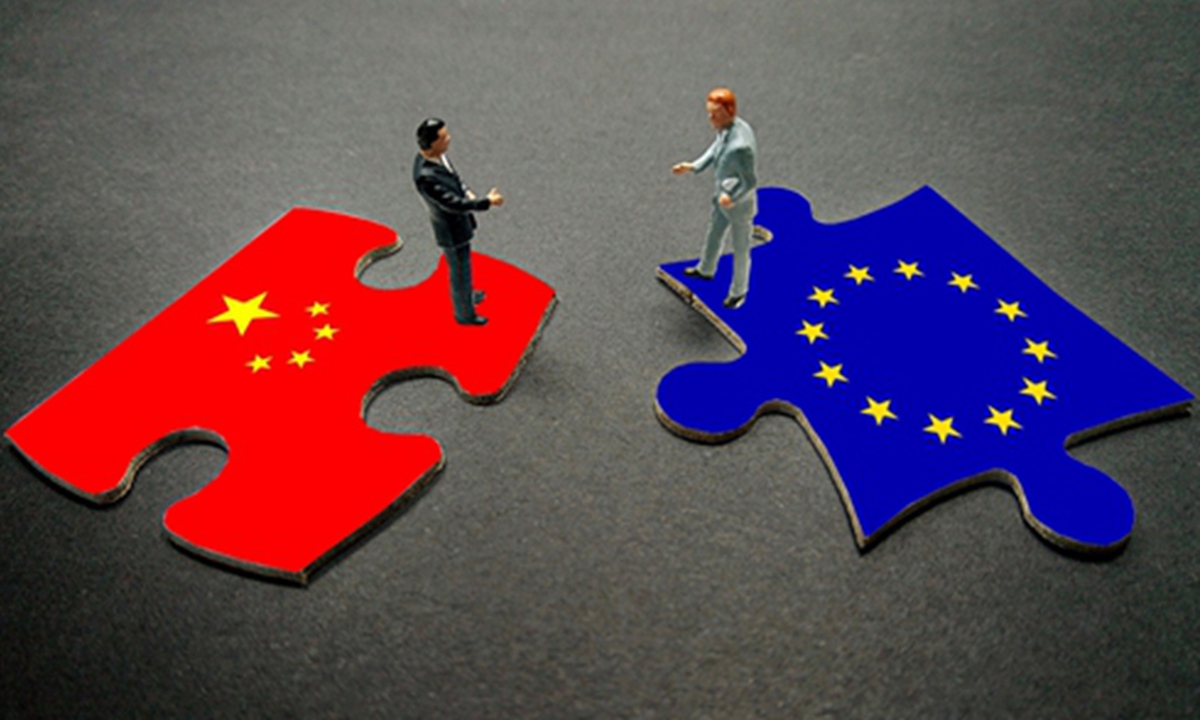
China-EU relationship Photo: VCG
Certain forces of the Taiwan region are exploiting yet another international platform to peddle their separatist agenda, this time using a Western buzzword in Poland to drag the EU into its political stunts. According to media reports, Taiwan's "foreign minister" Lin Chia-lung, during a speech in Poland on Tuesday, warned the EU that dependence on Chinese suppliers poses a risk to the bloc's freedom. The remarks came as European leaders will gather in Brussels this week to weigh up the future of trading ties with China.
Such remarks serve a number of ulterior motivations behind Taiwan politicians. First, Taiwan politicians harbor no genuine concern for the EU's interests, but only want to internationalize the Taiwan question by hijacking a major China-EU agenda, creating the false impression that Taiwan has a legitimate stake in Europe's trade and security decisions. Second, they aim to drive a wedge between China and the EU, exploiting Europe's internal debates on "de-risking" to sow suspicion and friction where none need exist. Third, they attempt to dress up a separatist agenda in the language of "freedom" and "values," borrowing Western slogans to lend their cause a veneer of legitimacy it does not deserve.
After all, the one-China principle is a consensus of the international community and a norm governing international relations. As an inalienable part of China, Taiwan has no right - under any name, in any capacity, or on any international occasion - to issue so-called "warnings" or make pronouncements on China-EU relations.
The EU's approach to China today is marked by a deep and unresolved ambivalence. On one hand, Brussels acknowledges the necessity of a "stable and balanced" trade relationship, recognizing that China remains an indispensable partner for Europe's economic and green transition goals. On the other hand, European institutions increasingly frame China as a "critical long-term strategic challenge," claiming it holds "asymmetric advantages" over the EU through its economic and technological dominance. Interdependence, once seen as a foundation for stability, is now treated as a source of vulnerability.
This tension has driven the EU toward a policy of "de-risking," which in practice often looks less like prudent diversification and more like a deliberate effort to reduce dependence on Chinese suppliers across critical sectors. A case in point is that in June, the European Commission decided to propose a new law requiring EU companies to diversify their sources of key supplies, the focus of which, clearly, is China.
With such measures as their policy tools, the EU is not protecting its freedom; it is eroding the very foundation of its prosperity. China has consistently supported a strong, united, and prosperous Europe. But if Brussels chooses to define its relationship with China through the lens of suspicion and adversarial posturing, it will find that the costs of derisking far outweigh the imagined risks of engagement.
The timing of the so-called warning from the Taiwan politician is telling. It also came just days after EU and Chinese trade officials concluded their second Trade and Investment Consultations in Beijing, where both sides reached agreements on hybrid vehicle exports, rare earth supply channels, and market access.
The EU should realize that the "warning" from Taiwan is nothing but a wolf in sheep's clothes. If European institutions allow such remarks to fester unchecked, or worse, use them as a pretext to advance the so-called "supply chain de-risking" agenda, it would mark a dangerous shift in Europe's trade policy - moving away from pragmatic cooperation and toward ideological confrontation. Such a move would only lend credibility to a separatist narrative that has no place in international affairs. If Brussels truly values strategic autonomy, it should resist the temptation to convert trade policy into an instrument of ideological posturing, and instead keep the China-EU relationship anchored in realism, reciprocity, and respect.
RELATED ARTICLES