China is rewriting the rules, not just playing catch-up
By Published: Oct 14, 2026 09:25 PM

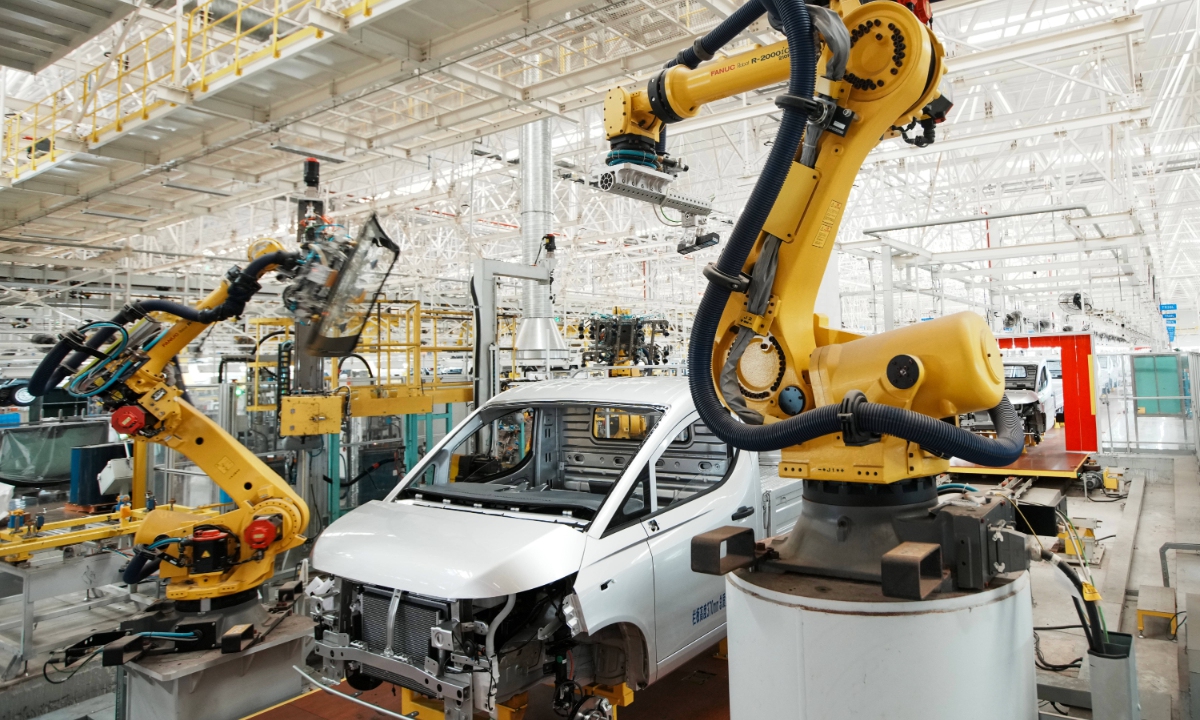
Robots assemble a new-energy vehicle at Liuzhou Wuling Automobile Industry Co in Liuzhou, South China's Guangxi Zhuang Autonomous Region, on July 18, 2026. Photo: VCG
I recently came across an article on Kelley Blue Book, a leading US automotive information website. The headline was striking: "Paris exhibit shows why American automakers fear China." The author made a blunt observation: American automakers, working through industry organizations, such as the Alliance for Automotive Innovation, are pushing for legislative bans. It reflects a fundamental fear - the realization that they cannot compete with Chinese competitors on innovation speed and user experience.Chinese brands are now defining consumer expectations. Western brands are being forced to follow. This is the clearest signal that the power to set the agenda has shifted. The US' real fear isn't whether Chinese cars can enter the market. It's what happens once they do. Chinese automakers, leveraging an integrated and rapidly iterative ecosystem, will first dominate the mid- and lower-end segments through scale effects, then systematically "erode" the entire supply chain - eventually "threatening" even the premium segment. October's Paris Motor Show featured more than 20 Chinese automotive brands. The previous show had nine. That is more than doubled. Numbers tell only part of the story. What mattered was how they shaped the future.
The Jaecoo J7 became the UK's best-selling vehicle in September, a fact that speaks louder than any analysis. Chinese automakers are not "catching up"; they have already established a foothold - at least in mature automotive markets such as the UK. Place this alongside the chip sector, and a larger framework emerges. The US controls chipmaking at the source - design software, manufacturing equipment, critical materials, every link in the chain. China cannot easily bypass it. This is the "chokepoint strategy." The automotive industry is different. The US can't control the source, as no single chip determines cars. Automobiles are an entire supply chain, market and ecosystem; therefore, the US can only "defend" - using tariffs and bans to protect its market.
Defense requires speed. If American automakers innovate faster than their Chinese competitors, the "defensive line" holds. But American automakers are slowing down. At the Paris Motor Show, Chinese brands discussed user-feedback systems, smart cabins, and autonomous driving experiences. Western companies said, "We're working on that too." One defines, the other follows - agenda-setting power has shifted.
The US' strategy of holding the premium segment contains a fatal flaw. Once China establishes a foothold in the mid- and mass-market segments, scale effects invert the equation. Talent gravitates toward fast-growing companies; Investment follows growth; Supply chains optimize around the largest market. Even if the US retains the premium segment, R&D investment becomes unsustainable without mid-market scale. Declining R&D, in turn, erodes the premium segment itself.
This reflects an industrial realignment. Chinese automakers have built an ecosystem: The domestic market serves as a foundation from which Chinese automakers radiate outward to Europe, Southeast Asia and the Middle East. American automakers, by contrast, operate behind protective barriers - isolated, confined to smaller markets, slower to iterate and losing talent.
For a century, Western automakers defined what consumers wanted: safety, comfort, reliability - three words that shaped automotive culture. Now, the definition has changed. Chinese companies say: Consumers want one-button feedback systems, intelligent cabins and autonomous driving experiences. Western companies must respond.
This reflects deeper competition between two distinct industrial models. The Western model is vertically layered. The US controls high-end innovation and critical nodes. Others provide components and manufacturing. Defense operates through "chokepoints" - controlling key segments to maintain structural stability. This system depends on stable supply chains and fixed market positions.
China's model is horizontally integrated. It runs from raw materials through manufacturing, software and markets - a complete closed loop. The core isn't superiority at a single point but end-to-end adaptability and speed. Vehicle feedback-to-iteration cycles are far shorter than Western timelines.
The chip industry shares similarities with the automotive industry: The US strategy relies on "choke." Chokepoints can delay competitors, but once you circumvent them, the system's fragility is exposed. One or several chokepoints cannot prevent breakthroughs at multiple levels. China can complete integrated industrial cycles once, twice or even three times. Each cycle accumulates not just products, but optimized processes, talent pools and supply chain efficiency.
For automobiles, the US now defends with barriers - and the effectiveness of those defenses depends on innovation speed. If American innovation can't outpace China's, they gradually fail. The critical threshold arrives when Chinese brands exceed 15 to 20 percent of global market share. At that point, scale effects become self-reinforcing, and American "delay" turns into inevitable decline. The 23 Chinese brands at the Paris Auto Show are not there merely to exhibit. They are there to declare that the rules are being rewritten.
The author is a senior editor with the People's Daily. dinggang@globaltimes.com.cn. Follow him on X @dinggangchina
RELATED ARTICLES