Takaichi’s claim on nuclear policy wording ‘conceals intent to dismantle postwar nuclear constraints’
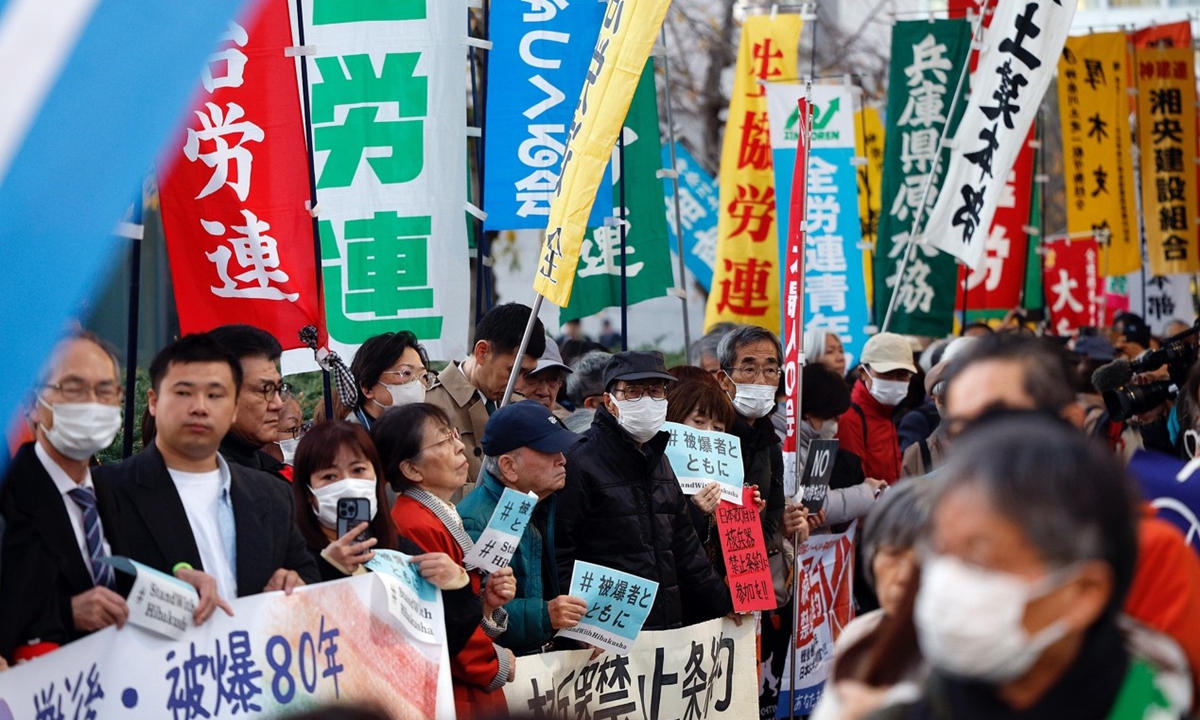
Demonstrators stage a rally before the Diet in Tokyo, Japan, 21 November 2025. Nihon Hidankyo, the Japan Confederation of A-and H-Bomb Sufferers Organizations, and others political organizations and unions, staged a protest in front of the Japanese Parliament after the new Japanese Prime Minister Sanae Takaichi criticized her country's traditional policy against nuclear weapons. Photo: VCG
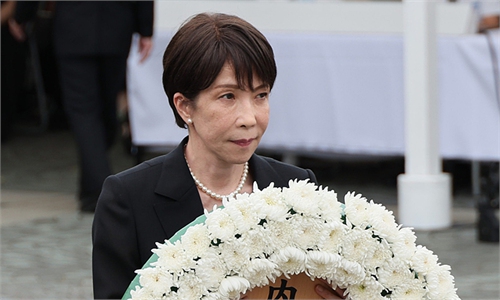
Japanese Prime Minister Sanae Takaichi claimed on Wednesday there was room for discussion regarding the wording of the "no introduction" clause under Japan's Three Non-Nuclear Principles as Japan plans to revise its three key security documents by the end of this year, a move that has drawn concerns over whether Japan is seeking to loosen its long-standing nuclear policy constraints, a Chinese expert said.
The expert noted the move is "an attempt to conceal its true intent" and reflects a dangerous signal that Japan is seeking to dismantle its postwar nuclear policy restrictions, which is unacceptable, and warned that any weakening of the "no introduction" principle could hollow out Japan's non-nuclear policy, open the door for US nuclear weapons to enter Japan, and bring risks to peace and stability in Northeast Asia.
According to Japanese media TBS News, Takaichi made the claims at a meeting on Wednesday, saying that while the government is discussing the revision of the three security-related documents, the specific wording of the "no introduction" principle is still under consideration. She also referred to the concept of US extended deterrence, saying these issues deserved consideration, while declining to predict the final wording.
This is not simply a consideration of review of wording, but an attempt to create room to dismantle Japan's postwar nuclear policy restrictions. It is an attempt to cover up the real intention, Lü Chao, a research fellow at the Liaoning Academy of Social Sciences, told the Global Times on Wednesday.
Lü said that the so-called "review of wording" could become the first step toward gradually relaxing nuclear policy constraints, eventually hollowing out the non-nuclear policy that Japan has maintained for decades, adding that there should be no room for compromise on such an issue.
"If even the key wording of this principle can be reinterpreted, the actual binding force of the Three Non-Nuclear Principles will be further weakened," the expert said.
China's Foreign Ministry has previously stressed that the possession of nuclear weapons is not an issue on which Japan can "allow discussion" if it wants to. Japan is a non-nuclear-weapon state party to the Non-Proliferation Treaty and therefore has a bound duty under international law to not receive, manufacture, acquire or transfer nuclear weapons. There is no room for negotiation, a spokesperson said.
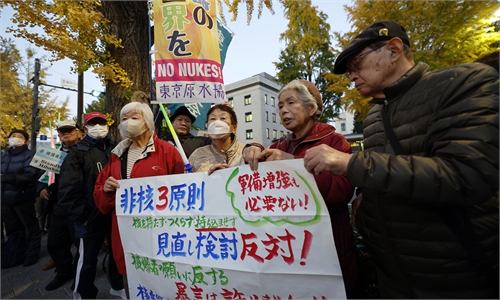
Takaichi's moves toward revising the Three Non-Nuclear Principles has also already triggered many concerns among some groups in Japan for some time. Japanese Communist Party lawmaker Yoshiko Kira previously criticized the move, saying that instead of revising the principles against the wishes of atomic bomb survivors, Japan should join the Treaty on the Prohibition of Nuclear Weapons, which she said was the responsibility of the only country to have suffered wartime atomic bombings, according to local media reports.
Japan's Ryukyu Shimpo previously wrote in a commentary that revising the Three Non-Nuclear Principles would amount to abandoning Japan's postwar vision as a peace-oriented nation, saying that as the only country to have suffered atomic bombings, Japan should not weaken its non-nuclear commitments. Earlier this year, 22 civic groups in Nagasaki also issued a joint protest statement opposing any move to revise the principles, Mainichi reported.
As Japanese right-wing forces keep challenging the postwar international order and the non-proliferation regime to move further down the wrong path, the international community needs to call on Japan to strictly observe the three non-nuclear principles, fulfill its obligations under the NPT, abandon remilitarization and nuclear attempt, and earnestly respond to the concerns of the international community, a Chinese Foreign Ministry spokesperson said.
"Such a remilitarization trend will not only alter Japan's own security direction, but also intensify strategic competition in Northeast Asia and bring risks to regional peace and stability," Lü added.
RELATED ARTICLES