SCI-TECH / OTHERS
China-developed rice line shows strong yields in extreme cold in latest trials
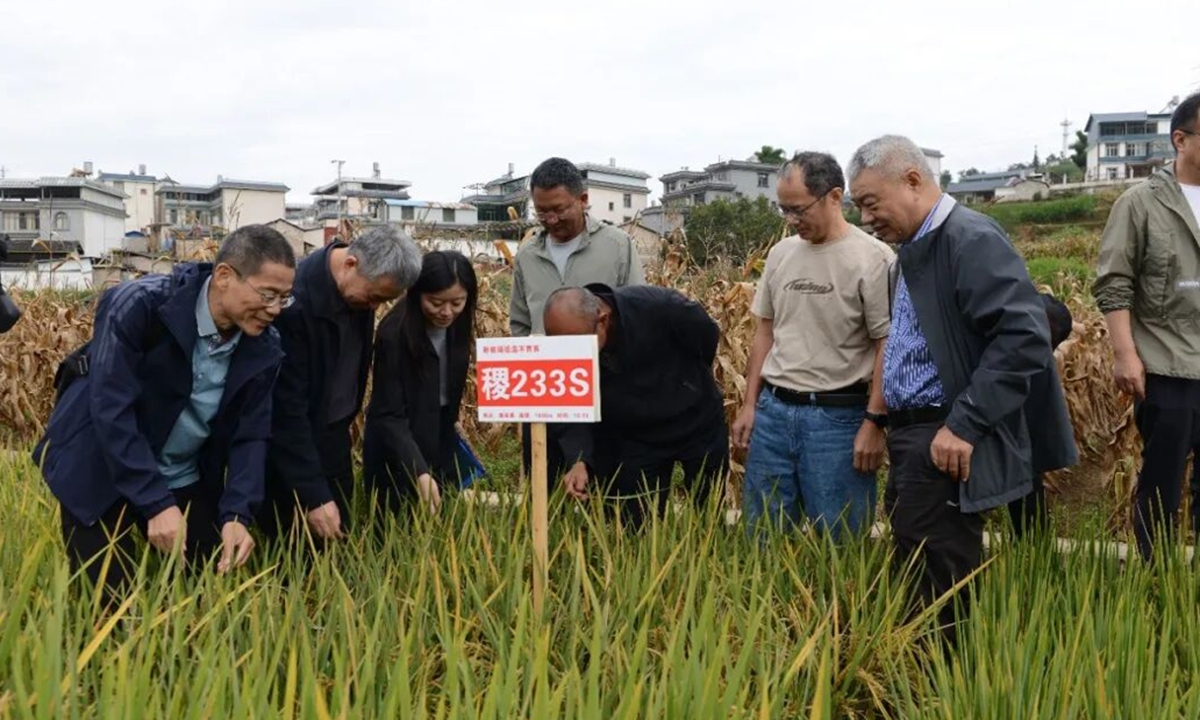
Expert panel members visit the Ji 233S trial field. Photo: Screenshot from the Science and Technology Daily
An expert panel conducted on-site evaluation of rice sterile line Ji 233S and its hybrid combinations, which were developed by multiple institutions to have tolerance to extreme temperatures. The evaluation took place in high-altitude trial areas in Southwest China's Yunnan Province, the Beijing-based Science and Technology Daily reported on Tuesday.Experts agreed that Ji 233S has strong cold tolerance, with its hybrid combinations showing significantly higher seed-setting rates than controls, giving it major application value in addressing extreme climate challenges.
The panel, made up of experts from the Chinese Academy of Agricultural Sciences, China Agricultural University and the Chinese Academy of Sciences, visited four trial sites in Yunnan, spanning altitudes from 1,739 to 2,403 meters above sea level. According to field meteorological data at the panicle layer, extreme low temperatures lasted 40 to 50 days at all four sites, meeting the criteria for extreme cold conditions.
Results showed that the seed-setting rate at the Shidian trial site in Baoshan reached 76.4 to 85.7 percent, significantly higher than that of cold-tolerant control varieties. Among them, Ji 233S and its combinations achieved seed-setting rates above 80 percent under extreme cold conditions. The same trial design produced similar results at the Tengchong and Lijiang sites.
Tang Wenbang, chief scientist of the team, said the team began researching extreme-temperature-tolerant breeding in 2003. Using C815S - a dual-tolerant foundation line for both high and low temperatures - as the core parent and combining multiple effective genes, the team spent more than 20 years developing Ji 233S, a dual-purpose genic male sterile line able to tolerate both extreme high and low temperatures. Ji 233S passed provincial technical appraisal in South China's Guangdong Province earlier in 2026.
"It has good plant and leaf architecture, strong combining ability, and tolerance to high temperatures in terms of seed-setting rate, grain quality and outcrossing habits," Tang was quoted as saying by the Science and Technology Daily.
On August 6, the Chinese Association of Agricultural Science Societies organized the experts to evaluate the heat tolerance of nine hybrid combinations based on Ji 233S. During the trial, the area experienced two extreme climate stresses: low-temperature overcast and rainy conditions with insufficient sunlight, followed by extreme heat and humidity.
Surveys found that the nine combinations achieved seed-setting rates of 86.1 to 94.2 percent, far higher than both heat-tolerant and heat-sensitive controls. The results were verified by five third-party testing institutions. The panel agreed on-site that the Ji 233S combinations show outstanding heat tolerance from panicle initiation to heading and flowering, with broad application prospects.
Building on the verified heat tolerance, the team has further advanced mechanized seed production.
Tang said the team has established an innovation system covering gene discovery, germplasm creation, variety breeding and demonstration, which is expected to provide new varieties and technical support for China's rice production amid global warming and increasingly frequent extreme temperatures.
RELATED ARTICLES