IPAC audit exaggerates differences between countries to criticize UK’s China policy
China UK Photo: VCG
The Inter-Parliamentary Alliance on China (IPAC) released an audit of UK-China relations on Wednesday, accusing the UK government of its lack of expertise on China and claiming that past engagement with China had exposed the UK to interference risks without delivering the promised opportunities. A Chinese expert said the audit reflects the tendency of some groups to exaggerate China-related security risks and differences in values, projecting their own practices onto China and undermining mutual trust between the two countries.
The expert noted that some voices were focusing excessively on differences while overlooking the benefits of cooperation with China, adding that such negative views should not be taken as representative of the UK government's position.
The audit claimed that the UK's engagement with China should take into account differences in political systems and China "does not share our values."
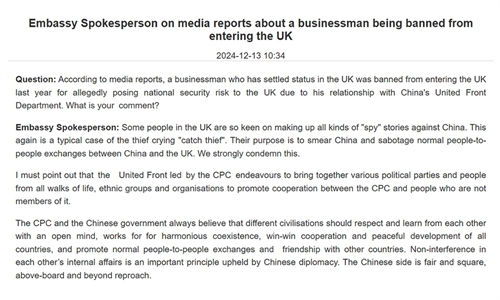
The Chinese Embassy in London said IPAC's "sole agenda is to manufacture falsehoods, mislead the public, and undermine China's relations with other countries." The report "distorts the facts" and "is not even worth refuting," the embassy added, according to The Guardian.
"The UK government is still pursuing the pragmatic China policy inherited from its predecessor. The framework of coexistence between competition and cooperation has not changed significantly, and there is unlikely to be much change going forward," Li Guanjie, a research fellow at the Shanghai Academy of Global Governance and Area Studies under Shanghai International Studies University, told the Global Times.
UK Prime Minister Andy Burnham's overall approach to China remains relatively cautious, Li said, adding that significant policy changes or new statements on key issues were unlikely.
According to The Independent, Burnham's pledge in September to engage with China "frankly and constructively" signals continuity with the approach adopted by his predecessor Keir Starmer, who promised to "cooperate where we can" with the world's second-largest economy.
Li noted that some voices in the UK were hyping up the so-called "China threat" narrative. He argued that statements by MI5 and views expressed in the IPAC report should not be taken as fully representative of the British government's stance.
Responding to allegations made by the head of MI5 on Tuesday during the agency's annual threat update that China was conducting espionage activities against the UK made during the release of the agency's annual threat assessment update, a spokesperson for the Chinese Embassy in the UK said the claims were "completely fabricated" and constituted "malicious slander." China firmly opposed and strongly condemned the claims, the spokesperson said.
China has always upheld the principle of non-interference in other countries' internal affairs, poses no threat to any country, and has no interest in interfering in the UK's domestic affairs, the spokesperson said.
"Judging from the repeated promotion of narratives such as the so-called 'China threat,' the UK does indeed face a shortage of people with a deep understanding of China, as well as a lack of China expertise," Li said. "Those promoting such narratives do not adequately understand China's current situation or the opportunities and benefits it can offer the UK through cooperation. In fact, we have never shied away from acknowledging differences in values, but have consistently emphasized the need to seek common ground while reserving differences."
"Such differences, however, should not be used as a pretext to sow discord in China-UK relations or spread misinformation about China," he added.
In a speech at a Chinese Embassy reception on September 29, Chinese Ambassador to the UK Zheng Zeguang said the two leaders of China and the UK had reached important common understandings on building a long-term and consistent comprehensive strategic partnership, including through stronger high-level exchanges and cooperation and collaboration across various fields.
"Despite our different national conditions, we must always bear in mind that our common interests far outweigh our differences. We should focus on expanding our common interests and properly handle differences and sensitive issues through dialogue and consultation, so as to avoid disrupting the broader interests of our collaboration," Zheng said.
RELATED ARTICLES