‘T. rex of fungi’: Chinese scientists discover giant new fungal family in Yunnan province
By Published: Oct 15, 2026 05:23 PM

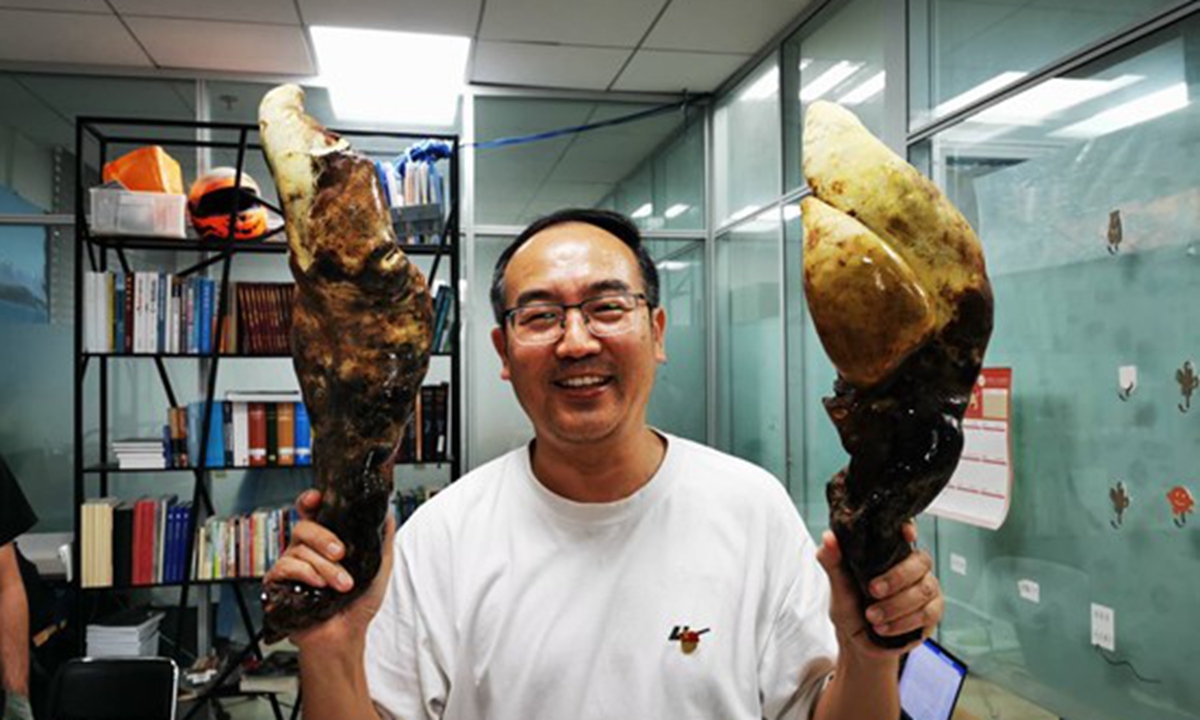
A member of the research team from the Kunming Institute of Botany under the Chinese Academy of Sciences poses for a picture with the newly discovered Dianjunus rex. Photo: Courtesy of the Kunming Institute of Botany under the Chinese Academy of Sciences
Deep in the forests of Southwest China's Yunnan Province, scientists have discovered a giant fungus that can stand half a meter tall and weigh more than two kilograms. But its extraordinary size is only part of the story. The discovery marks not only the identification of a new species, but also the discovery of an entirely new fungal family. Researchers estimate that the family originated around 65 million years ago, roughly when dinosaurs went extinct.
The discovery was made by a research team led by Yu Fuqiang from the Kunming Institute of Botany under the Chinese Academy of Sciences, the Global Times learned from the team on Thursday.
The researchers have named the fungus Dianjunus rex, with "rex," the Latin word for king, also appearing in the name of the mighty Tyrannosaurus rex. The newly established family, Dianjunaceae, currently has just one known member - this remarkable giant.
According to the research published in the scientific journal Frontiers in Fungal Biology, the discovery represents not merely a new species but an entirely new branch on the fungal family tree.
Unlike familiar edible mushrooms such as shiitake and oyster mushrooms, which belong to Basidiomycota, Dianjunus rex belongs to Ascomycota, a vast fungal group that includes microscopic molds such as Penicillium and the fungus responsible for forming caterpillar fungus, China Central Television (CCTV) reported.
While many familiar members of this group are relatively small, the newly discovered fungus is a giant by comparison.
During surveys conducted between August 2024 and July 2025, researchers collected specimens growing from the roots of recently dead trees and surrounding soil in Yunnan's subtropical and tropical forests.
Its massive reproductive structure, known as a stroma, can reach 50 centimeters in height. Typical specimens weigh between 250 and 600 grams, but one exceptionally large specimen weighed 2.2 kilograms.
According to the study, this is the largest stroma ever documented within Ascomycota.
Despite its imposing size, the fungus hardly resembles a typical mushroom. Young specimens are covered in whitish, powdery fibers, while mature ones gradually turn dark yellow. Their rounded tops resemble garlic bulbs, sometimes developing finger-like branches.
Yet the most intriguing part of the discovery may lie not in how this giant looks, but in how it lives.
According to CCTV's report on the discovery, scientists believe Dianjunus rex may have developed an unusual survival strategy that gives it an advantage over other fungi competing for nutrients.
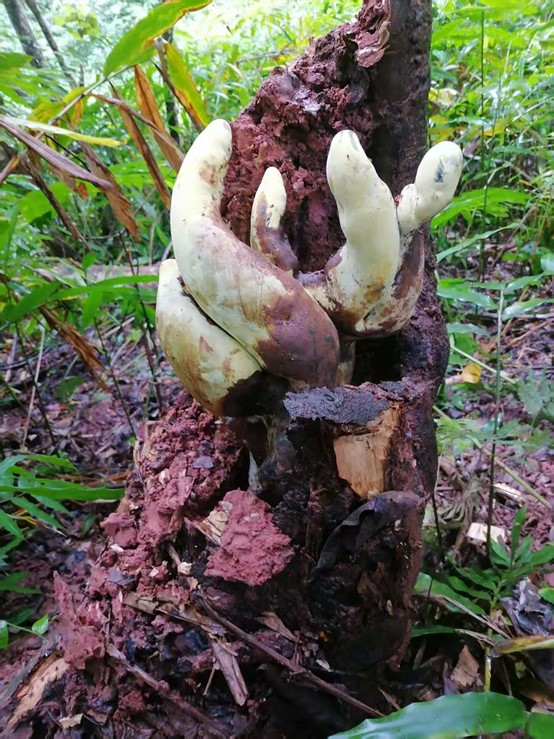
Photo: Courtesy of the Kunming Institute of Botany under the Chinese Academy of Sciences
Instead of waiting for a tree to die before moving in, the fungus may first live quietly inside a healthy tree as an endophyte, causing no obvious harm to its host.
Once the tree dies, the fungus can quickly switch to a decomposer lifestyle, taking advantage of the nutrients before other fungi arrive.
In other words, this forest giant may already have a seat at the dinner table before its competitors even arrive.
The strategy could help explain how the fungus accumulates enough resources to produce such an enormous reproductive structure.
The fungus also has a remarkable evolutionary backstory.
By analyzing its DNA using a technique known as a molecular clock, which estimates when different evolutionary lineages diverged, researchers traced the origins of the newly discovered fungal family to approximately 65 million years ago.
That estimate places its emergence around the time of the Cretaceous-Paleogene mass extinction, which occurred about 66 million years ago and wiped out non-avian dinosaurs, including Tyrannosaurus rex.
As CCTV noted in its coverage, the timing raises the intriguing possibility that dramatic environmental changes following the mass extinction created new ecological opportunities for the ancestors of this fungus.
As forests recovered and ecosystems reorganized, previously unavailable ecological niches may have opened up, allowing new fungal lineages to emerge.
The study's estimated evolutionary timeframe, however, spans approximately 50 million to 80 million years ago, meaning scientists cannot establish with certainty whether the lineage arose before or after the extinction.
Still, the coincidence makes its name particularly memorable: While one "rex" vanished from Earth, the ancestors of another may have been beginning their evolutionary journey.
For people familiar with Yunnan's celebrated wild mushroom cuisine, another question naturally arises: Can this giant fungus be eaten?
Asked whether the fungus is edible, a member of the research team told the Global Times on Thursday that the researchers had not tasted it because the available specimens were too few and too valuable to use for that purpose.
Researchers plan to investigate its potential nutritional and medicinal value, fermentation applications and possibilities for artificial cultivation.
For now, it remains unclear whether Dianjunus rex is edible, according to the CCTV report. Beyond its extraordinary size and ancient evolutionary history, the discovery also underscores how much of the fungal world remains unexplored.
Yunnan, long celebrated as China's "kingdom of plants and animals," has more than 6,000 documented fungal species. Yet researchers estimate that the province may actually harbor more than 100,000 species. The discovery of Dianjunus rex suggests that even some of nature's most extraordinary giants may still be hiding in plain sight, waiting for scientists to uncover their secrets.
RELATED ARTICLES