Foreign visitors are studying Chinese cars with tape measures. Times have changed!
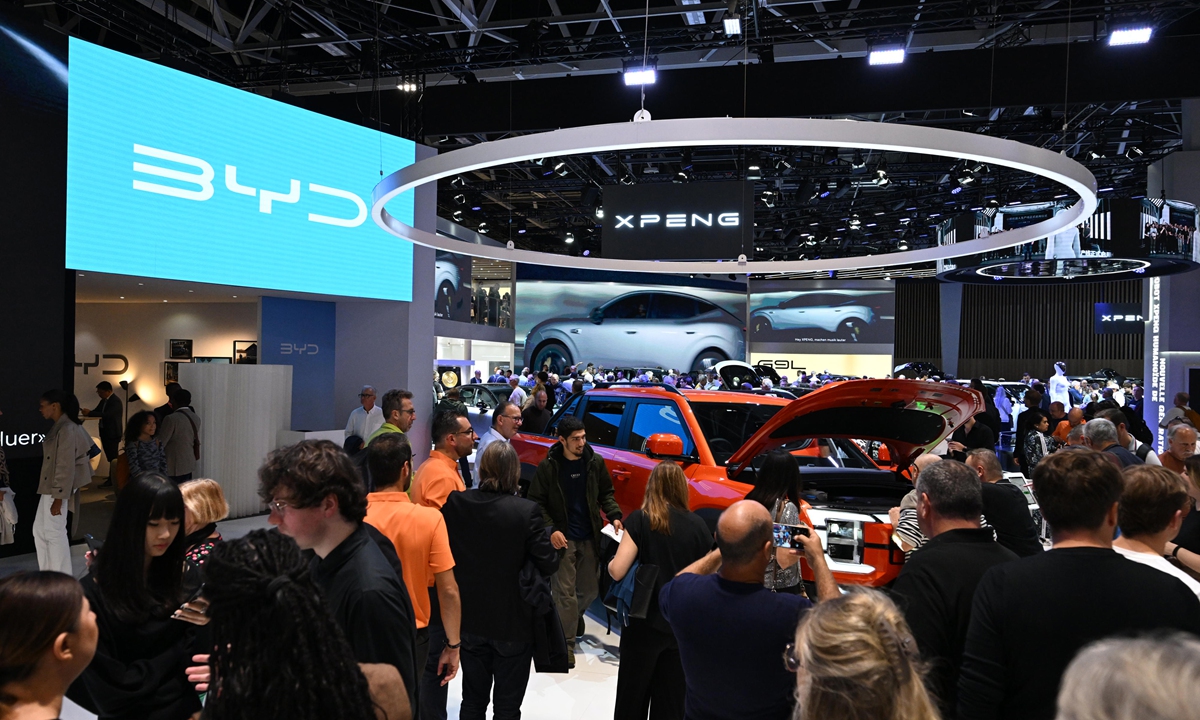
Electric vehicles in the BYD Co. and XPeng pavilions at the Paris Motor Show in Paris, France, on Tuesday, Oct. 13, 2026. The Paris Motor show runs Oct. 12-18. Photo: VCG
At the recent Paris Motor Show 2026, a scene could be spotted from time to time: foreign visitors pulling out tape measures to carefully study Chinese new energy vehicles (NEVs), taking notes as they went. Many automotive industry veterans couldn't help but remark, "Times have changed!"
This scene captures the journey of China's auto industry, from importing foreign technology and learning to absorb and adapt it, to breaking through with homegrown innovation. It also bears witness to a historic shift in the center of gravity of the global automotive industry - from the West to the East.
Foreign visitors studying Chinese cars with tape measures generally fall into two groups.
The first consists of consumers who are seriously considering buying a Chinese car. For European consumers, taking a tape measure to a car is typically a sign of genuine purchase intent. The streets of Europe's old cities are narrow, and parking spaces are often hard to come by. Buyers need precise measurements to make sure a car will fit in their garage or to check whether a stroller, skis, and other items can fit comfortably in the trunk. This is a clear sign that Chinese cars have made it onto their shopping lists.
The second group consists of engineers from European automakers. For decades, it was Chinese engineers who visited auto shows in Europe and the US to study their counterparts' vehicles, with tape measures in hand. It was an era in which Western automakers set the standards and led the way, while the industry's influence and decision-making power remained firmly in the hands of established industrial powers such as Germany. China's auto industry had little choice but to learn from the them and gradually close its technological and industrial gaps.
Today, the roles have been reversed. Those who once came to learn are now taking center stage at the Paris Motor Show. Meanwhile, companies that once set the industry benchmark are eagerly test-driving Chinese cars and closely examining Chinese brands' designs and smart technologies.
What is particularly striking is how quickly this role reversal has taken place. Just two years ago, only nine Chinese automotive brands exhibited at the Paris Motor Show. This year, 16 Chinese automakers brought a total of 25 brands to the event, accounting for roughly one-third of all participating brands. As one online commentator put it, European automakers once sat back and waited for orders to come in; now, Chinese automakers are bringing their cars right to Europe's doorstep and competing head-on in its home market. Even The Wall Street Journal has observed that "Chinese cars now dominate Europe's biggest auto show." All of this speaks volumes about the rapid development of China's NEV industry.
This year's show comes at a time of China-EU trade and economic consultations, with protectionist sentiment still simmering beneath the surface. Yet Chinese automakers have neither backed down nor wavered in the face of these challenges. Instead, they have taken the initiative to showcase their latest technologies and high-quality services to European consumers, while several companies have announced plans to increase their investment in Europe.
At this year's Paris Motor Show, Denza, a brand under BYD, announced plans to introduce its God's Eye driver-assistance system in Europe. XPeng and Tesla offered public demonstrations of intelligent driving on real roads. Changan Automobile, meanwhile, showcased a range of its independently developed core technologies, including its BlueCore Super Hybrid system and Golden Shield battery technology.
Chinese automakers are not merely exporting finished vehicles. Rather, they are entering the European market equipped with comprehensive technical solutions, an established industrial ecosystem, and a sincere commitment to long-term operations - addressing external discussions and skepticism through tangible products.
To be fair, Chinese automakers have yet to take the lead across the board. China's auto industry has traveled a long and difficult road from the strategy of "exchanging market access for technology" to winning markets through technological prowess. As the century-old automotive industry undergoes a profound transformation, the competitive landscape is expanding and new opportunities are emerging. We stand ready to work alongside our international counterparts to share the new opportunities created by the development of the global automotive industry.
RELATED ARTICLES