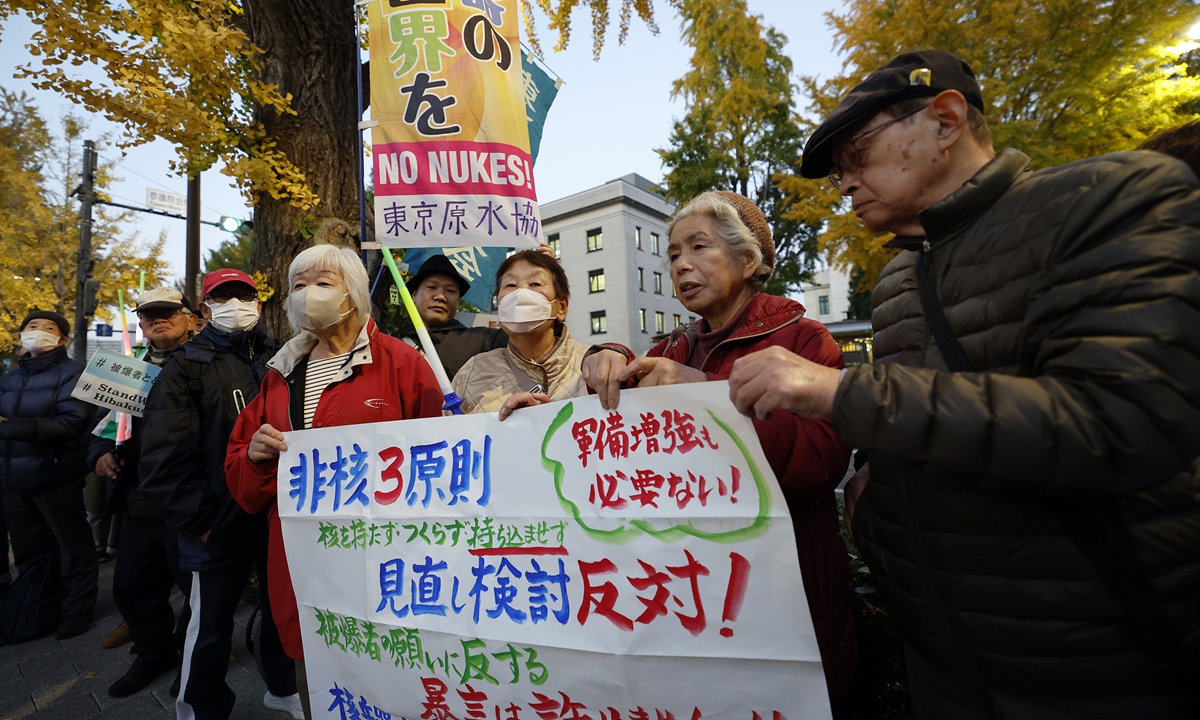
Demonstrators stage a rally before the Diet against the Japanese government's nuclear policies in Tokyo, Japan, on November 21, 2025. Protesters also call on the government to join the Treaty on the Prohibition of Nuclear Weapons. Photo: VCG
With her parliamentary remarks, Japanese Prime Minister Sanae Takaichi has pried open a crack in the thickest seal guarding Japan's postwar taboos on military use of nuclear energy.
According to Japan's Kyodo News, Takaichi stated during a session of the House of Representatives Budget Committee that in response to the "increased military activity by its neighbors," the Japanese government will "seriously consider" the possibility of Japan Self-Defense Forces (SDF) introducing nuclear-powered submarines. Sources reportedly indicate Tokyo intends to include this option when updating its key documents on defense and security later this year.
The phrase "seriously consider" does not indicate prudence, but rather serves as a prelude. While citing "limited intelligence-gathering and surveillance capabilities in the Pacific," Takaichi also singled out nuclear-powered submarine developments in Australia and South Korea - a rhetorical maneuver: She frames Japan as a "passive follower," portrays military expansion as a "defensive necessity," and casts taboo-breaking moves as a "regional trend." Her goal is to embed nuclear-powered submarines in this year's revised security and defense documents, turning a once-forbidden option into a "future initiative" in official policy texts. This is dangerous.
Successive Japanese cabinets have long barred the military use of nuclear energy under the Atomic Energy Basic Law, enacted in 1955, which stipulates the peaceful use of nuclear power. In 1965, the Japanese government issued an explicit interpretation prohibiting nuclear energy from being used as propulsion for SDF vessels - an interpretation that has remained in force to this day. "Now, Takaichi's remarks on considering the introduction of nuclear‑powered submarines mark a major conceptual breach of Japan's Atomic Energy Basic Law and the long‑standing Three Non‑Nuclear Principles it underpins," said Lü Yaodong, research fellow at the Institute of Japanese Studies, Chinese Academy of Social Sciences.
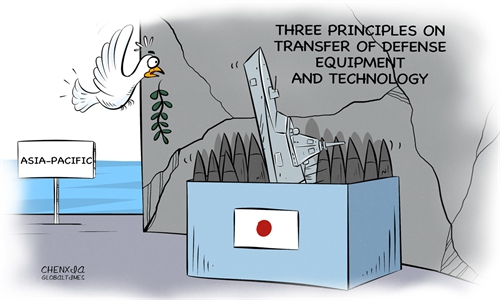
He noted that this was not a spur-of-the-moment statement, but rather an intentional, aggressive step aligned with the revision of three security documents scheduled for this year, a move with significant timing implications. The proposal to introduce nuclear-powered submarines is intended to lay the groundwork for provisions in the revised security documents, push for the inclusion of nuclear-powered submarines in Japan's medium- and long-term defense plans, and pave the way for the further undermining of the Three Non-Nuclear Principles.
"Japan is using nuclear-powered submarines as a breakthrough point to challenge the nuclear taboo established after World War II; this is a very dangerous shift," Lü said.
In fact, elevating nuclear-powered submarines from a taboo topic to a top-tier policy agenda is a major step in Japan's years-long, incremental process of breaking through postwar military constraints.
Zhou Yongsheng, professor at the China Foreign Affairs University, said submarines are inherently offensive platforms for open-ocean operations; equipping them with nuclear propulsion is not merely a "conventional equipment upgrade," but a crucial step toward military nuclear capability.
Takashi's decision to raise this issue in the legislative arena of the House of Representatives had a very clear purpose: to publicly build momentum, secure lawmakers' support, and pave the way for subsequent policy and legislative amendments, according to Zhou.
Zhou further pointed out that Japan's Three Non-Nuclear Principles prohibit the manufacture, possession and introduction of nuclear weapons. A nuclear submarine can be understood as "half a nuclear weapon": Although it is not a full-fledged nuclear bomb, the combination of nuclear propulsion and an offensive submarine platform will effectively introduce military nuclear propulsion capabilities into the SDF.
Even more serious is the chain reaction. "Once the Pandora's box of introducing nuclear-powered submarines is opened, it will set a strongly negative precedent and trigger a chain reaction of regional arms races. If this comes to pass, it will cast a shadow over the global nuclear non-proliferation regime," Zhou warned.
Today, politicians in Tokyo speak of "seriously considering" this matter as if it were no big deal, but history will not treat it lightly: When nuclear-powered submarines go from being a taboo to a legislative proposal, Japan is not merely revising an ordinary policy, but tearing off the seal on the very aspect of the postwar order that should never be touched.
RELATED ARTICLES