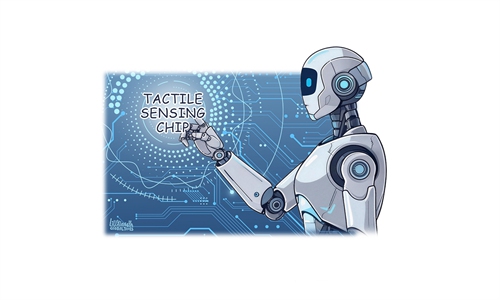
Illustration: Liu Rui/GT
Is China's robot boom a bubble, or evidence of genuine commercial momentum? While some foreign media outlets look for answers in robot expos and corporate IPOs, they may be overlooking a more practical test: eldercare. The sector could prove to be an important testing ground for bringing robots into everyday use in China.
With the approach of the Double Ninth Festival, a traditional Chinese occasion for honoring older people, eldercare has once again drawn attention. Recent media reports have highlighted a range of innovations, from ultra-portable "invisible" robots to toilet robots that can be operated at the touch of a button and automatically dispose of waste. Such devices are already finding applications in some eldercare settings, making daily care more convenient for older people.
Eldercare offers a glimpse of how advances in robotics are being translated into practical products for specific needs. A growing range of devices is designed to assist with tasks such as massage, moxibustion, rehabilitation and companionship. While many are not humanoid robots, some already demonstrate sophisticated capabilities in specialized applications, including holding conversations with older people.
Skepticism has long hung over China's robotics industry. Some foreign media outlets warn that the country's robot boom could develop into a bubble rather than generate genuine commercial value. Yet such concerns are misplaced. Rising robot adoption in eldercare shows the sector is making strides in real world, everyday use.
China has three advantages in developing its robotics industry. First is scale. As of the end of 2025, China had 323.38 million people aged 60 and above. This rapidly growing demand for eldercare creates significant market opportunities, paving the way for promising commercial prospects. Additionally, this vast demographic provides robots with real-world operating environments and a wealth of feedback data.
Second is the supply chain. China has developed an efficient robotics manufacturing ecosystem. From motors and sensors to complete system integration, a robust local supply chain helps contain costs and accelerates manufacturing iteration, an essential step toward commercialization.
Third is a supportive start-up environment. A wave of robotics start-ups is emerging across China, quickly translating technology into practical industrial products, bringing them to market, and refining them based on user feedback. While many current offerings are not advanced humanoid robots, the expertise gained from these specialized applications may ultimately contribute to advancements in humanoid robotics.
These factors provide opportunities for development within China's eldercare industry. Current progress indicates that commercialization is being built on a solid practical foundation. In this sector, robotics technology is gradually accumulating, driving continuous industrial growth.
This is a fast-moving industry, and concerns about bubble risks are unfounded. However, this does not imply that humanoid robots will take on a substantial share of caregiving in the short term. Future development depends on various factors. Nevertheless, the growth trajectory remains positive, and steady progress is anticipated.
The eldercare sector is just one lens through which to observe the evolution of China's robotics industry. In reality, robots have already penetrated numerous sectors across the country, encompassing both manufacturing and services. In these areas, the potential for commercialization is steadily expanding alongside rapid technological advancements.
These sectors, including but not limited to eldercare, provide an intuitive perspective for assessing the tangible progress of robotics in China and its interactions with consumers. Such interactions arise from genuine market supply and demand. This real market dynamic enables China's robotics industry to continuously recalibrate its positioning, avoid bubbles, and achieve sustainable growth.
The author is a reporter with the Global Times. bizopinion@globaltimes.com.cn
RELATED ARTICLES