Illustration: Xia Qing/GT
A report released by the China Software Testing Center (CSTC), cited by CCTV News on Tuesday, pointed to two developments worth noting. One is that China's eldercare robotics market is expected to surpass 10 billion yuan ($1.47 billion) in 2026. The other is that the sector is moving from technical validation toward wider commercial application. Taken together, those assessments reflect views within the industry about the direction of development.In recent months, some Western media outlets have raised the question of whether China is experiencing a "robot bubble." Part of the answer may be found in eldercare robotics. The developments taking place in this sector offer a useful micro-level perspective on how China's robotics industry is evolving in practice.
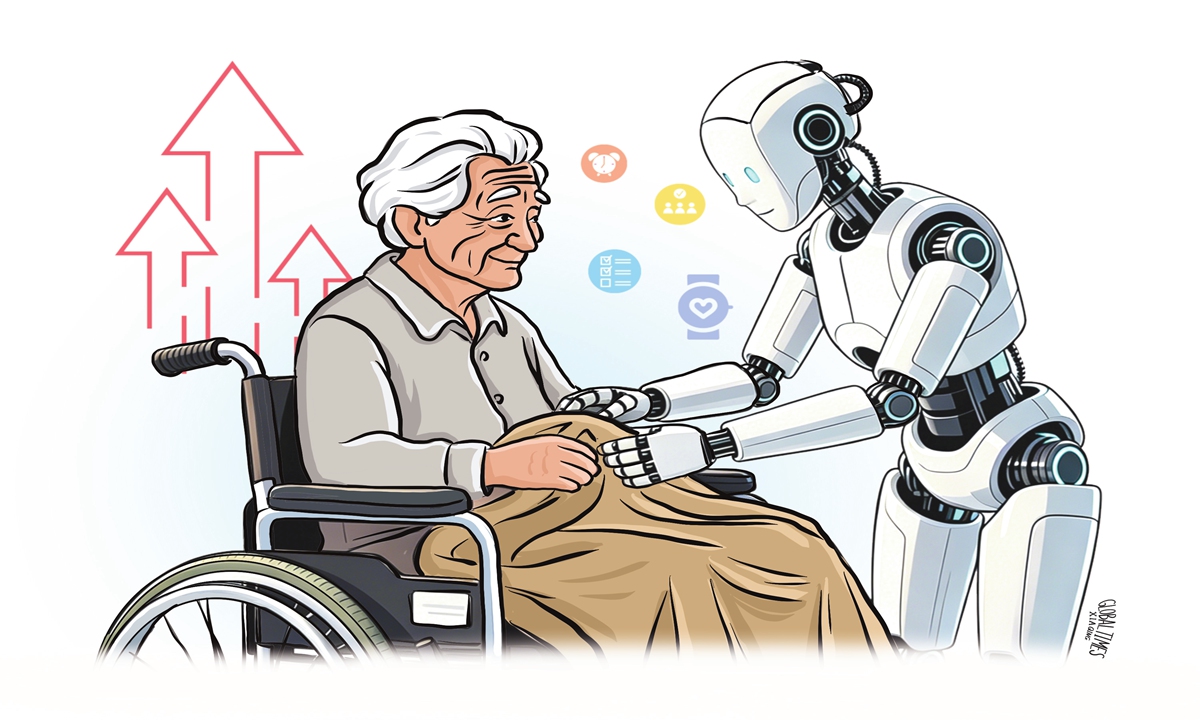
In many respects, the eldercare robotics sector points to one of the frontiers of the broader robotics industry, including humanoid robotics. Eldercare is widely seen as an area where demand for robotics applications could be relatively strong, spanning emotional companionship, medical support and daily caregiving assistance. The possibility that humanoid robots may eventually take on part of the work currently performed by human caregivers has increasingly become part of the industry's vision of the future.
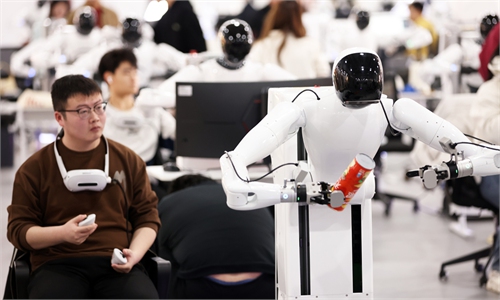
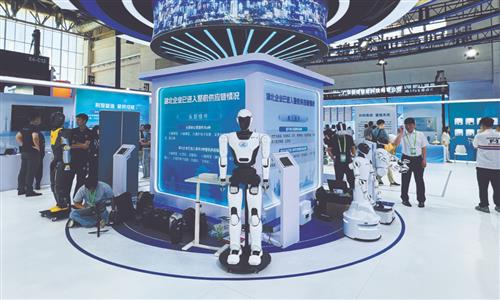
Recent industry developments suggest that advances in robotic intelligence are progressing quickly. On Monday and Tuesday, a senior care robotics competition, co-hosted by the CSTC, was held in Langfang, North China's Hebei Province. The robots on display demonstrated a wide range of functions: some could help elderly people stand up and walk, while others simulated bathing assistance. They could also deliver items, conduct patrols, answer health-related questions, and provide companionship and interaction.
Smart technologies designed to meet the needs of eldercare are steadily becoming a reality. The more capable robots become, and the more tasks they can perform safely and reliably, the stronger demand for eldercare robotics is likely to grow. In this field, technological progress and market potential appear to evolve largely in parallel. Each advance in technology tends to widen the scope for adoption.
One factor that may be easy for some foreign observers to overlook is the scale of China's domestic market. According to data from the National Bureau of Statistics, China's population aged 60 and above had reached 323.38 million as of end-2025. That demographic scale could carry important implications for eldercare robotics. Even relatively modest technological advances, when multiplied across such a large population base, may be enough to unlock substantial new demand.
The projected 10 billion yuan market may appear substantial in its own right. Yet viewed against the backdrop of China's aging population and the scale of demand associated with it, it also suggests considerable room for further expansion as the technology evolves.
Growth in demand is likely to be a continuing process, and that demand is already beginning to emerge in tangible ways. Eldercare institutions in China are accelerating the adoption of smart care technologies. From daily assistance and safety monitoring to rehabilitation support, eldercare robots are gradually moving beyond pilot programs and into broader practical use.
According to a March report by CCTV News, a smart eldercare robot service station in Beijing E-Town has already realized fully intelligent dining operations in its kitchen and dining areas. In the rehabilitation zone, massage and moxibustion robots provide professional therapy services, exoskeleton robots assist with scientific rehabilitation training, while chess-playing and tea-making robots add enjoyment to seniors' leisure time.
Media reports indicate that in nursing homes across Shenzhen, Chengdu, Wuxi, and some other cities, robotic caregivers can patrol rooms 24 hours a day, accurately identify risks such as falls or prolonged bed absences, and immediately alert medical staff.
For observers who question whether China's robots are capable of little more than attention-grabbing performances, while lacking sufficiently practical application scenarios, eldercare robotics offers a compelling answer. The developments taking place in this sector provide a window into the broader robotics industry. If the question is whether China has a "robot bubble," the answer is "no."
The industry's momentum is being underpinned by continued technological advances, the scale of China's domestic market, an expanding range of practical applications and considerable room for growth. In that sense, China's robotics industry is underpinned by more durable foundations than some skepticism suggests, while continuing to create opportunities for both domestic and international companies.
The author is a reporter with the Global Times. bizopinion@globaltimes.com.cn
RELATED ARTICLES