BMW starts 6G battery production in China as European automakers deepen industrial ties
By Ma Tong and Published: Oct 15, 2026 10:53 PM

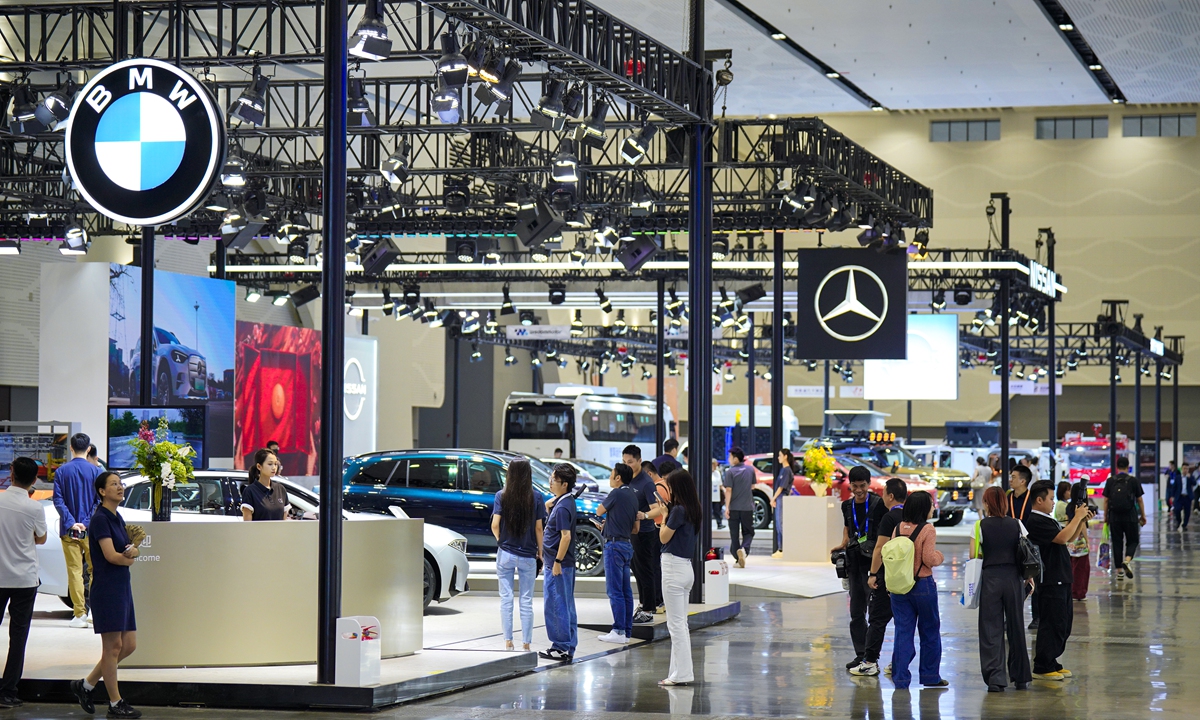
BMW's exhibition booth at the 2026 World New Energy Vehicle Congress in Haikou, South China's Hainan Province, on September 22, 2026 Photo: VCG
German automaker BMW on Thursday began mass production of its sixth-generation high-voltage batteries at its 10-billion-yuan ($1.4 billion) facility in Shenyang, Northeast China's Liaoning Province, marking another major step in European carmakers' growing efforts to deepen ties to the Chinese market.
The Shenyang facility is BMW's third manufacturing location for its latest-generation batteries worldwide, following plants in Hungary and Germany. The locally produced batteries will power future Neue Klasse models built in China, helping shorten transport routes and ensure an efficient and resilient supply chain, according to a BMW statement.
BMW Chairperson Milan Nedeljković said at the launch that China had become "a key pillar of our global innovation network," where the German automaker develops, tests and industrializes new technologies.
"In many key aspects, China sets the pace: it adds scale, speed and advanced technology. The capabilities we develop here strengthen our competitiveness worldwide," he said, according to the text of a speech provided to the Global Times.
The latest move reflects BMW's continued confidence in the Chinese market and its strategy of expanding local battery production to support its EV manufacturing operations in China, Li Guanjie, a research fellow with the Shanghai Academy of Global Governance and Area Studies at Shanghai International Studies University, told the Global Times.
For BMW, producing batteries in China is a practical choice given the country's large consumer market and well-established automotive manufacturing base, Li said, adding that the move also underscores the importance of China in BMW's global production network and its long-term commitment to the market.
BMW's move comes as European automakers face mounting pressure to accelerate electrification and improve competitiveness, prompting deeper cooperation with Chinese technology companies.
Volkswagen is also expanding its localization strategy, with more than 3,000 employees developing next-generation technologies at its research center in Hefei, East China's Anhui Province, the Global Times learned from the company.
"China is not only a market for Volkswagen. China is increasingly becoming a source of global competitiveness," the company said, describing its evolving strategy as a shift from "In China, for China" to "In China, beyond China."
The trend extends beyond German automakers. Stellantis, the European group behind brands including Peugeot, Fiat and Opel, is also reportedly deepening cooperation with Chinese EV maker Leapmotor, including plans for a jointly developed electric sport utility vehicle for its Opel brand.
Such moves highlight how China's mature EV industrial ecosystem, competitive manufacturing costs and innovation capabilities are becoming increasingly important to European automakers seeking to navigate the global electrification transition, industry analysts said.
European carmakers' increasingly close ties to China mean that EU trade restrictions on China-made EVs could also affect European automakers, and further protectionist measures could therefore hurt European companies' own interests, Li said.
China and the EU recently reached an understanding on hybrid vehicle trade and agreed to continue procedures related to price undertakings and reviews in the EU's anti-subsidy case involving Chinese EVs. China's Ministry of Commerce said that the understandings had helped prevent an escalation of trade frictions and provided a "stable, predictable and sustainable" environment for bilateral trade and investment.
According to data released by the Ministry of Commerce on Thursday, China's foreign direct investment equity stock rose for the sixth consecutive year in 2025, ranking second globally. The ministry said that China's vast market offers foreign businesses opportunities to generate tangible returns.
RELATED ARTICLES