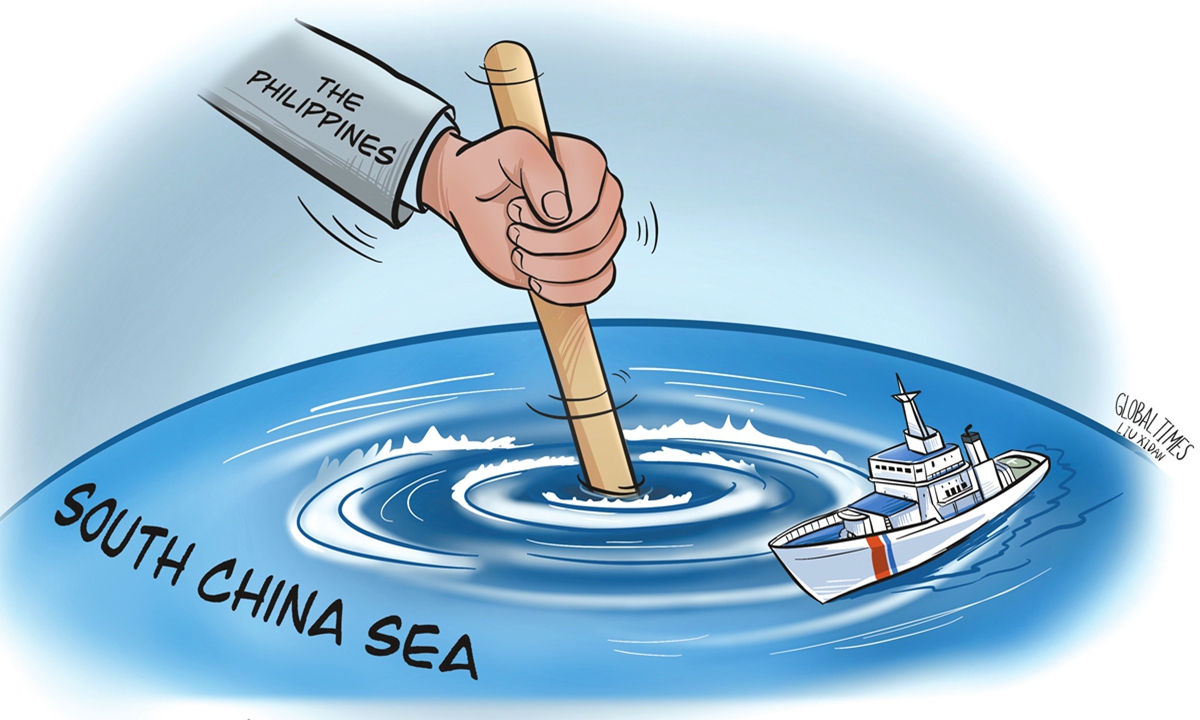
Philippines South China Sea Illustration: Liu Xidan/Global Times
Recent remarks by Chinese Ambassador Jing Quan have been portrayed in Manila as a threat. In fact, they restate a consistent Chinese position: firm defense of territorial sovereignty and maritime rights, together with a preference for peace, restraint and managing differences through direct dialogue.
In the South China Sea, China will not use its size to bully the small, nor allow the Philippines to use its smallness to blackmail the strong.
China’s approach to territorial and maritime disputes has remained stable for decades. It safeguards its territorial sovereignty and maritime rights while consistently advocating peaceful settlement through bilateral negotiation and consultation. This principle applies not only to the South China Sea but also to other territorial and maritime questions involving its neighbors.
The disputes between China and the Philippines have a long history. China maintains that they stem primarily from the Philippines’ occupation of eight features in China’s Nansha Islands beginning in the 1970s and its subsequent claim over Huangyan Island. Overlapping maritime claims also emerged as the international law of the sea developed. Successive Philippine administrations have repeatedly taken actions that have aggravated tensions, including arrests of fishermen from the Chinese mainland and Taiwan, and the unilateral initiation of the South China Sea arbitration case, which China opposed as contrary to prior bilateral understandings and the principle of state consent.
China regards its responses to infringement and provocation as legitimate measures to defend its rights. The equality of states under the United Nations Charter and general international law does not give any country a free hand to manufacture incidents at sea. Where a state has illegally occupied another state’s territory, the latter retains, in principle, the right of self-defense. China has exercised considerable restraint, prioritizing regional stability and preserving space for dialogue. That restraint should not be mistaken for the absence of limits.
The disparity in national strength, particularly maritime capabilities, between China and the Philippines is an objective fact. Manila cannot expect its repeated provocations, public smearing, and the suspension of military communication channels to be met indefinitely with silence. China has treated the Philippines as an equal neighbor, but restraint is not unlimited.
Effective management of maritime differences depends substantially on whether the Philippine government can restrain its military and coast guard. Persistent difficulties in bilateral relations serve neither country’s interests and are particularly damaging to the Philippines’ development. Regional countries should jointly safeguard the region’s hard-won peace and development.
Whenever the two sides have moved toward dialogue, certain forces within the Philippines, particularly its military and coast guard, have manufactured incidents to disrupt progress.
These forces appear driven less by public welfare than by external powers’ preferences and their own political or institutional interests. If Manila calls for dialogue while allowing these forces to create friction and stoke anti-China sentiment, bilateral communication mechanisms will struggle to function.
China and the Philippines are permanent neighbors. Maritime disputes do not change this geographic reality. External military equipment and joint military exercises cannot reverse the regional balance of power. Nor can repeated invocations of a “China threat” narrative resolve the Philippines’ domestic development challenges. Manila may believe that militarization and maritime incidents demonstrate its value as a “frontline platform” for the US and other Western countries, securing stronger security guarantees and economic benefits. Such expectations overlook external powers’ independent strategic calculations. External powers may provide equipment and diplomatic backing while using the Philippines’ geographic location to strengthen their military posture. Their support does not guarantee a willingness to bear the costs of escalation. If a crisis spirals out of control, distant powers can reduce their involvement, leaving the Philippines to face the consequences. History offers repeated warnings about tying national security to another country’s strategic agenda. Manila should weigh that risk carefully.
China-Philippines relations stand at a crossroads. Continued tolerance of maritime provocations will invite bolder moves and further damage bilateral ties. The immediate priority for the Marcos government should be to restrain adventurist impulses within its military and coast guard, halt provocations and information operations directed against China, and return to bilateral dialogue and consultation. Only sustained dialogue, supported by restraint and consistent action, can manage differences and stabilize ties.
The author is director of the Research Center for International and Regional Studies at the National Institute for South China Sea Studies. opinion@globaltimes.com.cn
