COMMENTS / EXPERT ASSESSMENT
China's dynamic adjustments to its tech export management in step with shifting global trends

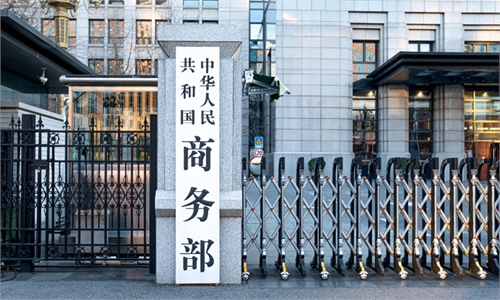
AI photo: VCG
China's Ministry of Commerce (MOFCOM) on Friday issued a notice seeking public comments on draft adjustments to its Catalogue of Technologies Prohibited and Restricted from Export, adding a total of 40 technologies in artificial intelligence (AI), biomedicine and photovoltaic (PV) solar systems to the list. Notably, the notice also requires that, from the date of publication until the date of formal revision and implementation, technology export operators shall complete pre-export registration before exporting the newly added technologies. All sectors of society, especially the industrial and commercial circles, may put forward opinions on the scope of newly added technologies.
This is an important step in line with common international experience and China's domestic laws and regulations regarding foreign trade and tech export management. Formulating and continuously adjusting and improving the catalogue is aimed at regulating the order of technology exports and safeguarding the country's economic and technological rights and interests.
Currently, emerging technologies are developing at a rapid pace in China. The World Intellectual Property Organization's reports showed that China has become the world's largest holder of AI patents, accounting for 60 percent of the global total. In biopharmaceuticals, China is moving from a "follower" to a "frontrunner" in the race - the year 2025 saw over $130 billion in outbound licensing deals for Chinese innovative drugs, with China's new drug R&D pipeline ranking second globally at roughly 30 percent. China also leads in PV production and R&D, with some technologies already applied in aerospace and other sensitive fields, making improved management and control measures necessary.
Countries worldwide adopt different approaches to managing technologies critical to their domestic economic and social development. Countries and regions such as the US, the EU, Japan and the UK use export controls on advanced technology exports. For example, South Korea formulated various laws on export controls on advanced technology, under which it has adopted and dynamically updates a core technology list and a strategic technology list, which require prior declaration and approval for exports and related foreign acquisitions of listed technologies.
China's approach is consistent with these common international practices and with WTO rules, and rests on long-standing domestic practices. Routine, lawful adjustment of the catalogue has become an important part of China's technology export administration.
As China's technological advancement accelerates, the international environment for tech cooperation and competition grows more complex. Certain countries have continuously introduced measures that both constrain China's R&D capacity and impose direct or indirect forced technology transfer.
In August 2023, the US issued an executive order establishing prohibitions or restrictions on investments in China's semiconductor, quantum information and AI sectors. Affected by this mechanism, some US funds have required their Chinese portfolio companies to relocate entirely out of China. For example, a leading Chinese AI video generation company deregistered its Shenzhen entity and moved its entire team and technology to the US.
Similar tactics targeting China's technological edges have appeared in biopharmaceuticals just like in the AI area, prompting some Chinese firms to transfer core assets or undervalue overseas rights. In December 2025, the US enacted the so-called Comprehensive Outbound Investment National Security Act, elevating US outbound investment restrictions from the executive order to statute and expanding covered sectors to include biotechnology. The US' BIOSECURE Act was also passed by the US Congress - putting more pressure on Chinese tech firms.
Additionally, high tariffs, stringent foreign investment security reviews, direct or indirect expropriation risks, and forced technology transfer requirements in certain countries' legislation could push Chinese firms to transfer frontier technologies abroad against commercial logic.
China's revised catalogue balances security with high-level opening-up. Dynamicaly updating of the catalogue helps Chinese firms and investors protect intellectual property, counter forced-transfer pressure and conduct orderly overseas expansion. The revisions are based on extensive research and fully account for enterprises' need for mutually beneficial international technology cooperation. Balancing openness and security while expanding high-level opening-up is a fundamental national policy.
China continues to encourage an open-source AI innovation ecosystem. Technologies already in the public domain through open-source release or academic publication are excluded from control.
For restricted AI technologies, automatic licensing and other facilitation measures apply to exports through open source, overseas self-built and self-operated computing centers, overseas chip tape-out, joint R&D using overseas resources, and participation in international standard-setting - essentially achieving "report and export." In biomedicine, the regulatory focus is on transfers of technology ownership. Outbound licensing models that retain domestic ownership are not within the prohibited category; for restricted technologies, facilitation measures also apply to outbound licensing.
Enterprises and industry associations are encouraged to provide feedback during the consultation period and subsequent implementation so that the regime can continue to be refined, remaining efficient and supportive of further opening-up.
The author is a professor at the University of International Business and Economics and an arbitrator at the China International Economic and Trade Arbitration Commission.
RELATED ARTICLES