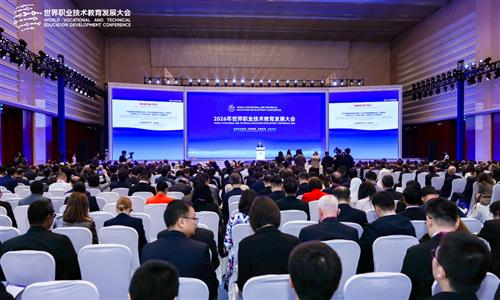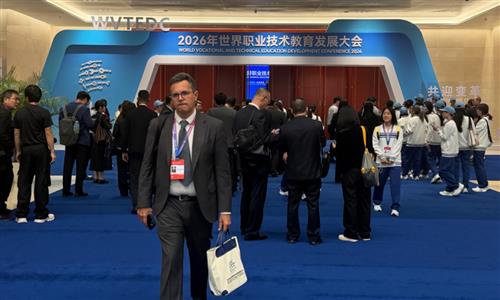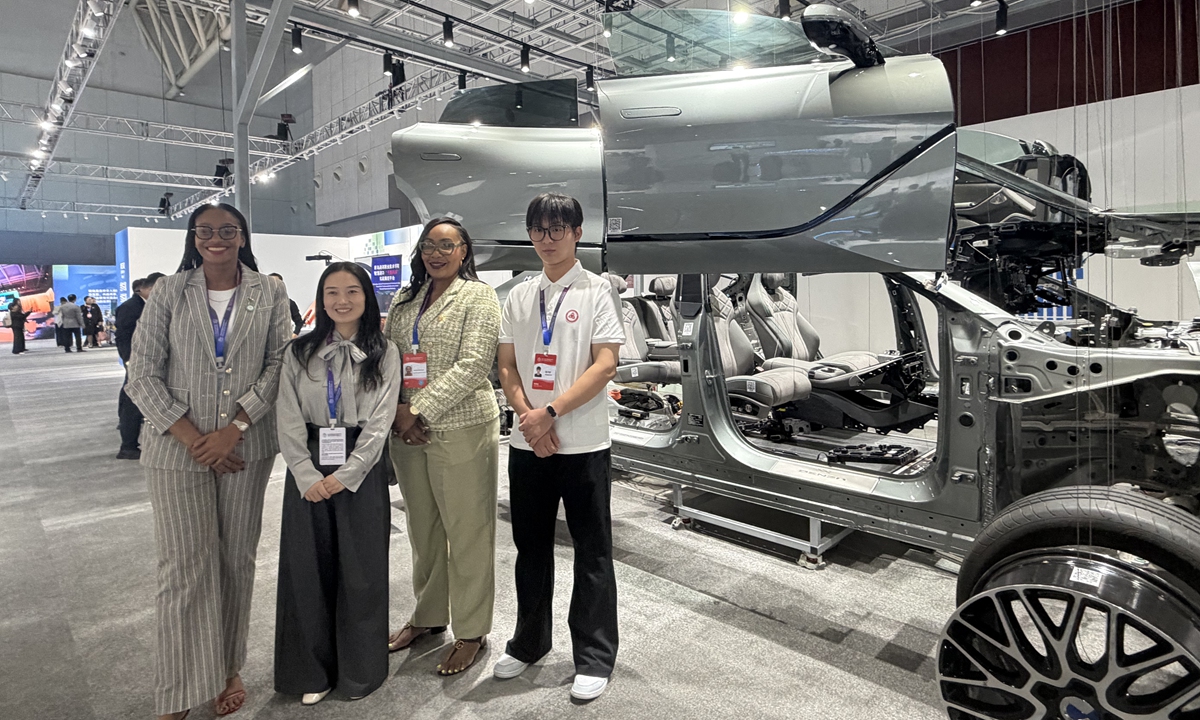
A disassembled BYD Denza Z9GT plug-in hybrid car is on display at the exhibition area of the 2026 World Vocational and Technical Education Development Conference in North China's Tianjin Municipality on October 16, 2026. Photo: Zhang Weilan/GT
A disassembled BYD Denza Z9GT plug-in hybrid car has become one of the most popular exhibits at the exhibition hall of the 2026 World Vocational and Technical Education Development Conference held in North China's Tianjin Municipality. The display drew crowds of Chinese and foreign delegates to the booth, where a Jamaican delegate spoke highly of it, spending more than 15 minutes listening attentively to the staff's explanation.
According to the staff member, the vehicle was professionally dismantled by the company for hands-on teaching at Shenzhen Polytechnic University in South China's Guangdong Province. Each component of the vehicle comes with a QR code, which visitors can scan to view 3D models of the components and detailed information, enabling digital interactive learning.
Wang Weijie, a student at Shenzhen Polytechnic University, told the Global Times on Friday that those students use the car in class. Compared with traditional PPT presentations or single-engine demonstrations, the fully disassembled vehicle gives students a comprehensive view of the car's internal structure and helps them identify components such as the engine, battery and wheel hubs and understand their positions through hands-on learning.
Wang said the display is not merely a teaching tool, but a new model of vocational education that targets future industries, future technologies and future scenarios.
"China's vocational education and China's technology are truly impressive," Nahema Daniels Heath, an official at Jamaica's Ministry of Education, Skills, Youth and Information, told the Global Times.
"I am beginning to feel overwhelmed by the vastness of the technology that is so advanced here in China. I truly believe it is second to none," the Jamaican official said. "I would love for us to have this kind of system established in Jamaica."
Speaking on China's robotics and artificial intelligence sectors, the official described them as "top-tier and among the best in the world," adding that Jamaica hopes to reach that level through bilateral cooperation mechanisms.
Regarding people-to-people and institutional exchanges, she said Jamaica is open to building a stronger partnership with China, and hopes to send not only more students but also instructors to China for exchange programs. "In this way, we can ensure that we are training people not only for the present, but also for the future," she said.
The booth is a key component of the conference exhibition, which runs from Thursday to Saturday.
Meanwhile, a Bruneian delegate visiting the exhibition hall also spoke highly of China's industry-education-research model.
He noted that China has perfectly integrated the industrial chain with teaching, continuously supplying talent to the industry, "and this is exactly what Brunei needs to learn," Azrul Melda Abu Bakar, a representative from Brunei Darussalam's Ministry of Education, told the Global Times.
ANM Ehsanul Hoque Milon, Bangladesh's education minister, told the Global Times on the sidelines of the conference's closing ceremony that this is an important time for Bangladesh to deepen and expand vocational and technical education cooperation with China, and that the Tianjin conference has offered great opportunities.
Milon said China, with its cutting-edge technologies and rich talent resources, is well positioned to help Bangladesh keep pace with global technology trends. He added that China and Bangladesh could begin with joint university research and align cooperation with industrial needs to support mutually beneficial development.
RELATED ARTICLES