China's space station marks new ‘harvest season,’ aims to grow two generations of rice in orbit for first time
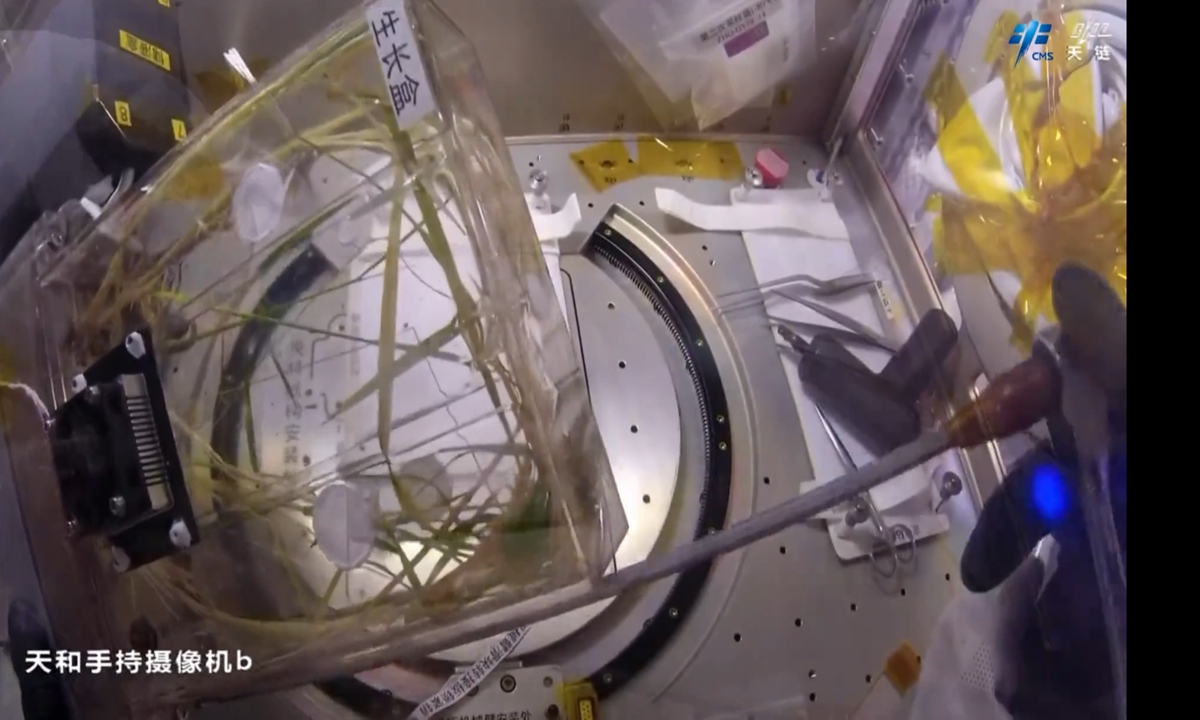
Picture of China's space station rice experiment. Photo: China Central Television
China's space station has welcomed a new "autumn harvest," with astronauts collecting, sowing and storing a new batch of rice experiment samples last week, marking further progress in research on rice cultivation in space, CCTV News reported on Sunday.
The research project, which focuses on the molecular mechanisms regulating multigenerational genetic stability and environmental adaptability of rice in space, is progressing smoothly, according to the media report.
The latest experiment is expected to grow two generations of rice in orbit for the first time, helping researchers understand the mechanisms through which prolonged exposure to microgravity affects the genetic stability of rice.
In addition to the rice experiment, the astronauts conducted touch-interaction tests with Xiaohang, their robotic companion aboard the space station. The tests collected data on the robot's movements in response to different types of physical contact, providing data to improve its motion planning for future operations in orbit.
The crew also completed assessments of emergency decision-making capabilities and tests of their emotional states in orbit. The data collected will be used to investigate how astronauts' emergency decision-making abilities and emotional states change during long-duration space missions.
As part of a research project on musculoskeletal loading during exercise, the astronauts measured Achilles tendon stiffness, conducted biomechanical tests of the lower limbs, and assessed muscle and tendon characteristics.
By collecting plantar pressure, joint kinematics data and exercise images during running and resistance exercises under different loading conditions in orbit, researchers aim to establish relationships between these data and muscle parameters, while identifying changes in muscle-tendon interactions.
In another experiment examining changes in muscle groups, the astronauts used force-measuring equipment to conduct grip strength tests and ultrasound diagnostic equipment to examine important antigravity muscles, including the soleus, collecting relevant data.
The crew also completed sample replacements in the experimental chamber of the containerless materials processing cabinet and maintenance of electrodes in its axial mechanism, in accordance with the experimental schedule.
Last week, the three astronauts completed scheduled in-orbit medical rescue training, reinforcing their understanding of rescue procedures including how to apply force in a microgravity environment, according to the CCTV report.
They also completed a full-system pressure emergency drill, simulating the entire emergency response process in the event of a loss of pressure inside the space station. The exercise helped strengthen the crew's emergency response capabilities and coordination between the space station and ground teams.
Routine maintenance of the space station platform and crew health management also continued. The astronauts maintained equipment in the regenerative life-support system, cleaned the cabin environment and exercised according to schedule to maintain their physical and mental well-being.
China's national space laboratory is expected to yield more scientific research achievements as experiments continue aboard the space station.
Global Times
RELATED ARTICLES