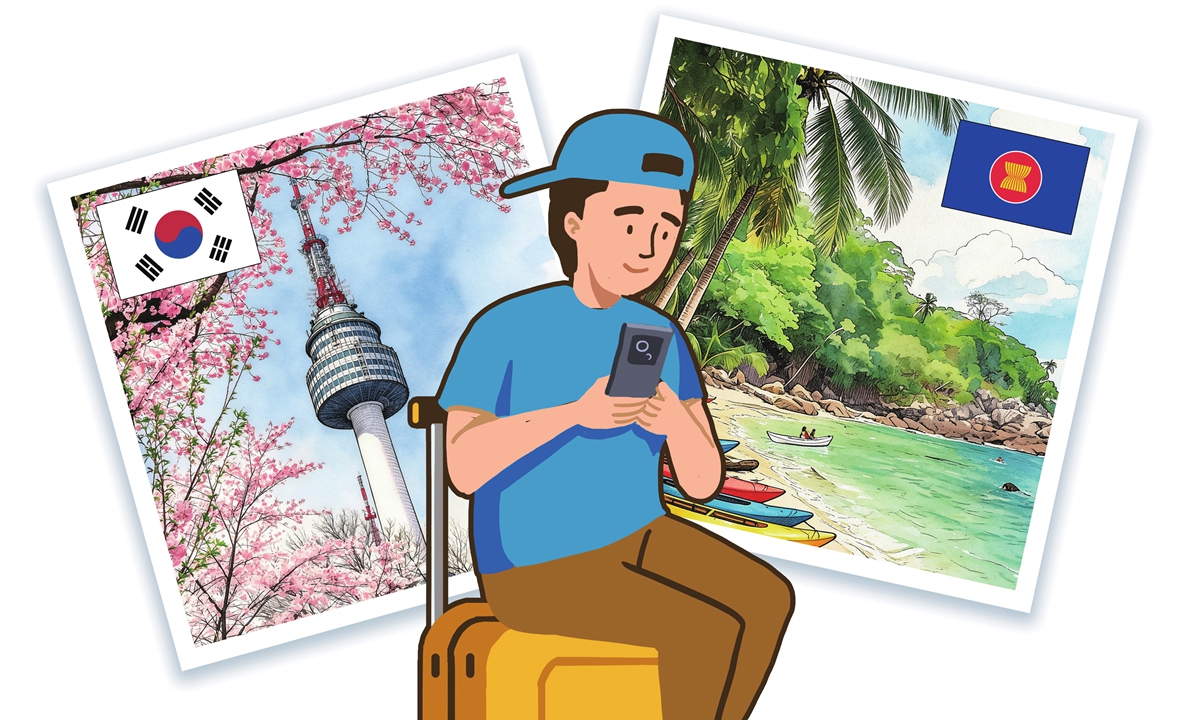
South Korea travel Illustration: Liu Rui/Global Times
Direct flight between Daegu in South Korea and Southwest China's Yunnan Province, operated by China's Lucky Air, was launched on Thursday and will run through October 15 next year, the Yonhap News Agency reported on Friday, noting that the Daegu city government plans to provide administrative and financial support in order to make the route a regular service.
Modest as the service is, the direction is telling. Taking the launch of the direct flight as an opportunity, Daegu aspires to attract more Chinese visitors, including from Southwest China, according to Yonhap.
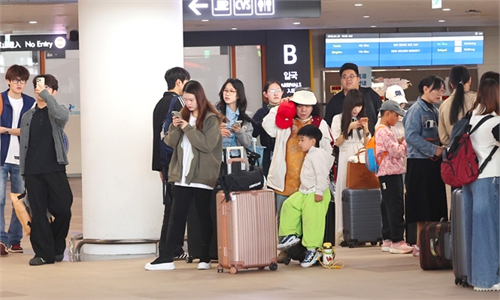
The Daegu city government said on Friday that it invited a group of eight people, including journalists from major media organizations in Yunnan Province and local travel influencers, to take part in a six-day inspection tour that began on October 10.
The tourists visited multiple attractions, taking in the city's rich offerings in history, culture and cuisine. They also traveled to Gyeongju and Busan to examine a southeastern tourism route centered on the Daegu airport that links nearby cities.
A city-level road show like this may look routine, yet it points to a shift in where South Korea is looking for its next visitors.
For South Korea, the timing is favorable. China is on track to reclaim its position as the world's largest outbound travel market, with spending forecast to surge by 22.5 percent to nearly $280 billion in 2026, surpassing the US, according to a report released by the World Travel and Tourism Council in June.
Another recent industry report showed that although first- and second-tier Chinese cities are the main sources of outbound travelers, the fastest growth comes from smaller cities. In places such as Tongchuan in Northwest China's Shaanxi Province and Yingtan in East China's Jiangxi Province - each with fewer than 500,000 residents - outbound trips doubled in the first eight months of this year. The base is small, yet it points clearly towhere the next increment is coming from.
Yet potential demand is not bookings, and here the picture may be more complicated. For a traveler in Yunnan, South Korea is one option among several, and not the nearest.
Meanwhile, Southeast Asia's advantages, from shorter flights and lower costs to mature resorts and widening visa-free access, are hard to match. Industry data showed that six Southeast Asian countries received close to 15 million Chinese visitors in the first eight months of this year, notching approximately double-digit growth.
None of this makes the Daegu-Kunming bet misplaced, but it does suggest that convenience alone may not be enough. That points to three doors worth opening. The first is the visa. South Korea has already taken a step, with the Justice Ministry pledging on July 1 that it will extend a waiver of visa application fees for group tourists from six countries including China until December 31, a move aimed at supporting the recovery of inbound tourism. There remains considerable room, however, to make entry easier still. For the smaller-city travelers, simplifying entry could matter more than adding another route.
The second door is convenience. For a first-time traveler, the choice often rests less on attractions than on whether paying, getting around and asking directions will work. Many South Korean visitors to China have said that what struck them most was able to pay with their mobile devices without carrying cash, a convenience that Chinese travelers increasingly expect abroad too.
The third door is distinctiveness. With Gyeongju and Busan within easy reach, Daegu offers a combination of historic resource, coastline and K-culture that a gateway city cannot easily replicate.
Flights are the first condition, not the last. A destination that is merely near may lose to one that feels distinct. For South Korea, the emergence of China's smaller-city travelers presents the dual reality of a wider source market and a more demanding one. Expanding air links and ensuring convenient entry can put those travelers within reach.
Yet the flow runs both ways. South Korean visits to China are rising, and routes opened for tourists can carry students, exhibitors and small businesses - making this more than a tourism story, and an opening for broader bilateral people-to-people exchanges and economic and trade cooperation.
Whether the tourists will come, and whether they will return and visit, could depend less on how many flights are added than on what they will find after they land.
The author is a reporter with the Global Times. bizopinion@globaltimes.com.cn
RELATED ARTICLES