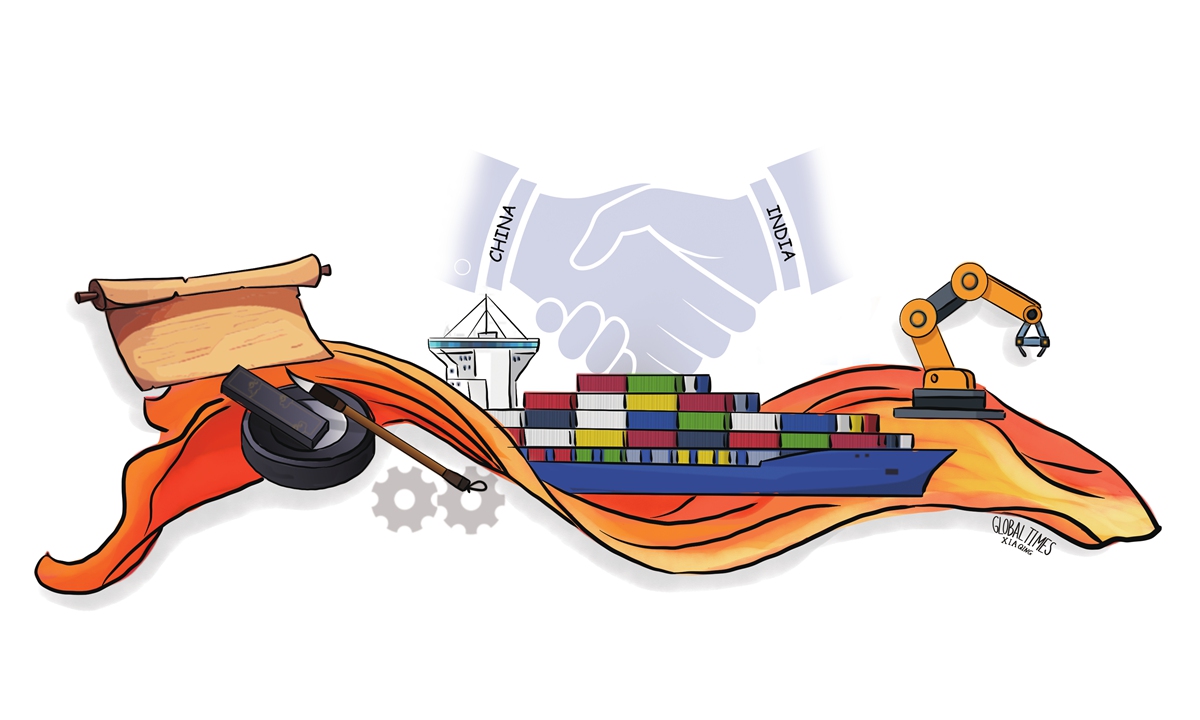
China, India Illustration: Xia Qing/GT
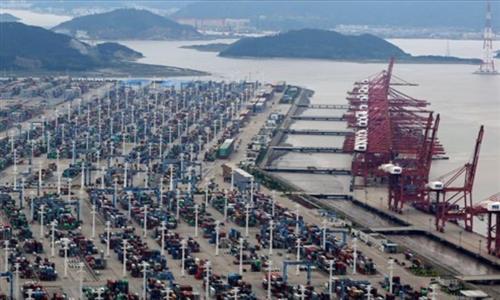
The latest China-India trade figures again thrusts the economic relationship into the media spotlight. India's bilateral trade with China rose nearly 29 percent year-on-year to reach $91.76 billion in the April-September period, making China the largest trading partner of India in the first half of the 2026-27 financial year, according to India's Commerce Ministry.
The rising momentum of China-India trade is a positive development both sides should treasure. Yet behind the impressive numbers, India's anxiety about its trade deficit with China remains clearly visible. Frankly speaking, India's long-running trade deficit with China is a structural phenomenon shaped over the years by the two countries' industrial structures and comparative advantages.
India is by no means short of competitive industries. From its fast-rising electronics assembly capacity to globally recognized pharmaceutical intermediate products, specialty agricultural products and textile goods, India holds a lot of cards that it can use to compete internationally. But having competitive industries is not the same as delivering a surge in exports to China.
For a very long time, the basic pattern of China-India trade saw China ship large volumes of electromechanical equipment, electronic components and industrial intermediates to India, while India exported iron ore, seafood and other resource-based and primary goods to China. This division of labor was the natural outcome of the two countries' different stages of industrialization.
If India wants to gradually ease its trade deficit, the key lies in tapping its own potential and turning its competitive industries into products that the Chinese market demands.
What makes this moment different is that China's ongoing push for high-end, intelligent manufacturing upgrading and continued opening-up of its services sectors have opened unprecedented new window of opportunities for India.
The massive new demand generated across these fields can easily become the core direction for India to cultivate new export growth points to China. Rather than competing for shares in traditional primary product categories, aligning export portfolios with the trajectory of China's industrial upgrade represents a more pragmatic and sustainable path forward.
Signs of progress in this direction are emerging. According to Chinese customs data, China's imports from India surged 40.7 percent year-on-year in the January-September period, far outpacing average trade growth. This clearly shows that India's exports to China are gradually finding a direction suited to the Chinese market.
The real question before India is whether it can sustain this round of growth, extend breakthroughs in a few sectors to more industrial tracks, and turn short-term export gains into long-term domestic manufacturing competitiveness.
Some in India simply attribute the trade deficit with China to market access issues, and even go so far as to claim that "non-tariff barriers remain the biggest obstacle" to bilateral trade. But if access to the Chinese market was riddled with barriers to the extent that some claim, how could India's exports to China have grown by more than 40 percent?
Viewed from another perspective, such voices actually reflect a growing awareness across Indian circles of how important the Chinese market is to the future of Indian manufacturing, along with a strong eagerness among Indian exporters to expand their footprint in China.
China's overall level of opening-up has been substantial, and India's high export growth was delivered under the current open trade framework ̵ a fact that speaks far louder than any debate.
Blaming trade deficit entirely on alleged external barriers risks covering up real shortcomings in product competitiveness, channel development, and international standard alignment. This approach does nothing to solve the actual problem, and will only work against the healthy development of bilateral trade relations.
In the long run, there remains ample room to deepen China-India economic cooperation, and the two sides can certainly move forward together on the basis of mutual benefit and reciprocity to make the pie bigger.
The economic relationship between two countries should not be defined by a single deficit figure. Volumes are rising, exports are growing, and the willingness of both sides to expand cooperation is strengthening, which are all encouraging signs. What needs to be done is to let the potential continue to materialize and make mutual benefit and reciprocity the shared guiding principles.
RELATED ARTICLES