SCI-TECH / OTHERS
Heightened vigilance needed in spring and summer 2027 due to super El Nino event
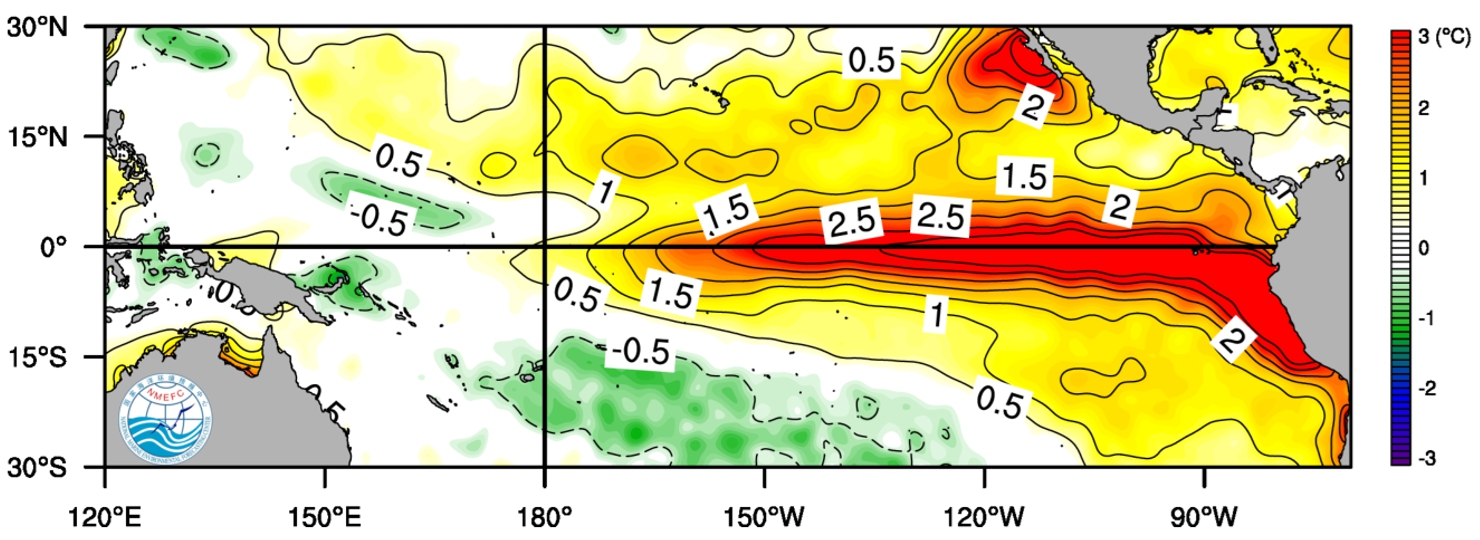
Illustration: Courtesy of Jiang Hua
A potentially record-breaking El Nino event is developing in the tropical Pacific and could bring significant climate and marine ecological risks to China in the spring and summer of 2027.The central and eastern equatorial Pacific entered an El Nino phase in May, with the event strengthening rapidly in the following months, according to the National Marine Environmental Forecasting Center under China's Ministry of Natural Resources.
By September, the sea surface temperature anomaly in the Nino 3.4 region had reached +2.84 C, remaining above the El Nino threshold of +0.5 C for five consecutive months. The Nino 3 region, farther east in the Pacific, recorded an anomaly of +3.64 C, indicating a typical eastern-Pacific El Nino event, according to the center.
The current El Nino event is expected to peak in November or December, with the Nino 3.4 index reaching around +3.5 C and the Nino 3 index exceeding +4 C, making it the strongest El Nino event on record since systematic observations began.
Jiang Hua, the center's chief forecaster for El Nino events, said that the current event that began in May could persist until April or May 2027.
"Based on current model predictions, the Nino 3 index will exceed +4 C," Jiang told the Global Times. "Since relatively complete ocean observation records became available, this would be the strongest event. The second strongest was in 1997-98, when the peak reached +3 C."
El Nino is a natural climate phenomenon characterized by the warming of sea surface temperatures in the central and eastern equatorial Pacific. It typically occurs every two to seven years and lasts about nine to 12 months. Its effects on global temperatures are often most pronounced in the year following its formation.
El Nino events typically reach maturity toward the end of the year, around November and December. After that, it takes some time for oceanic and atmospheric circulation to respond. As a result, the current event's most significant effects on China's climate are expected to occur in the spring and summer of 2027, noted Jiang.
The risks extend beyond weather-related disasters to marine ecosystems and fisheries, he noted.
Persistently high sea temperatures can reduce the amount of dissolved oxygen in seawater, placing stress on the respiration of marine species such as fish, shrimp, crabs and shellfish. Marine larvae are particularly vulnerable to the combination of high temperatures and low oxygen levels, while temperature fluctuations can alter the distribution of fish populations and cause heat-sensitive species to die.
The effects are already emerging in fishing grounds off the eastern Pacific coast, particularly near Peru and Ecuador, where marine ecosystems respond relatively quickly to El Nino conditions. In China's coastal waters, the negative effects on fisheries and marine aquaculture may emerge later and become more pronounced in 2027, Jiang said.
"El Nino can trigger various types of natural disasters, including marine, geological, ecological, meteorological and cryospheric hazards," said Jiang. "People have traditionally paid more attention to weather-related disasters, while other types have received less attention."
"It is important to recognize that marine, geological, ecological and cryospheric hazards also pose risks, not just meteorological disasters," Jiang argued.
Jiang advised the public to stay informed about changes in oceanic and atmospheric conditions, follow forecasts and take preventive measures in advance. As climate conditions vary by region, some areas may face flooding while others experience drought, making it essential to prepare for both risks.
He also urged the marine aquaculture and fishing industries to closely monitor changes in marine conditions ahead of the spring and summer of 2027 and factor in the potential effects of El Nino on marine ecosystems, aquaculture and fishery resources.
RELATED ARTICLES