Researchers identify world’s 1st known juvenile fossil of Huphsuchus dating back around 247 mln years in C. China’s Hubei
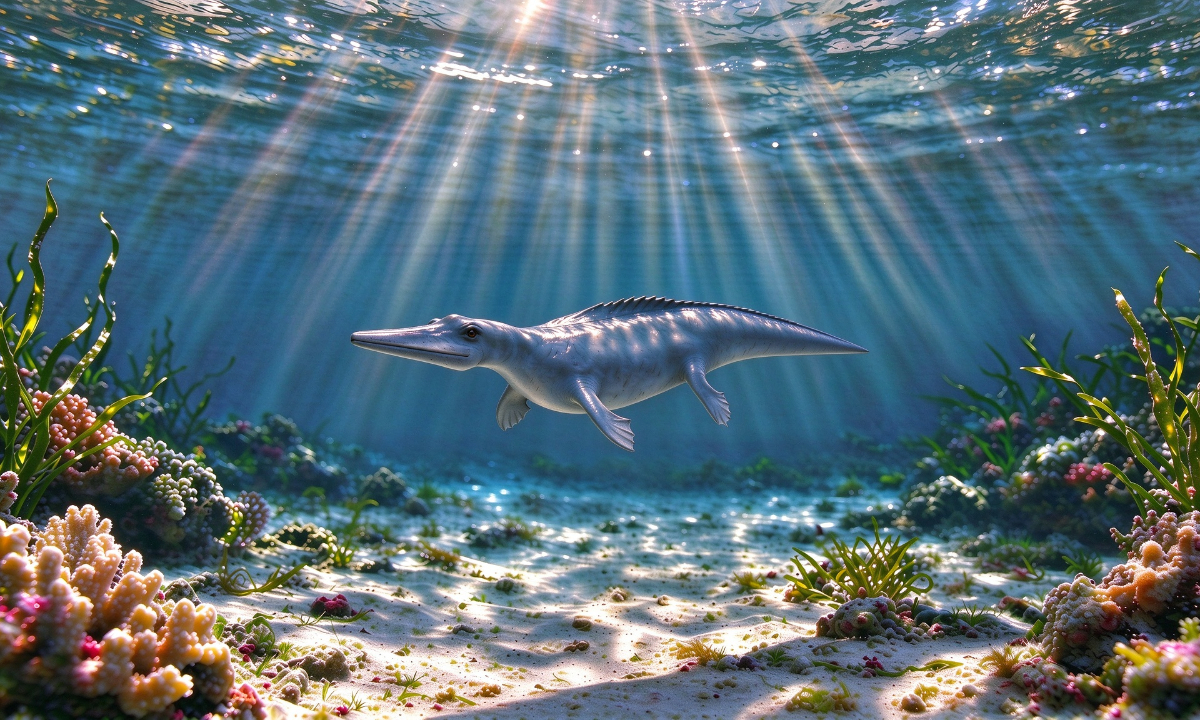
Reconstruction of a juvenile Huphsuchus in its natural habitat Photo: Courtesy of Hubei Institute of Geosciences
An international collaborative study has recently confirmed the world’s first juvenile fossil of Huphsuchus, an extinct genus of small marine reptiles dating back approximately 247 million years, discovered in Yuan’an county, Central China’s Hubei Province, the Global Times learned from the Hubei Institute of Geosciences, Hubei Geological Bureau, on Sunday.
The research has been published in the Zoological Journal of the Linnean Society. Wang Yinuo of Peking University, and Zou Yarui, a senior engineer from the Hubei Institute of Geosciences, Hubei Geological Bureau, are the paper’s co-first authors.
Researched and named in 1972 by Chinese paleontologist Yang Zhongjian, Huphsuchus was a prehistoric marine reptile that lived in shallow marine waters during the Early Triassic, approximately 247 million years ago. The genus represents one of the early evolutionary branches of reptiles that diversified into marine environments following the end-Permian mass extinction.
More than 50 years of research has found Huphsuchus fossils only near the border of Yuan’an and Nanzhang counties in Hubei. However, as nearly all known specimens are adults, some researchers have suggested that its juveniles may be the same species as Nanchangosaurus, fossils of which were discovered in the same geological strata in the area and first reported in 1959.
In 2023, the Hubei Institute of Geosciences began ecological restoration and emergency fossil excavations at Yinggou Quarry, a major marine reptile fossil site in Yuan’an county. During quarry slope clearance, researchers discovered a partially preserved fossil skeleton, designated YGM17-1, in the fossil-bearing layer numbered 17. After careful restoration and examination, researchers confirmed that the specimen belonged to a juvenile Huphsuchus, rather than Nanchangosaurus or other marine reptiles.
According to Zou, the research team conducted detailed morphological and comparative anatomical studies of the specimen, confirming that it was distinct from Nanchangosaurus and exhibited the characteristic features of Huphsuchus, including 10 cervical vertebrae and 26 to 28 dorsal vertebrae.
The fossil specimen also exhibits key characteristics of juvenile ichthyosaur reptiles, including short forelimbs, incomplete ossification of the humerus and ribs, and unossified wrist bones.
After comparing 20 previously reported fossils and conducting morphological and statistical analyses, the researchers found that despite similarities in skull features and vertebral counts, Huphsuchus and Nanchangosaurus differ significantly in several key traits.
According to Li Jiangli, head of the joint research team and director of the paleontology center at the Hubei Institute of Geosciences, Yuan’an county hosts a globally rare assemblage of Early Triassic marine reptile fossils, with abundant, exceptionally well-preserved Huphsuchus specimens of significant scientific value.
The Yuan’an fauna, together with four other fossil assemblages spanning the Early to Late Triassic, forms a rare, nearly complete evolutionary sequence of Triassic marine reptiles in South China, offering valuable insights into their origins, diversification, evolution and extinction while presenting new scientific challenges, Li said.
At present, the joint research team is stepping up the restoration and study of Yuan’an’s prehistoric marine reptile fossils, seeking new insights into their evolution, physiology, behavior and environments in which they lived, Li added.
RELATED ARTICLES