Overseas Chinese students deserve praise for standing up against ‘spiritual Japanese’

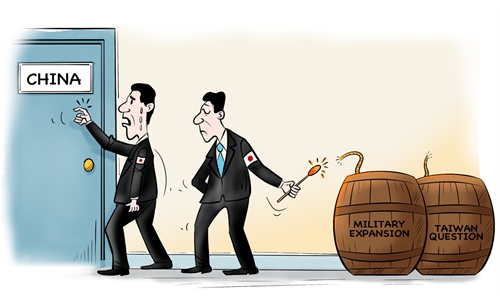
Japan Illustration: Xia Qing/GT
Recently, during a history class at Moscow State University (MSU), a Chinese student studying abroad openly draped himself in the "rising sun flag," a symbol of Japanese militarism, and displayed an old Japanese military cap. The incident sparked widespread outrage among Chinese students overseas and across public opinion in China.
Immediately after the incident, other Chinese students present demanded that the student take down the flag and questioned him about its origins. They subsequently took the initiative to gather evidence, contact the Chinese Students And Scholars Association (CSSA) and relevant Chinese diplomatic institutions, and report the matter. On Saturday evening, the MSU CSSA issued a statement confirming that it had promptly verified the facts and collected evidence, repeatedly contacted the university to demand serious action, and that the university had launched an investigation. The association also reported the incident to the Education Section of the Chinese Embassy in Russia. Meanwhile, a petition jointly signed by Chinese students studying in Russia was formally submitted to the administration of MSU's Faculty of History. The petition explicitly rejected the student's defense that his actions were "merely an academic display" and called for him to be held seriously accountable in accordance with university regulations. In this incident, the overseas Chinese students who stepped forward to defend the dignity of their nation's history deserve recognition and praise from the whole society.
University campuses abroad are distinctive arenas of public discourse. Chinese students studying overseas frequently encounter clashes between different value systems, the spread of historical revisionism and even statements and situations that distort the history of aggression and offend China's national interests and the feelings of the Chinese people. In this incident, the Chinese students present neither turned a blind eye nor remained numb and silent. Instead, they stood firm in their national convictions, responding with reason, resolve and restraint while clearly drawing the line between right and wrong in matters of history. Their deep-rooted sense of responsibility toward their country, their clear-eyed understanding of history, and their determination to "cast off the chill of apathy" and "give off whatever warmth and light they can" embody the finest qualities of China's younger generation.
Academic presentations do not grant unlimited license to disregard historical sensitivities, and classroom research is no excuse for desecrating history or seeking attention through provocation. These principles do not change simply because the setting is in another country. The "rising sun flag" is an emblematic symbol of Japan's history of militarist aggression. It evokes the Chinese nation's deeply etched memories of immense suffering and stands as a historical stain associated with killing, invasion and colonial rule. The student's absurd and disgraceful act of draping himself in such flag in a classroom abroad crossed a fundamental line. Although he apologized twice afterward, he continued to downplay the seriousness of his actions and make excuses to absolve himself of responsibility. His behavior has crossed the line.
China and Russia fought alongside each other against fascism and are partners in upholding the postwar international order. We hope that MSU will listen carefully to the concerns voiced by Chinese students and take firm action after conducting a thorough investigation. At the same time, we applaud the Chinese students at MSU who had the courage to speak out, as well as all overseas Chinese students who stood by their stance throughout this incident.
RELATED ARTICLES