State media explains modular refueling pods' role in Y-20B dual tanker-transport capability
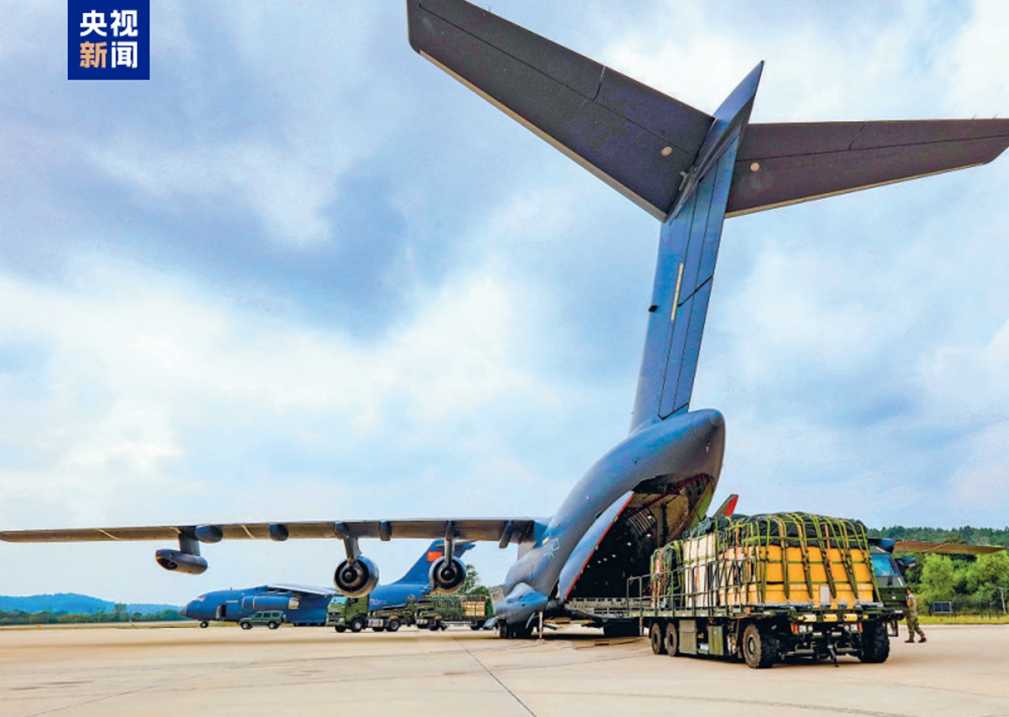
A Y-20B large transport aircraft sits with its cargo hold open for loading. Photo: Screenshot from the CCTV News
CCTV News reported on Monday on a recently circulated image of the Y-20B large transport aircraft that shows refueling pods mounted under the wings while its cargo hold is open for loading. Military affairs experts in the report analyzed the Y-20B's dual transport-refueling configuration and what makes it so capable.The image was first published by the PLA Daily on Wednesday.
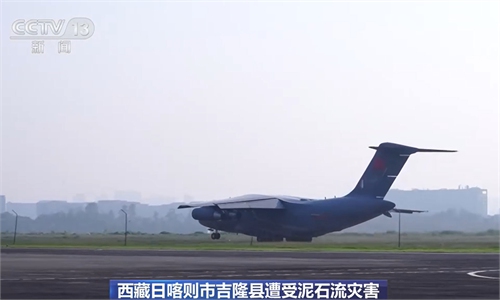
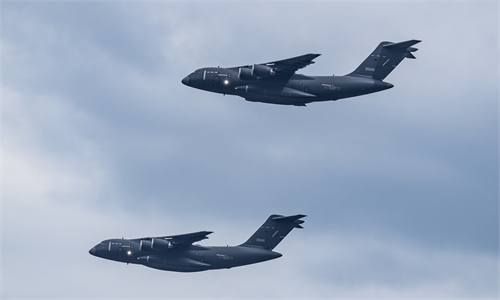
According to the CCTV report, the Y-20 family has grown steadily in recent years. The Y-20A focuses on strategic airlifts, the YU-20 on aerial refueling, and the domestically developed Y-20B - built on the same platform as the Y-20A but with a new-generation power system - is a modular design that can handle both cargo transport and aerial refueling.
How does a transport aircraft carry out refueling missions? Military commentator Fu Qianshao explained that the Y-20B's refueling pods are modular and detachable, allowing the aircraft to switch roles at any time depending on the mission.
Fu told the CCTV that pod placement is critical. If mounted too far outboard, wingtip vortices can interfere with the refueling hoses; if too far inboard, two fighters being refueled simultaneously would be too close together, creating potential danger. Thanks to testing with the YU-20, the Y-20B requires no major structural changes, making conversion relatively simple.
In the published image, the Y-20B has refueling pods under its wings while its cargo hold remains empty, preserving full transport space. This means the aircraft relies on its own internal fuel to provide limited refueling support through the pods.
"The Y-20B's internal fuel capacity is already very large, so no additional tanks are needed to refuel heavy or medium fighters. Tests have shown that without extra tanks, the aircraft is lighter and thus burns less fuel, so its refueling output is not significantly affected," Fu was quoted by CCTV as saying.
The report noted that the PLA Air Force has fielded heavy transport aircraft and tankers in recent years, and the Y-20B's dual-role capability offers new flexibility. Fu said that developing and producing dedicated tankers would tie up part of the transport fleet. However, with this modification, a large number of Y-20Bs could be deployed on a given strategic axis to temporarily handle refueling during long-range strike missions, and while refueling, they can still carry cargo, personnel and other supplies.
CCTV also noted that multi-role capability may be a future trend.
Previously, a documentary on the domestically developed Y-20 family aired by state media on August 5 revealed that a pilot said the Y-20B could take on roles including bomber, early warning aircraft and electronic warfare platform.
Song Zhongping, a Chinese military affairs expert, told the Global Times that by equipping different functional pods, the aircraft can quickly change roles: with refueling pods, it becomes a tanker; with electronic jamming pods, an electronic warfare platform; with bombing modules, it could potentially perform bombing missions; and with early warning modules, it can serve as an airborne early warning platform.
Thanks to the Y-20's fully indigenous design, Song said, Chinese engineers have a comprehensive understanding of its aerodynamic configuration, airframe structure, flight control and avionics systems. This means that, as long as technical conditions are met, modifications can be carried out with greater flexibility and tailored to operational needs. The Y-20B's multi-role capability greatly enhances the PLA Air Force's mission flexibility and support efficiency.
Military commentator Song Xiaojun told the CCTV that the Y-20 platform's conversion potential could extend to drone operations.
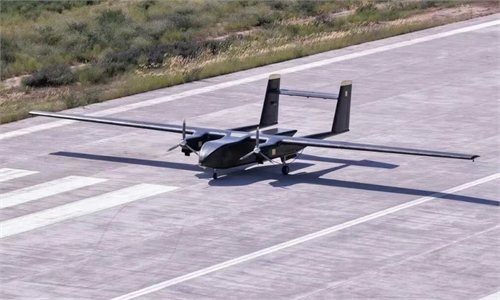
"For example, a large transport aircraft could carry swarms of small drones and release them at a distance from the battlefield, effectively becoming an 'airborne drone carrier.' And as a tanker, could it refuel drones? In the future, aerial refueling between drones and crewed aircraft is entirely possible," Song Xiaojun was quoted by CCTV as saying.
On July 6, 2016, the Y-20 officially entered service with PLA Air Force aviation units. A decade later, the Y-20 has evolved from a single transport platform into a family of models including the Y-20A, Y-20B and YU-20 aerial refueling tanker, with its operations extending to more than 40 countries and regions across four continents, according to the Aviation Industry Corporation of China, the aircraft's manufacturer, on its WeChat account in June.
RELATED ARTICLES