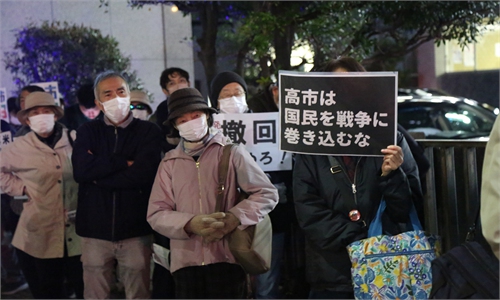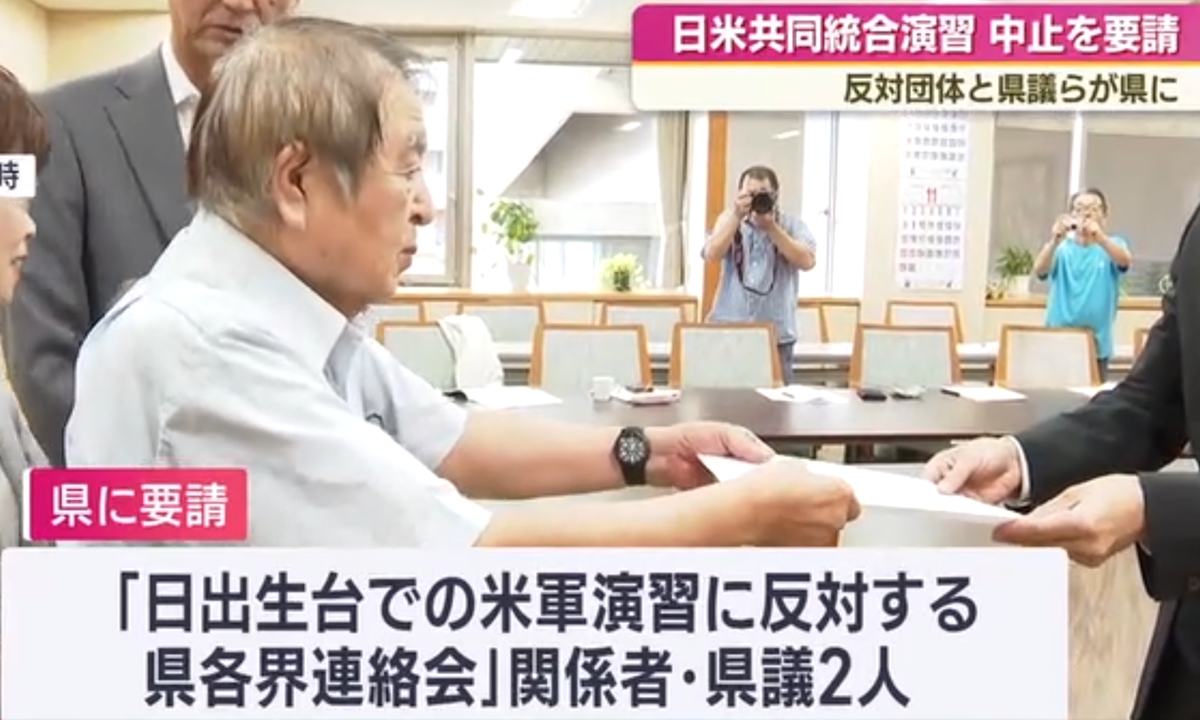
Representatives of groups opposing the upcoming Japan-US joint military exercise Keen Sword 27, along with prefectural assembly members, submit a petition addressed to Oita Governor Sato on October 15, 2026 at the prefectural government office, calling for the cancellation of the exercise scheduled to begin on October 19, 2026. Photo: Screenshot of Oita Asahi Broadcasting
If a force repeatedly insists that it is acting in self-defense, perhaps the best way to judge is not its press releases, but where it places its missiles.According to Japanese media, US-Japan Keen Sword 27 military exercises - "seen as a dress rehearsal for defending Japan's southwestern island chain" - kicked off Monday. This year's exercise is the largest of its kind to date. But what is this "sword" really for? The answer is not in the exercise's introduction, but in a string of firsts.
The first "first": The drill will see Japan for the first time deploy its longer-range Type 25 surface-to-ship missiles outside their base in Kumamoto Prefecture. It derived from the Type 12 anti-ship missile. As its name may have maintained understated, its reported range has surged from roughly 200 kilometers to 1,000 kilometers. Reports say the range puts much of the East China Sea, parts of China's coast and the Korean Peninsula within reach.
This is no longer simply a defensive system. With its extended range, it substantially increases Japan's ability to conduct long-range strikes. Deploying it in a major exercise is a clear indication that Japan's military is expanding.
The second "first": The US' NMESIS anti-ship missile system will be deployed to Yonaguni Island, barely 110 km from Taiwan island, for the first time. Though marketed as an anti-ship system, NMESIS can fire cruise missile Naval Strike Missile, which provides precision land-attack capabilities.
It means a once-quiet maritime outpost is being turned into a forward military position capable of launching strikes
The third "first": Five countries - France, Germany, the Netherlands, New Zealand and the Philippines - will join the exercise for the first time.
The drills let Washington show it can still rally partners in the Western Pacific, while giving Tokyo a chance to wrap its expanding military role - and its move away from exclusive defense - in the appearance of allied consent.
The fourth "first": The exercise is expanding further into emerging domains of warfare.
Alongside traditional drills involving integrated air and missile defense and ground operations training, the exercise also includes cyberattack response, information warfare training and electromagnetic warfare training. It signals Japan's drive to enhance its abilities in emerging domains of warfare and deepen the "modernization" of the US-Japan alliance.
Nevertheless, a country committed to exclusively defense-oriented policy has little reason to rehearse 1,000-kilometer missiles strikes, or to station offensive-capable weapons on small islands sitting right next to its neighbors.
These steps indicate that the US and Japan are moving past conventional island defense, converting Japan's southwestern islands into forward nodes for projecting power outward.
The region is concerned not simply because the exercise is larger, but because Japan's placement of weapons is changing what "defense" means in practice.
Japan's ambitions pose longer-term risks. It seems to be using joint drills to steadily erode the limits of exclusive defense, after all, 1,000-km missiles far exceed any narrow territorial requirement. At the same time, it is trying to integrate more deeply into US operations, moving from a protected ally toward a core role in the forward posture along the First Island Chain.
These efforts also align with Tokyo's wider push to revise the pacifist constitution. Taken together, they raise serious questions about where Japan's postwar security identity is heading.
European participants are largely symbolic. They may be willing to appear in an exercise, but that does not mean they are prepared to bear the heavy costs of a conflict in the Western Pacific. The US, for its part, has long kept strategic ambiguity on Taiwan question. Whether Washington would fight on Japan's behalf in a crisis remains an entirely different question.
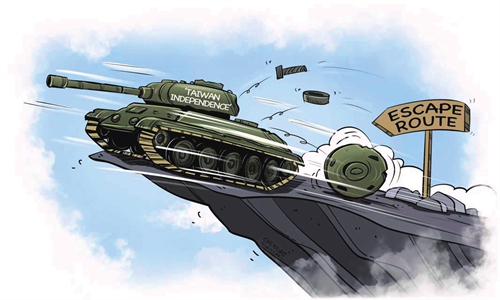
As for Japan, Tokyo seems to think that tightening its alignment with Washington and acquiring offensive-capable weapons will boost its geopolitical position. Yet this overlooks a stark reality: Stationing missiles only 110 kilometers from Taiwan island would place Japan on the front line of one of the region's most volatile flashpoints if fighting broke out.
Waving weapons on one's own doorstep can hardly bring lasting peace. More often, it simply stacks the risks higher and puts one closer to the flames.
Japan once pursued a militarist path that brought great suffering to Asia. As it now boosts its military role again, the question is not just how much protection it says it needs, but how it will prove it will not repeat that history.
When Japan's missile ranges run ahead of peace commitments, and long-range strike power quietly supplants exclusive defense, the more prominently Keen Sword is displayed, the heavier the shadow it may cast across the region.
RELATED ARTICLES