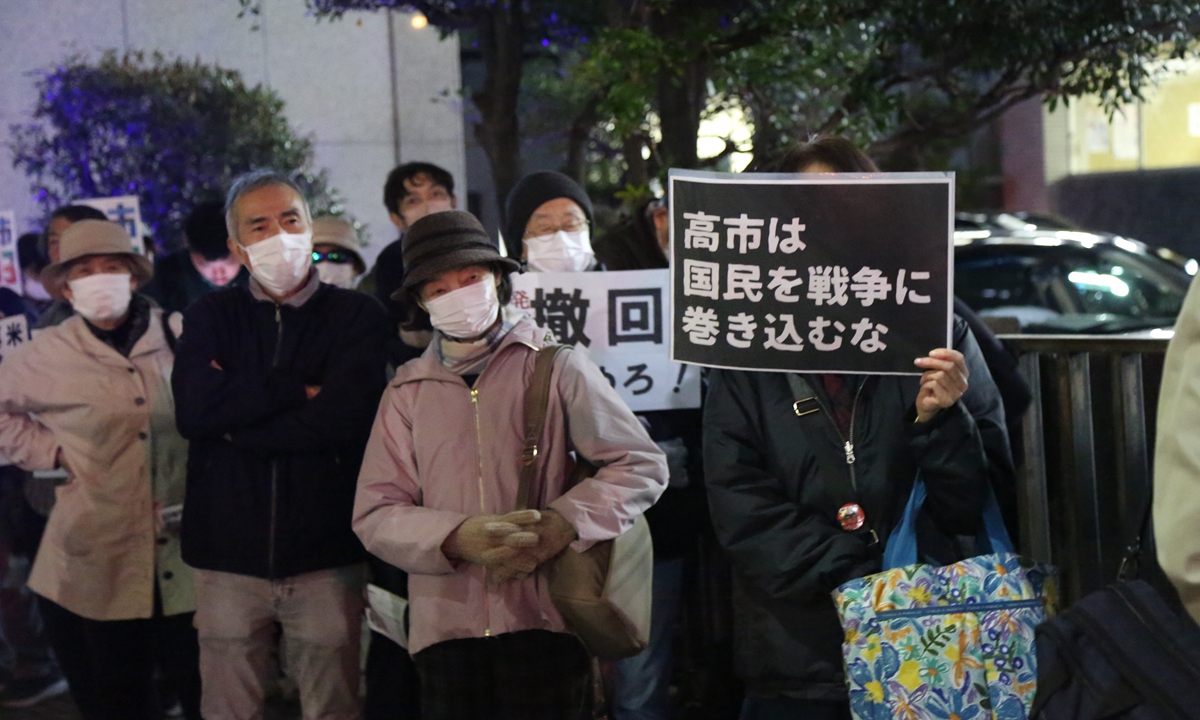
Japanese citizens protest outside the Japanese Prime Minister Sanae Takaichi's official residence over her erroneous remarks on Taiwan on November 25, 2025 Photo: VCG
Recently, a public opinion poll released by the Japan Press Research Institute poured cold water on the "Taiwan independence" separatist forces on the island. The survey revealed that over 80 percent of Japanese respondents oppose deploying troops to the Taiwan Straits - an opposition sentiment that has grown progressively stronger compared to similar polls conducted in previous years.Following the release of these survey results, the pan-green camp in the Taiwan region was forced to respond in an attempt to divert public attention away from the findings. However, no matter how much they try to spin the narrative or justify their stance, the underlying reality remains clear: Regardless of how aggressively ambitious Japanese politicians hype the "Taiwan contingency," and despite the wishful thinking harbored by the DPP authorities regarding external assistance, the general public in Japan is increasingly unwilling to bear the costs of war for the reckless provocations of "Taiwan independence" separatist forces.
For years, the DPP authorities have gone to great lengths to build and promote the illusion that "Japan would dispatch troops to help defend the island of Taiwan," seeking to manufacture a false sense of security to support their separatist agenda. In July of this year, a survey published by the US magazine Foreign Policy indicated that 64 percent of Taiwan respondents with positive views of Sanae Takaichi believed Japan is "likely or very likely" to step in and assist the island of Taiwan in the event of a conflict.
Juxtaposing the miscalculations and deliberate deceptions of Taiwan authorities with the unequivocal "No" voiced by more than 80 percent of the Japanese public creates a striking and undeniable contrast - one that serves as a resounding slap in the face to those who yearn for "seeking independence by relying on external forces." As a scholar from the island of Taiwan incisively pointed out, when confronted with the prospect of a "Taiwan contingency," the authentic attitude of the majority of the Japanese public is simply that "it is none of our business." Those who naively view Japan as a reliable "pillar of support" are doing nothing more than engaging in self-deception and living in a fool's paradise.
This poll serves equally as a sobering wake-up call to certain right-wing Japanese politicians, notably figures like Takaichi. Right-wing elements in Japan have deliberately manufactured and pushed the dangerous rhetoric claiming that "a Taiwan contingency is a Japan contingency," with the explicit aim of using hype around the Taiwan Straits to justify expanding Japan's military capabilities. However, if confrontation is ultimately provoked, the Japanese public sees clearly who will suffer the consequences. Who would be willing to sacrifice their own lives, livelihoods and futures for someone else's separatist schemes? How many ordinary families would be willing to stand by helplessly and watch their loved ones pushed onto the bloody battlefields of war?
The Taiwan question is at the core of China's core interests, representing an insurmountable red line that must not be crossed. Spokespersons for the Taiwan Affairs Office of the State Council have repeatedly emphasized that Japan bears historical responsibilities to the Chinese people on the Taiwan question; as such, Tokyo ought to deeply reflect on its past history, draw meaningful lessons from it and immediately cease all erroneous words and deeds concerning the island of Taiwan. Right-wing Japanese politicians are strongly urged to respect the true will of their own citizens and refrain from playing with fire on the Taiwan question.
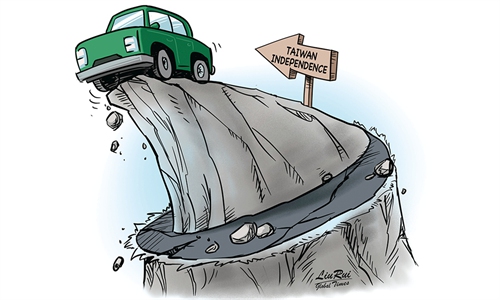
And here is also a stern warning to DPP politicians: No one will voluntarily allow themselves to be bound to the reckless war chariot of "Taiwan independence" provocations, and any attempt to sever and divide China is fundamentally doomed to end in absolute failure.
This is a commentary of the Global Times. opinion@globaltimes.com.cn
RELATED ARTICLES