Tsai Ing-wen’s provocative trip to the US: an outright sellout of Taiwan: Global Times editorial
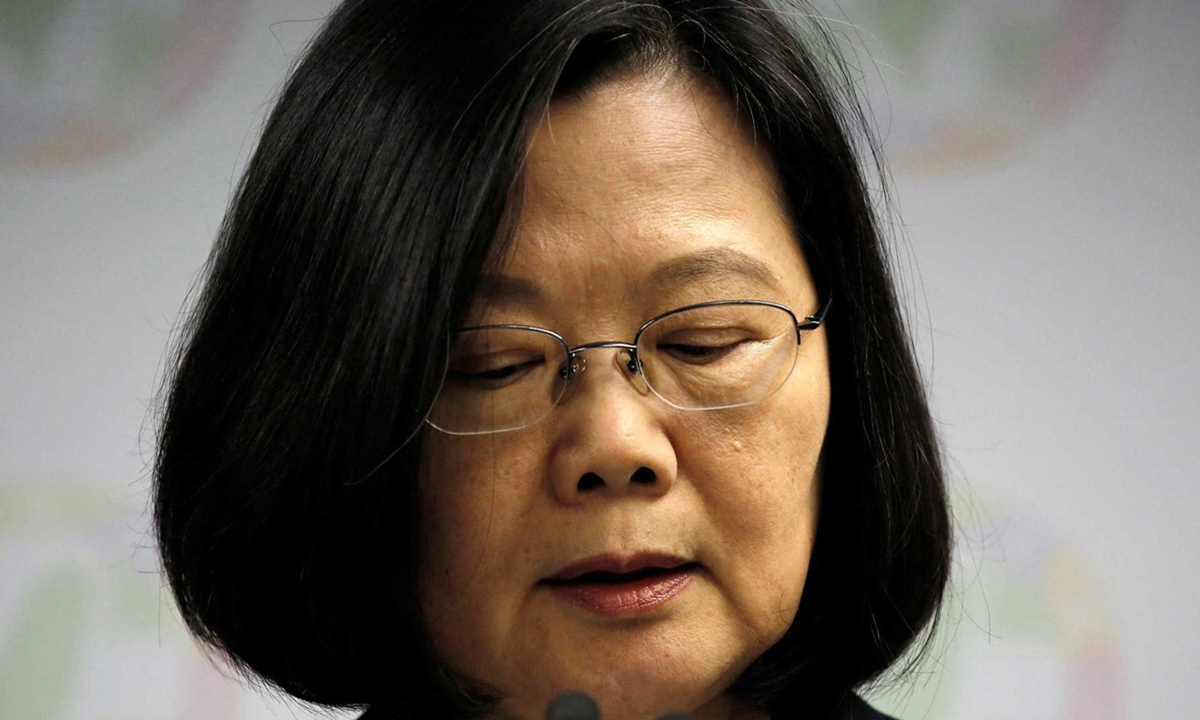
Tsai Ing-wen Photo:VCG
The essence of Tsai Ing-wen's provocative trip to the US is to sacrifice Taiwan's industrial development in a bid to curry political favor with Washington. It amounts to gambling with the lives and livelihoods of Taiwan residents and using the island's valuable resources to secure verbal endorsements from certain US politicians in exchange for the DPP's own political survival.
Tsai Ing-wen, former leader of the Taiwan region, is on a provocative trip to the US. Upon her arrival, she first met with former US House speaker Nancy Pelosi. The two washed-up politicians, who have long exploited the "Taiwan independence" agenda for political gains, once again colluded to recycle the same old rhetoric and remind the world of their fading political relevance.
Tsai then delivered a speech at Stanford University's annual DEFCON Technology & National Security Conference, where she touted Taiwan's position in the semiconductor sector and global artificial intelligence (AI) supply chains. She hyped up the island's so-called "democratic resilience" and its "position at the center of the first island chain," smeared the Chinese mainland's policy toward Taiwan, and deliberately framed the Taiwan question as an "international security issue." Taken as a whole, Tsai's US trip is nothing less than an act of selling out Taiwan: It sacrifices the interests of the Taiwan residents in pursuit of the separatist "Taiwan independence" agenda, while offering nothing to safeguard the well-being of the people on the island.
It is well known that Taiwan's semiconductor industry is the product of decades of hard work and investment by industrialists on the island. In recent years, it has become an important engine of the island's economic development and a critical link in global supply chains. Against the backdrop of the rapid development of AI technology in the Chinese mainland, this sector should have become an opportunity for cross-Straits integrated development and mutually beneficial cooperation, rather than a political bargaining chip for "Taiwan independence" separatist forces to pursue personal gains and collude with external powers.
Yet in the eyes of Tsai and the Democratic Progressive Party (DPP) authorities, the island's hard-won industrial advantages are little more than tools for political maneuvering. During her provocative trip to the US, Tsai has actively tied Taiwan's cutting-edge technology industries to Washington's geopolitical maneuvering, catered to the US strategy of "using Taiwan to contain China," and deliberately securitized and politicized economic and industrial interests.
It is worth noting that Taiwan Semiconductor Manufacturing Co. (TSMC) has already brought its advanced technology to Arizona and begun mass production there, strengthening the US domestic supply of advanced chips. The essence of Tsai's speech at Stanford University is to sacrifice Taiwan's industrial development in a bid to curry political favor with Washington. It is an act of flattery and an outright sellout of Taiwan.
Tsai currently serves as the campaign headquarters chairperson for several DPP candidates running for "city mayors" and "county chiefs," and Taiwan media generally believe that she hopes to use her trip to the US to raise her personal profile and boost the prospects in local elections. Such an approach - trading industrial interests for political gains and sacrificing the public interest for personal ambitions - seriously undermines the foundation of Taiwan's development and harms the long-term interests of all residents in Taiwan.
Moreover, during her visit to the US, Tsai made a great deal of hype about Taiwan's so-called "difficult-to-replace role," deliberately stoking cross-Straits confrontation and exaggerating tensions in the Taiwan Straits in an attempt to expand the space for "Taiwan independence" separatist activities by binding the Taiwan region more closely to the US. Such an approach won't bring Taiwan genuine "security." Instead, it will only heighten the risks of a crisis in the Taiwan Straits.
A private trip by a former politician can't change the fact that the US regards Taiwan as a pawn, or even a disposable pawn, in its "Indo-Pacific Strategy." Nor can it change the genuine feelings and rational judgment of voters on the island.
According to the latest poll conducted by Taiwan's media outlet My Formosa, as many as 60.3 percent of respondents expressed a lack of confidence that Washington would safeguard Taiwan's interests, including 30.2 percent who said they had "no confidence at all." Various signs suggest that the deception of "seeking independence by relying on the US" has long lost its effectiveness on the island. Similar polls have been released by multiple organizations, including institutions on the island that lean toward either the blue or green political camps, as well as US think tanks and media outlets. Despite their different backgrounds, the findings of these polls point to the same conclusion: Mainstream public opinion in Taiwan does not believe that the US will come to Taiwan's defense.
Public opinion cannot be defied, nor can the trust of the people be squandered. For years, the DPP authorities have engaged in self-deception by beautifying US-Taiwan relations and touting support from external forces. At the same time, they have misled the Taiwan public to gain votes, continuously sought to externalize and internationalize the Taiwan question, and recklessly provoked cross-Straits confrontation. The essence of Tsai's visit to the US is to gamble with the lives and livelihoods of Taiwan residents, using the island's valuable resources to secure verbal endorsements from certain US politicians in exchange for the DPP's own political survival. What appears to be a high-profile political spectacle is, in reality, an exercise in isolation and a loss of public support. Ultimately, it is nothing more than a futile political performance.
Taiwan is a part of China, and its future and destiny will always rest in the hands of all Chinese people. No matter how Tsai and others like her collude with external forces or hype up the "Taiwan independence" agenda, they cannot change the established fact that Taiwan is part of China, nor can they stop the historical trend toward national reunification. If "Taiwan independence" separatist forces refuse to abandon their illusion of "seeking independence by relying on external forces" and insist on using the island's industrial capabilities to curry political favor while treating the lives and livelihoods of the people as bargaining chips, they will ultimately only harm and ruin Taiwan, bring about their own destruction, and see their names written on the wall of shame.
RELATED ARTICLES