ARTS / CULTURE & LEISURE
Scenic spots vie for non-player character actors who bring Chinese classics to life
Beyond the stage

An aerial view of Hetou Old Street scenic area in Fengnan District of Tangshan City, North China's Hebei Province. Photo: VCG
"Two golden orioles sing amid the willows green; a line of white egrets soars into the blue sky."
These lines from a poem by Tang Dynasty (618-907) poet Du Fu were the starting point for an impromptu poetry exchange between an Australian tourist and Wang Haonan, who plays the ancient poet Li Bai at Hetou Old Street in Tangshan, North China's Hebei Province. Li Bai, one of China's most celebrated poets, lived during the Tang Dynasty and is known for his romantic, free-spirited verse. Wang responded with another quatrain by Du Fu.
The next day, the tourist returned, having learned the poem to continue the exchange with "Li Bai."
Wang told the Global Times that classical Chinese poetry is more than words in books; it can also bring people from different cultural backgrounds together. Such spontaneous encounters are part of the appeal of live-action non-player character actors, often referred to as NPCs in China, at Chinese tourist attractions.
Recently, Situ Town in Jincheng, North China's Shanxi Province, announced plans to invest 30 million yuan ($4.2 million) to recruit 100 of these immersive-experience actors, offering annual salaries of up to 10 million yuan. The announcement sparked discussion about the growing popularity of performers who invite visitors to become part of a story rather than simply watch it.
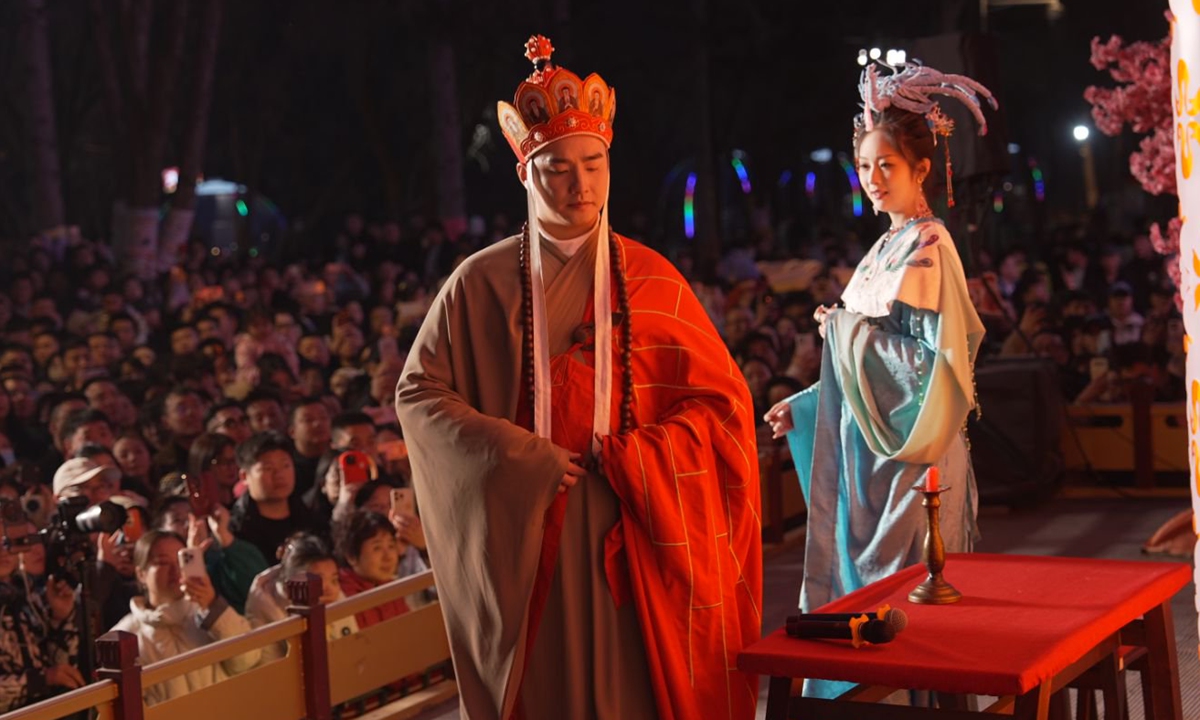
Tang Monk, potrayed by Yan Dong, performs on stage Photo: Courtesy of Yan Dong
Spontaneous interactionAt the Changchun Zoological and Botanical Park in Northeast China's Jilin Province, Yan Dong, who plays the Tang Monk from the classic novel Journey to the West, has amassed more than 5.8 million followers on social media. He is also an actor with the Jilin Provincial Jiju Theater.
"The biggest difference is that opera has a fixed script and fixed scene partners. NPCs have no fixed lines, and visitors become their partners on the spot," Yan told the Global Times. Instead of following a rehearsed performance, he must respond to visitors' questions and jokes while staying true to the character.
At first, Yan portrayed the Tang Monk as serious and somewhat rigid. After a group of young visitors teased him about the novel's pilgrimage adventures, he relaxed and played along.
"That was when I realized that people didn't want a monk who seemed above them. They wanted a Tang Monk they could actually talk to," Yan said. He now adjusts his performance to each group, moving between solemnity and humor.
Some details have emerged naturally from these encounters. After noticing that visitors often offered him good wishes, Yan made "May things get better and better for you" his signature response. He also varies his poses when taking photos with visitors.
"If it feels true to the character and people like it, I keep it. Eventually, it becomes part of the character's habits," he said.
The actress who plays the Queen of the Kingdom of Women alongside Yan has also developed her own interpretation of the character, emphasizing both her dignity and her courage in love.
"I love you, but I will not use my power to keep you by my side," she said, describing her understanding of the queen's relationship with the Tang Monk.
"We should never forget the wonderful stories and classic characters in Journey to the West, but we are also happy to see them step out of the novel and into the modern world, taking on new life," she said.
While Changchun's performers bring familiar fictional characters into face-to-face encounters, Wang's portrayal of Li Bai at Hetou Old Street offers visitors a chance to engage with classical poetry. But costume and familiar verses alone are not enough to bring a poet from more than a thousand years ago into a conversation with modern audiences.
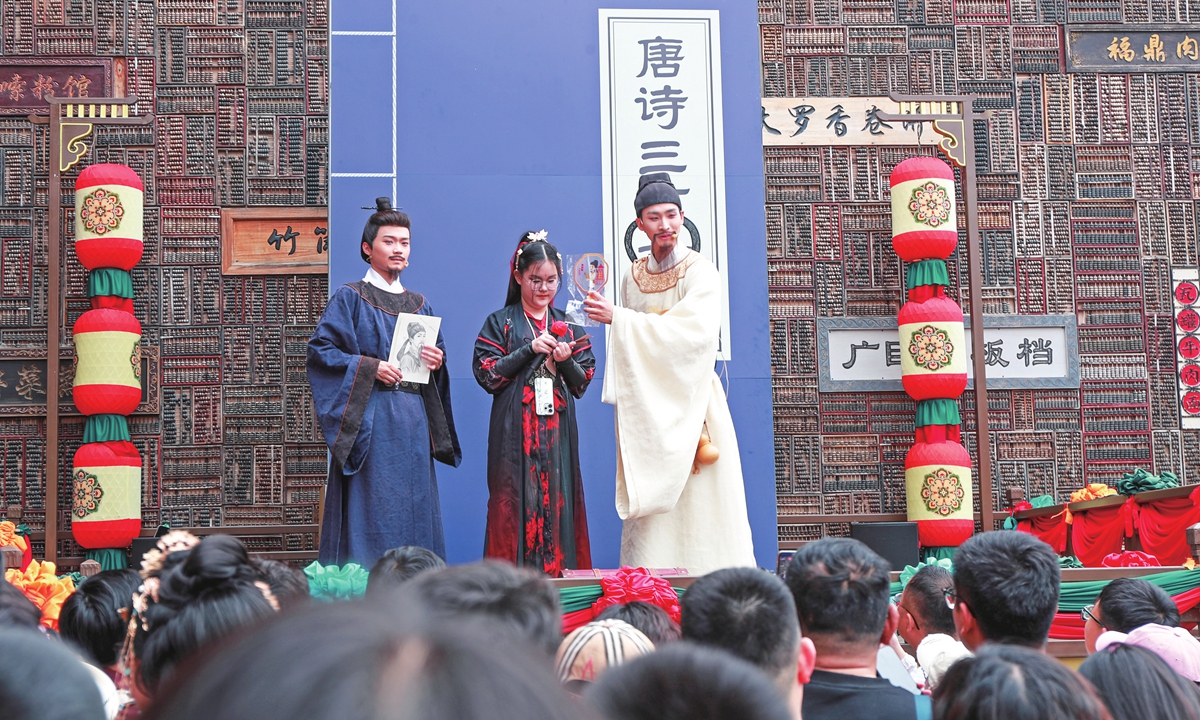
"Li Bai," portrayed by Wang Haonan (right), joins other performers onstage. Photos: VCG
Classics in conversation
When Wang first took on the role, he felt confident. "Quiet Night Thoughts" was the first Tang poem he learned as a child, and he admired Li Bai's free-spirited, independent and romantic nature. Before starting, he rewatched the animated film Chang'an, which is about the poet's relationship with a Tang military commander, to study the poet's expressions and mannerisms.
His confidence was soon tested when a visitor asked him to recite "Song of the Xia Ke (Ballad of the Knights-Errant)." Wang stumbled at the opening line and joked: "I wrote this poem during the Tianbao era (742-756), but we are still in the Kaiyuan era (713-741), so I haven't put pen to paper yet."
The joke saved the moment, but Wang went home determined to prepare better. That night, he memorized nearly 20 of Li Bai's poems.
"I don't even remember how I fell asleep that night. I was completely obsessed," he recalled. Since then, memorizing poems, studying their historical background and practicing expressions and movements in front of a mirror have become part of his daily routine.
The effort has led to memorable encounters. A 6-year-old boy from Tangshan once came onstage hoping to recite Li Bai's "To Li Yong," but remembered only two lines: "The great roc rises with the wind one day, soaring ninety thousand li." Wang taught him the entire poem.
A week later, the boy returned and recited it fluently, then asked "Li Bai" for another poem to learn.
"That was when I felt cultural inheritance become something tangible," Wang said.
RELATED ARTICLES