IN-DEPTH / IN-DEPTH
The gift of green life
Let us first look at a set of figures. In mid-October 1934, an army of 86,000 troops under the leadership of the Communist Party of China set out from southern Jiangxi Province on a long journey — this was the First Front Army of the Chinese Workers' and Peasants' Red Army (the Central Red Army).
One month later, the 25th Red Army left the Dabie Mountains; in March of the following year, the Fourth Front Army crossed the Jialing River westward; in November, the Second and Sixth Army Corps (later organized into the Second Front Army) withdrew from western Hunan. These forces successively began their strategic relocation at different times.
After enduring a long and arduous trek, the various units of the Red Army, having narrowly escaped death time and again, finally gathered on the Loess Plateau. This is the legendary Long March that has left an indelible mark on history.
Long afterward, when later generations looked back on the history of the 20th century, the Long March was described in the chronicle of major events in The Life Millennium as a rare expedition in human history. Pursued and blocked by enemy forces dozens of times larger, and beset by hunger, cold, and illness and injury, the Red Army not only broke through desperate situations by relying on "firm conviction, strong will, and unparalleled courage," but also formed a close connection with the plants along the way.
In early October 1934, before the Central Red Army set out on the Long March, the Central Revolutionary Military Commission had already made meticulous arrangements for material supplies. It ordered each army corps to ensure it had sufficient personnel and weapons and ammunition, requiring every person to carry four days' worth of grain, and each mess unit to prepare one jin of oil and one jin of salt per person — this was a pragmatic arrangement. At the time of departure, no one imagined that this expedition would form such a bond with plants. On the unknown journey ahead, wild vegetables, wild fruits, wild grasses, grass roots, and tree bark would become important supplements to food supplies.
On October 22 of the same year, a notice was issued that clearly stipulated the confiscation of property from landlords and reactionaries, the mobilization of rich peasants and urban merchants to make donations, and the absolute prohibition of any harm to the interests of the worker and peasant masses. The notice reflected strict discipline and respect for the people's food supplies, making the importance of plants as an alternative source of sustenance all the clearer.
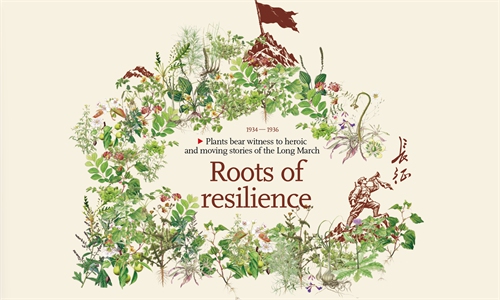
From the stockpiling of wild vegetables in southern Jiangxi to the identification of poisonous grasses in the Songpan Grasslands, from the use of herbal medicines to treat wounds in the mountain forests of northern Guizhou to cereal crops taking root on the northern Shaanxi Plateau, plants, in their most simple form, became integrated into the Red Army's marches and survival.
The Red Army's narrow escapes from death during the Long March could not have been achieved without the sustenance these plants provided. When the Central Red Army set out carrying four days' worth of grain, when the 25th Red Army's rice bags held both raw and cooked food, when the Fourth Front Army made its own dried provisions for the westward journey, and when Zhu De, Zhou Enlai, and Wang Jiaxiang issued circular telegrams calling for grain conservation, the existence of these plants enabled the Red Army to maintain basic physical strength in desperate situations.
When wild vegetables and wild fruits were completely exhausted, tree bark, roots, and stems became food in the extremity of hardship. Elm bark, after being stripped, soaked, and ground to remove astringency, was mixed with coarse grain for consumption. But most tree bark was coarse and fibrous, and some contained toxins; improper processing could cause abdominal distension and poisoning. This was food used only as a last resort and stand as stark reminders of the sufferings during the Long March.
The tenacity, simplicity, and resilience of these plants closely resembled the spiritual qualities of the Red Army — they tolerate barren soil just as the Red Army endured hardship; they resist severe cold just as the Red Army withstood oppression; they grow in harsh conditions just as the Red Army rose up in desperate situations.
The Long March was a great expedition of ideals and convictions, a great expedition that tested truth, a great expedition that awakened the people, and a great expedition that broke new ground.
The plants of the Long March were precisely the silent yet steadfast witnesses and supporters of this great journey.
RELATED ARTICLES