How Chinese people view France’s protests through history and contemporary observations
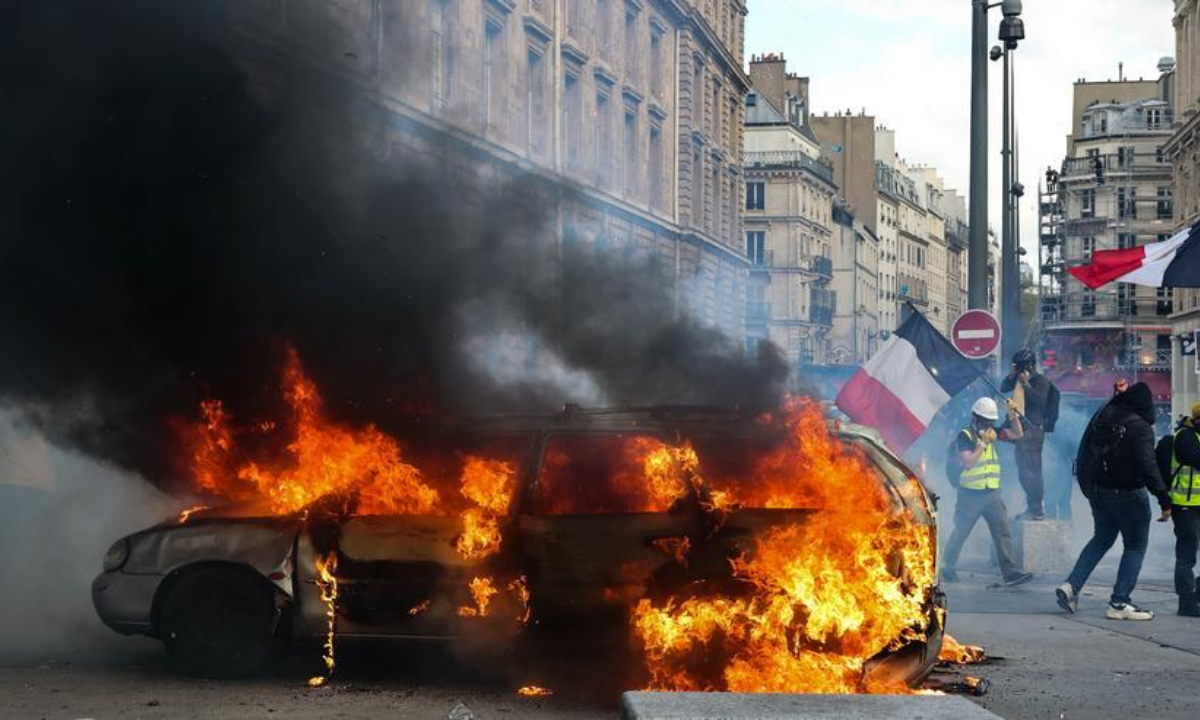
This photo taken on Oct. 17, 2026 shows a burning vehicle during a protest in Paris, France. (Xinhua/Wu Huiwo)
A country's resilience doesn't mean never running into problems. It means being able to rebuild trust, fix what's broken, and keep going.Since September, a country once associated with industrial strength, strong public institutions system, and political thought has once again been pushed into the international spotlight by street protests. France has just faced its most serious social unrest in recent years, leading authorities to impose localized curfews, including in parts of Paris.
The protests, which began in late September, started with very specific demands: increased education funding, better school conditions, and relief from staff shortages. Yet within just a few weeks, they swelled into widespread unrest on a scale rarely seen in decades. Anger spread to civil servants, farmers, healthcare workers, and others who depend on public services and welfare. Opportunistic rioters later joined in, using the protests as cover for looting.
Over half a million people demonstrated across France on Saturday. Some protests descended into violence and looting. According to reports, more than 3,000 businesses and retail shops were ransacked. More demonstrations are scheduled for next weekend. And in November, labor unions plan to strike.
Videos of the unrest have spread on Chinese social media, including footage of a Paris convenience store being smashed. The female owner can be heard shouting, "Stop! Why are you doing this? This isn't what the protest was about!"
On Chinese social media, some observers note that while the protests started with livelihood demands, the looting has hit ordinary and vulnerable people the hardest. A society's level of civilization is judged not only by how freely people can protest, but also by whether it can protect those who simply want to live in peace. The right to voice discontent is a freedom; protecting the daily lives of ordinary people is the basic responsibility of any government.
Other commentators see the roots of France's current troubles in its economy, a shrinking manufacturing base, weaker innovation, and declining competitiveness. They also noted that political fragmentation has made it harder to push through reforms and govern effectively. The governing coalition cannot get steady support in parliament and the budget is often stuck and cannot pass. Socially, persistent inflation and rising energy costs have eroded purchasing power and placed a heavier burden on lower- and middle-income households.
The combined impact of the Russia-Ukraine conflict and the ongoing war in the Middle East continues to hinder Europe's economic recovery, including France's. Yet France continues to provide substantial support to Ukraine, push ahead with education spending cuts despite a shortage of teachers, and press the EU to implement tougher trade measures against China -even though closer economic and trade ties with China could become one way to create new opportunities for French businesses. These contradictory choices are hard to understand. Sometimes the real cost for a country is not a mistaken decision, but pressing ahead even after starting to question whether the path is right.
More troubling still, the protests have not only disrupted public order in France. Similar demonstrations have also emerged in other European countries, including Italy, Belgium, and Switzerland.
Time, however, may give France and Europe little chance to catch their breath. As winter approaches, heating demand will rise, and energy prices remain at risk of further sharp changes. For households already protesting over fuel prices and the cost of living, higher winter bills could add to the pressure. For governments already stretched financially, finding the right balance between subsidies, deficit control, and essential public services will only become harder.
At the same time, another perspective has emerged among Chinese netizens. Many Chinese people still admire France for its culture, art, ideas, and revolutionary tradition. The French Revolution, the Paris Commune, Napoleon, and France's history of diplomatic independence have all shaped how the Chinese public views the country.
In 1964, France became the first major Western country to establish formal diplomatic relations with the People's Republic of China. That decision is still remembered in China today. Chinese people remember France not just because it was once powerful, but because it once had the clarity to think and act for itself.
Hopefully a country that once offered the world a sense of direction can find its way forward again.
RELATED ARTICLES