Washington issues penalty tickets in vain while staring at DeepSeek’s taillights: Global Times editorial

Illustration: Liu Rui/GT
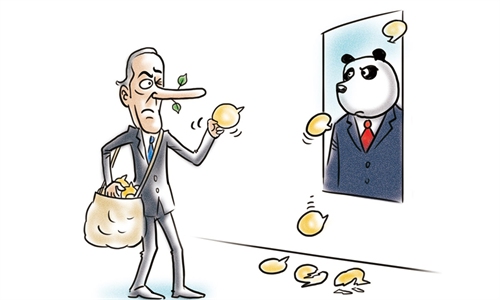
America's absurd ban has done nothing to slow the progress of China's large language models. The harder Washington clamps down, the more it lays bare its anxiety and powerlessness in the face of China's AI rise. In the end, Washington has issued piles of punitive orders yet cannot even catch a glimpse of DeepSeek's taillights.On October 19 local time, the US Department of Homeland Security (DHS) issued an official notice, ordering all federal civilian agencies to remove products developed by Hangzhou DeepSeek Artificial Intelligence Co., Ltd (DeepSeek), and its affiliated entities from their IT systems, and prohibiting the procurement and use of third-party products and services built on DeepSeek technology. Yet just two days before the ban was unveiled, DeepSeek's new model V4.1-Flash-1017 claimed the top spot among open-source models on Code Arena: WebDev, scoring 1,670 points to outperform closed-source models including America's Claude Opus 5 and Grok 4.7. The irony could not be sharper.
A close look at DHS's list of accusations reveals nothing but speculative language: DeepSeek "may result in the transfer of sensitive data" to China, the model could pose "multiple threat vectors." Every charge relies on "may", "might" and "concerns," without a single shred of hard evidence. Washington politicians have long mastered this tactic of levelling charges on flimsy grounds. When Huawei built a competitive 5G network, it was labelled a "security threat." When TikTok won hundreds of millions of US users, it was smeared as a "surveillance tool."
Now that DeepSeek has built an R1-class model with a training cost of roughly $6 million, matching the performance of OpenAI's models built with hundreds of millions of dollars in investment and shaking up the global market, accusations of "knowledge distillation" soon followed. In reality, DeepSeek has never been found to pose any of the risks mentioned in the aforementioned announcements. By contrast, multiple US tech products have repeatedly been caught red-handed with "backdoor" surveillance and data breaches, which makes this DHS notice reads more like a "brutal self-satire" of Washington.
Many observers have noticed the notice bears a July 24 date, meaning the ban has been in place for nearly three months. Over those three months, DeepSeek has made steady leaps in reasoning, coding, agentic capabilities and cost control. It first narrowed the performance gap with top US models, and soon outpaced them.
Viewed in hindsight, this upward trajectory is a stark mockery of Washington. Its absurd ban has done nothing to slow the progress of China's large language models. The harder Washington clamps down, the more it lays bare its anxiety and powerlessness in the face of China's AI rise. In the end, Washington has issued piles of punitive orders yet cannot even catch a glimpse of DeepSeek's taillights - and the crackdown has inadvertently given DeepSeek free publicity.
This absurd contrast stems fundamentally from the collision of two development paths on the AI track: "closed-off containment" versus "open-source breakout." From its inception, DeepSeek has stuck to an open development model. It releases core model weights to global developers, fully opens its toolchains and technical documentation, and subjects all performance and security features to worldwide public scrutiny.
US tech giants, by contrast, have long followed a closed-source monopolistic approach. Their black-box technology is itself the biggest source of cybersecurity risks. Now Washington is trying to block an open, transparent open-source ecosystem in the name of national security, and the logical contradiction could not be more obvious.
What truly worries Washington is the remarkable speed at which China is visibly catching up in artificial intelligence. Yet the increasingly stringent restrictions are undermining America's own innovation ecosystem. The bans target not only DeepSeek itself but also third-party products that use its technology. Legislation being advanced in Congress goes even further, prohibiting American companies from selling software developed on the basis of Chinese AI models to the government. The reality, however, is that American companies such as Snowflake and Vercel have already integrated DeepSeek technology into their products. Following the release of its new model, discussions on overseas social media platforms generated hundreds of thousands of posts. Even an AI adviser to the Trump administration has acknowledged that AI companies should not seek administrative protections to shield themselves from competition. Keeping the most dynamic technologies out of the country is tantamount to locking up the toolboxes of America's own developers.
From algorithm optimization under chip restrictions to ecosystem adaptation for domestic computing platforms and breakthroughs in indigenous AI chip development, Chinese technology companies have long grown accustomed to forging ahead under pressure. DeepSeek's open-source strategy is precisely the most powerful response to technological blockades: If you close the door, we will open ours even wider, allowing developers around the world to use the technology for free and improve it together. As developers and small and medium-sized enterprises in more countries gain access to AI models comparable to the world's best at extremely low cost, the benefits of technological diffusion will draw an increasing number of participants toward an open ecosystem. The isolationism of unilateral technological blockades will inevitably find itself isolated by a global consensus in favor of technological openness.
China and the US each have their own strengths in AI and should work together through dialogue and cooperation to manage risks and share the benefits. The two countries' leaders have already established a dialogue mechanism on AI issues, setting the broad direction for cooperation. Yet Washington's contradictory approach of talking about cooperation while simultaneously imposing bans will only erode the foundation of mutual trust. It is hoped that Washington will fully and faithfully implement the consensus reached by the two heads of state. This would benefit not only China and the US, but also the world as a whole.
RELATED ARTICLES