SCI-TECH / OTHERS
Chinese scientists develop world’s lightest 1-gram wireless mesoscale microscope, a new tool for neuroscience research and BCI research
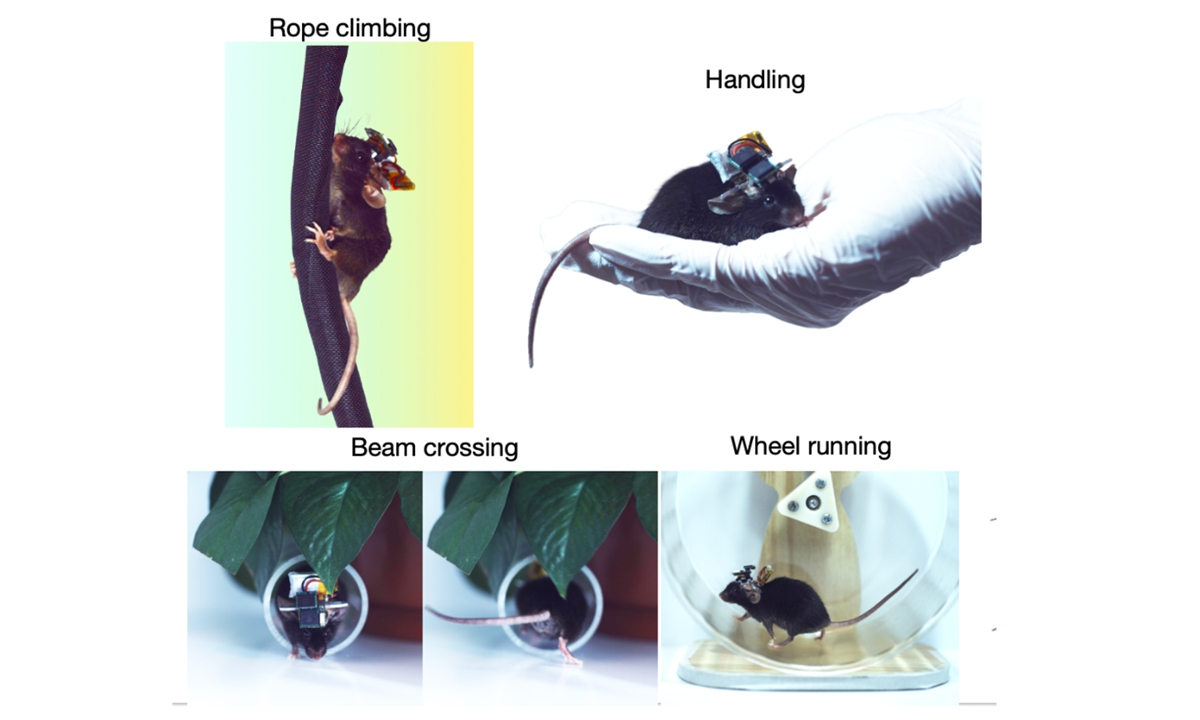
Mice with the wearable mesoscopic microscope called Airscope in experiments. Photo: Courtesy of Wu Jiamin
Chinese scientists have successfully developed a 1-gram wireless mesoscopic microscope called Airscope, billed as the world's lightest megapixel device of its kind. It enables large-scale, high-resolution wireless imaging of neural activity in the brains of naturally behaving animals, offering a new tool for neuroscience research and brain-computer interface (BCI) development, the Global Times learned from the research group on Tuesday.A major challenge in neuroscience is understanding how large populations of neurons across the brain regulate complex behaviors in natural and social setting. Traditional microscopes struggle to balance field of view, resolution and animal mobility. While head-fixed or wired systems restrict animals' movement, distorting their behaviors, conventional wireless devices are too heavy and offer too narrow a field of view to capture large-scale neural activity.
The wireless mesoscope developed by a joint research team led by Dai Qionghai, professor from the Department of Automation and adjunct professor from the School of Life Sciences, Tsinghua University, and Dai Pu, chief physician from the Sixth Medical Center of Chinese PLA General Hospital, Chinese PLA Medical School, achieved a major reduction in weight, weighing just one gram without its battery, more than 30 percent lighter than comparable head-mounted devices.
Equipped with a 2-megapixel sensor and a minimalist optical system consisting of just four aspherical lenses, Airscope achieves single-cell-resolution (4 to 6 micrometers) imaging across an exceptionally wide 6-millimeter field of view. By employing efficient data compression technology, the device has also successfully enabled wireless transmission of megapixel-resolution images.
Combined with a magnetically attached, quick-swappable battery, the device supports prolonged, continuous observation. Animals wearing the device can perform a range of natural behaviors, including climbing and crawling through tubes, without hindrance.
In terms of imaging capabilities, Airscope can simultaneously record more than 8,500 cortical neurons in a single mouse, 25 times the capacity of existing wireless devices. It can also maintain stable recordings from the same brain region for more than 200 days, with signal quality comparable to that of conventional benchtop microscopes.
According to Wu Jiamin, an associate professor in the Department of Automation, Tsinghua University, and a member of the joint research team, Airscope stands out for its lightweight, wireless design, wide field of view and high-throughput imaging capabilities. While conventional head-mounted miniature microscopes typically weigh over 3 grams and can restrict mice's movement, Airscope offers a lighter, more compact, fully wireless alternative with the capability of mesoscale imaging.
Using this animal-wearable device, the team recorded a range of complex exploratory behaviors in mice under natural conditions and conducted numerous experiments that had previously been difficult to carry out due to constraints imposed by cables or the weight of the equipment, Wu told the Global Times on Tuesday.
These experiments included monitoring cortical activity in multiple mice exploring a 5-square-meter naturalistic habitat and tracking their prolonged, self-directed exploration of a large maze with 32 terminal arms. Researchers found that brain cortical activity varied systematically with the type of terrain the mice encountered, Wu said.
According to Zhang Yuanlong, assistant professor from the School of Life Sciences, Tsinghua University, Airscope allows animals greater freedom of movement during neuroscience research, enabling large-scale neural recordings to accompany animals as they engage in a wider range of natural behaviors.
According to Dai Qionghai, the new type of microscope offers a new tool for studying the neural basis of intelligence and is expected to advance optical brain-computer interfaces toward more precise neural sensing. In the future, its potential applications could also extend to immunology and oncology, enabling comprehensive tracking of disease progression.
RELATED ARTICLES