Visa-free foreign entries rise 24.1% in Q3 as ‘China Haul’ reflects appeal of Chinese innovation, experiences
Innovative products, diverse experiences draw overseas visitors beyond sightseeing
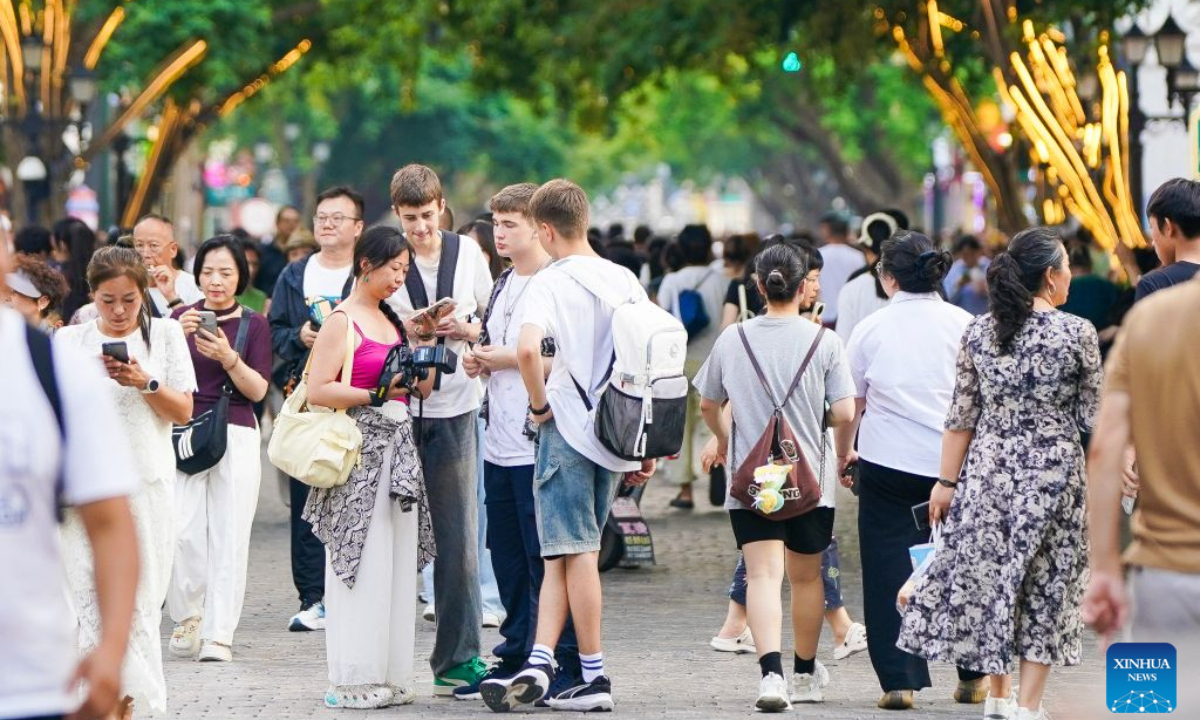
Foreign tourists visit the Central Street in Harbin, northeast China's Heilongjiang Province, July 22, 2026. Thanks to the visa-free entry policies, China has witnessed an increasing number of foreign tourists visiting China this summer. According to the official data, 77.7 percent of foreign visitors entering China in the first half of the year enjoyed visa-free entry policies. (Xinhua/Na Yuqi)
"So that's six phones in total, right?" A buyer from Kazakhstan attending the Canton Fair told the Global Times that she was calling family and friends while shopping at a mall to tally their requests. "At the moment, I plan to buy six phones. I'm still counting how many earphones, AI glasses and smart toothbrushes I need. so far, I need to buy more than10 earphones and more than 10 smart wristbands."
Her expanding shopping list offers a glimpse of the consumer activity surrounding China's growing appeal to international visitors. Foreign nationals made 8.992 million visa-free entries into China in the third quarter of 2026, up 24.1 percent year-on-year and accounting for 77.5 percent of foreign entries, the National Immigration Administration (NIA) said on Tuesday. Total entries by foreign nationals reached 11.601 million, up 15.6 percent year-on-year.
Following the popularity of "China Travel" and "Chinamaxxing," a trend embracing aspects of Chinese daily life, "China Haul" is gaining traction on overseas social media, with visitors sharing shopping finds.
Experts said easier entry procedures and the emergence of innovative products were encouraging foreign visitors to gain a deeper understanding of and experience China. Jiang Yiyi, dean of the School of Leisure Sports and Tourism at Beijing Sport University, told the Global Times on Tuesday that the continued expansion of visa-free arrangements, improved border clearance services and convenient transportation were jointly supporting growth in inbound travel.
Zhang Yi, CEO and chief analyst at iiMedia Research, said visitors' interest in innovative products reflected recognition of China's technological progress. Their recommendations and posts shared overseas could further amplify that recognition and encourage businesses to continuously improve their product offerings.
The trend brings together two sources of appeal: products reflecting technological advances and everyday goods offering variety and value. For businesses, the opportunity extends from purchases made during a visit to recommendations that introduce those products to consumers in other countries, said observers.
From electronics to accessories, overseas consumers are finding products that combine practical functions, distinctive designs and affordable prices.
Shakhzod Mirzaev Richard, an Uzbekistani student in Hangzhou, East China's Zhejiang Province, bought electronics, clothes and small gifts for family and friends back home during his several years of living and studying in China. His friends also purchased gadgets and accessories to take home.
"China offers many choices at reasonable prices. You can find useful, good-quality products without spending too much," he told the Global Times. Families and friends in Uzbekistan were often curious about Chinese products, especially new technology, he said.
For him, trying products firsthand helps explain their appeal. Recalling a recent VR game, he said: "For a moment, I almost forgot I was playing a game." Such experiences show how advanced technology has become and help explain the interest in AI glasses and drones, he added.
"They are not just interesting to look at; people can actually try them and experience what they can do."
A merchant selling smart electronics in Yiwu, East China's Zhejiang, told the Global Times that the number of foreign visitors had noticeably increased since September, with electrical appliances and AI-powered products attracting interest.
In Shanghai, Australian visitor Wayne traveled to the city after attending the Canton Fair. He said China's visa-free entry policy for Australians had made border clearance smooth. His purchases included Disney- and Ultraman-themed trading cards. "This trading card game is really popular back home in Australia," he said.
Maria, a Brazilian visitor, selected phone straps, bag charms and five blind boxes for family and friends. She discovered blind boxes on TikTok and said such novelty goods were available only online in Brazil.
"The designs are so lovely and unique - we do not have styles like these in Brazil, and similar accessories are extremely pricey there," she said. A comparable phone charm could cost more than 200 yuan in Brazil, against 20 to 30 yuan in China.
These experiences reflect a broader trend in inbound tourism. Russia, South Korea and Vietnam were the top three source countries for foreign visitors to China in the third quarter, while the top 10 source countries accounted for 63.9 percent of all foreign arrivals, according to the NIA.
Citing Trip.com data, Xinhua's Globe magazine reported that summer bookings by Brazilian travelers rose 358.52 percent year-on-year, while those by Swiss travelers increased 234.73 percent. Zhangjiajie climbed from 13th to seventh place among Chinese cities receiving inbound travelers on the platform.
The summer travel trend also extended beyond shopping. Globe magazine reported growing interest in destinations offering cooler weather and smaller cities, where travelers can explore natural landscapes and local cultures. The growing diversity of travel experiences is giving foreign visitors more reasons to venture beyond major international gateway cities and discover more of China.
Jiang said lesser-known destinations, food experiences and interactive cultural activities were enriching China's tourism offerings, while high-speed rail and new-energy vehicles had themselves become attractions. "Shopping is also a very important part of the overall tourism experience," she said.
Richard said many foreigners are discovering a China more modern and technologically advanced than they had expected. After seeing products on social media, people wanted to try and buy them, linking online curiosity with purchases and experiences during their visits.
The Uzbekistani student described "China Haul" as a natural next step in a trend driven by social media, which encourages people to try products for themselves. "For me, 'China Haul' is not just about shopping; it's also about discovering new things and taking a little piece of the China experience back home."
China has continued to expand its visa-free entry arrangements and improve shopping services this year. On August 20, Kyrgyzstan and Vietnam were added to the list of countries eligible for China's 240-hour visa-free transit policy and Hainan's 30-day visa-free entry policy, bringing the total number of eligible countries to 57 and 61, respectively.
Jiang attributed the growth in inbound travel to policy improvements, better transport connections and a wider range of tourism products. The restoration and expansion of direct flights, cross-border railways and other transport links were making travel to China more convenient, she said.
A notice issued by six government departments in May introduced further improvements to departure tax refunds. From July 1, refund applications involving sales of less than 10,000 yuan became subject to random physical inspections, while applications involving sales of 10,000 yuan or more remained subject to individual inspections. The measures also enabled paperless processing throughout the refund process.
The notice also promoted cross-regional recognition of "instant refund" services, allowing travelers receiving an advance refund in one location to complete departure tax refund procedures at another eligible port. It also standardized the departure deadline for the service at 28 days.
Payment and delivery services are also adapting to the needs of international visitors. For example, Chinese e-commerce giant JD.com said in July that eligible travelers shopping in Beijing could use its Chinese- or English-language interface of its app, link overseas bank cards and submit tax refund information online. Purchases could be delivered to hotels or designated addresses within Beijing.
The measures address successive stages of a visitor's journey, from entering China to paying for purchases and arranging delivery. Combined with product innovation, these practical improvements help explain why shopping is becoming a more prominent part of international visitors' experiences in China, experts noted.
Official figures reflect the growing scale of tax-refund shopping. In the first half of 2026, the number of overseas travelers obtaining departure tax refunds increased 366 percent year-on-year, while sales of eligible goods and the total value of refunds both grew 69 percent, according to the State Taxation Administration.
Jiang said product variety of products, competitive prices and improved shopping environment were encouraging overseas visitors to spend.
Zhang also noted that greater recognition of Chinese innovation, amplified through overseas social media, could create a positive cycle supporting further innovation.
As China continues to open up, visitors' purchases and experiences are also creating opportunities to share the country's development achievements with the world. Continued innovation would further strengthen China's capabilities and provide "better products for people around the world to enjoy," Zhang said.
RELATED ARTICLES