It is not that storms bypass China, but that we have built a steady shield: Global Times editorial
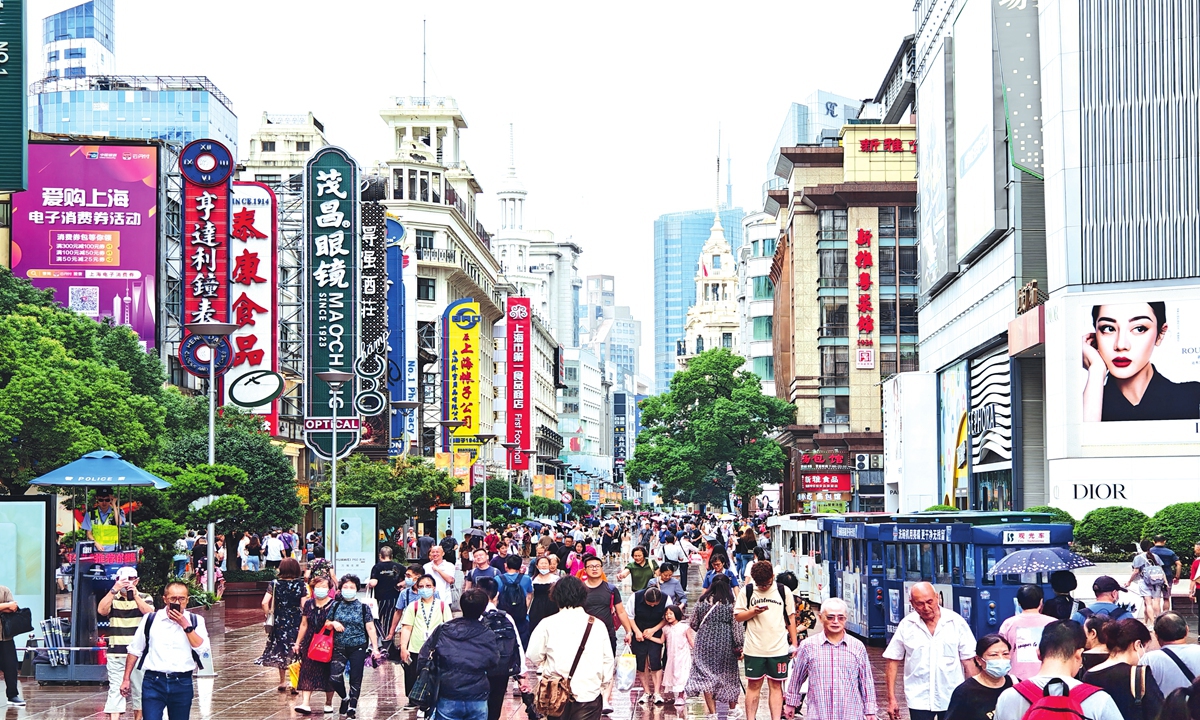
Bustling scenes on Nanjing Road, East China's Shanghai Municipality on September 14, 2023 Photo: VCG
This autumn of 2026 lays bare a stark contrast between a turbulent world and China's stable governance. On one side, the ongoing conflict in the Middle East keeps roiling global energy supplies. Diesel prices in Europe and the US have climbed to an all time high of around $220 per barrel. Meanwhile, France and wider Europe are gripped by sustained unrest, with long simmering social contradictions boiling over. On the other side, China presents a vastly different picture over the same period. Nationwide cross regional trips reached 2.144 billion over the seven day National Day holiday, bringing the combined figure for the Mid Autumn and National Day holidays close to 2.8 billion as people traveled across the country. In September, China's consumer price index (CPI) rose by just 0.9 percent year on year, while food prices actually fell by 1.7 percent.The world is in turmoil, yet ordinary Chinese people can still plan trips and live their lives with peace of mind. Many are asking why the global crises unfolding elsewhere seem to have limited impact on China. The answer is straightforward: It's not that the storm has automatically veered off course; it's that we have preemptively shielded people's livelihoods from these risks.
Ample, diversified stockpiles form the first "flood retention zone" that stabilizes prices, preventing violent swings in international markets from spilling over into households' grocery baskets and store shelves. As the world's largest crude oil importer, China's crude imports tumbled to roughly 8.1 million barrels per day in the second quarter. Imports fell below 8 million barrels per day in May and June, hitting the lowest level since 2016. Even so, there was no shortage of refined oil supply domestically. Industry estimates that China's strategic petroleum reserves are ample. Together with substantial inventories of refined products, these reserves provide a reliable buffer at the onset of a crisis. Where others face immediate supply collapse once shipments are cut off, China holds sufficient reserves to stay calm.
At the same time, the bottom line of China's food security remains firmly secured. Summer grain output in 2026 surpassed 300 billion jin (150 million tonnes) for the first time. The country's daily capacity to process and supply grain and edible oils exceeds 1.8 million tons for each category. These national stockpiles grant China ample room for maneuver amid external shocks.
A complete and highly resilient industrial chain acts as a "wave breaking dyke" that dampens the transmission of risks. Shocks from rising global commodity prices are absorbed and softened at successive links along the industrial chain, so their impact on end consumer goods is greatly diluted by the time they reach shoppers.
To be clear, China is not immune to external shocks - as reflected in that 32 percent quarter on quarter drop in crude imports in Q2. But production never ground to a halt. In September, the value added output of industrial enterprises above designated size rose 5.5 percent year on year, with a 5.3 percent cumulative gain for the first three quarters. Manufacturing output grew 6.0 percent, automobile manufacturing by 6.7 percent, and electronics manufacturing surged by 16.4 percent. While fierce storms rage abroad, our factories keep running and industrial links hold firm. That is our source of confidence.
Behind this lies the resilience provided by China's diversified energy system. In the first nine months of this year, domestic output of raw coal from industrial enterprises above designated size reached 3.45 billion tons, crude oil 164.6 million tons, and natural gas 196.7 billion cubic meters. In September, nuclear, wind and solar power generation increased by 21.5 percent, 10.6 percent and 19.5 percent year-on-year, respectively. By the end of August, installed photovoltaic capacity surpassed that of coal-fired power for the first time in history, becoming China's largest source of installed power generation capacity. When the price of one energy source rises, alternative sources can quickly step in to fill the gap.
More importantly, China's industrial chains have mechanisms for absorbing and sharing costs, meaning that rising raw material prices are not simply passed directly on to consumers. In September, national industrial producer purchase prices rose 6.9 percent year-on-year, while prices in upstream coal mining surged 35.3 percent and those in oil and gas extraction climbed 24.5 percent year-on-year. By proactively reducing profit margins and flexibly adjusting production schedules, the domestic refining and petrochemical sector, in conjunction with the refined oil price regulation mechanism, ultimately limited the year-over-year increase in domestic retail prices for refined oil products to 16.6 percent. In some other countries, the surge in global oil prices has translated directly into higher household expenses.
Why is China consistently able to build a solid bulwark against turbulent winds and rough seas? The answer lies in an efficient, well-coordinated and proactive government that takes a holistic approach and intervenes when necessary to provide timely support. Ahead of the summer peak in energy demand, the government made early arrangements to ensure energy supplies nationwide. A high proportion of medium- and long-term contracts for thermal coal, electricity and natural gas were signed and fulfilled, laying a solid foundation for stable supplies and prices.
This summer, China's national peak electricity demand set new records three times, reaching a high of 1.553 billion kilowatts. Yet coal inventories at centrally dispatched power plants consistently remained sufficient for more than 30 days of consumption. Not a single province experienced power rationing, and no region had to implement rolling blackout. Faced with a massive travel surge totaling 2.144 billion passenger trips during China's National Day holiday, public security, transportation and meteorological authorities worked in coordination to support road travel, with self-driving trips accounting for more than 90 percent of journeys. Travel by new-energy vehicles reached 1.8 times the usual daily level, while expressways continued to operate smoothly even as traffic peaked at 71 million vehicles on the first day of the holidays. It is precisely the combination of an efficient market and a proactive government that ensures economic and social activities can be effectively organized and coordinated.
Looking ahead, global turbulence will not easily disappear, and new "gray rhino" and "black swan" events could emerge at any moment. China has never been sheltered from the storms sweeping the world. What makes a major country truly great is not merely its vast size or its loud voice, but its ability to ensure that, even amid raging storms, ordinary people can still buy their daily groceries, turn on the lights and begin another ordinary day with peace of mind.
Those 2.144 billion passenger trips represent more than just a travel boom. They are also a confident testament to the country's chosen path of development. It is not that the storms have passed China by, but that China has kept their full force from disrupting the everyday lives of hundreds of millions of people.
RELATED ARTICLES