Long March spirit sails on in China’s modern navy
Long March legacy inspires innovation, spurs self-reliance: experts
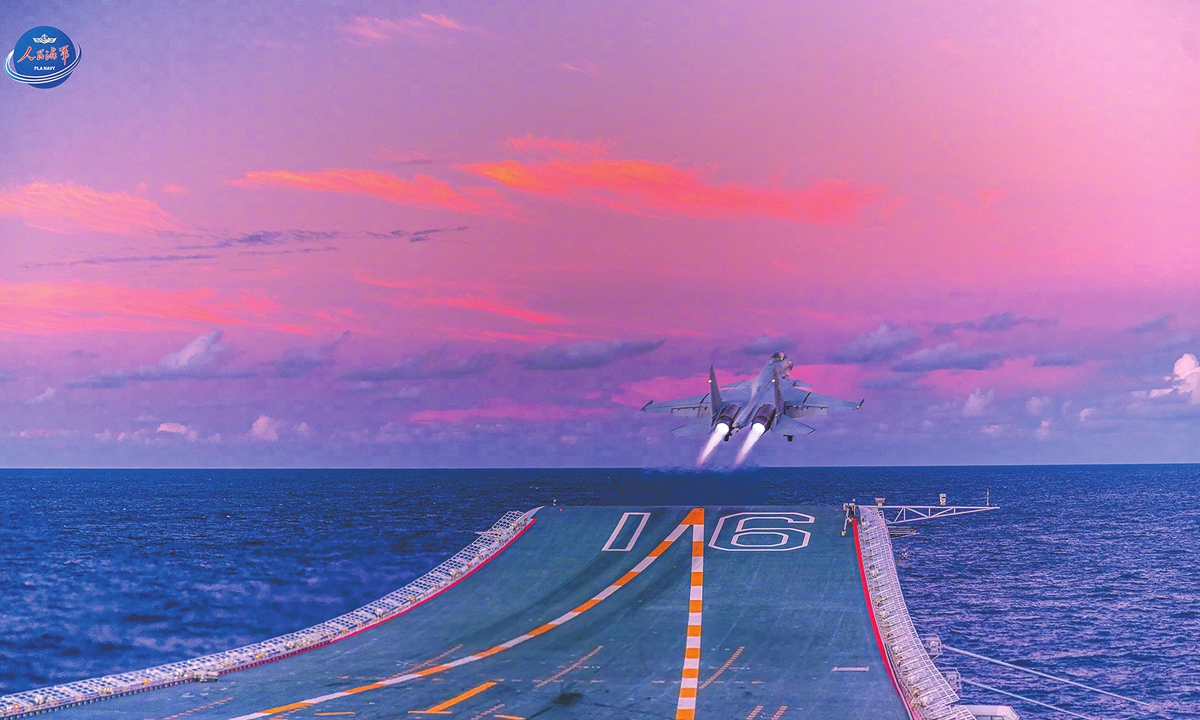
A photo released by the Chinese People's Liberation Army (PLA) Navy on August 6, 2026, shows the moment when a J-15 fighter jet took off from the aircraft carrier Liaoning amid sunset hues. Photo: WeChat account of the PLA Navy
From nuclear-powered submarines beneath the waves to destroyers on the open sea, names that originated in China's Long March now travel far beyond the routes once taken by the Red Army in the 1930s. The name Changzheng, or Long March, has become the hallmark of China's nuclear submarines, while warships named Zunyi, Chishui and Aba, important places along route of the Long March, carry reminders of the epic journey into today's naval missions.
Ahead of Thursday's 90th anniversary of the victory of the Long March, China's military is reflecting on how that experience helped shape its direction and development. Experts said the legacy lives on in the equipment China builds: the pursuit of independent innovation and the determination to overcome formidable obstacles give these historic names a meaning that extends beyond remembrance.
That connection stretches from Long March-1, China's first nuclear-powered submarine, commissioned in 1974, to the third generation of Long March nuclear submarines and a recently reported strategic missile test by a nuclear-powered submarine, according to a report by the Xinhua News Agency. Alongside them, successive generations of surface warships have carried the names of places associated with the Long March, linking the navy's expanding capabilities with its revolutionary heritage.
History carried to sea
The Long March was an epic military trek from 1934 to 1936 that broke through the encirclement of Kuomintang forces. Red Army soldiers braved raging rivers, snow-covered mountains and treacherous grasslands, with some marching as far as 12,500 kilometers. The maneuver helped lay the foundation for the eventual victory of the Chinese revolution.
Ruijin, Zunyi, Chishui, Aba and Liupanshan are some of the places associated with that arduous undertaking, which culminated with the joining of the Red Army's main forces in October 1936. Nine decades later, its influence can be traced in a very different setting: China's naval fleet.
China's Long March nuclear submarines have developed to a third generation, and a Long March nuclear submarine has had a successful test launch of a submarine-launched strategic missile, the Xinhua News Agency reported on Saturday. This evolution follows a path that began with the country's first nuclear submarine entering service in 1974.
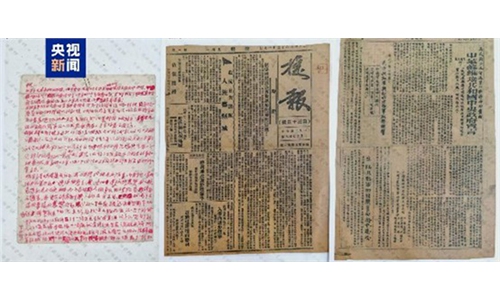
According to CCTV News, the name Long March was adopted following a worker's suggestion. It reflected the difficulties overcome in developing the submarine and symbolized its endurance and ability to undertake missions in distant waters. The name subsequently became a defining feature of China's nuclear submarine force.
The development of China's strategic nuclear submarines has focused on quieter operations, greater stealth and survivability, improved diving performance and greater diving depths, Zhang Junshe, a Chinese military affairs expert, told the Global Times on Wednesday. He also pointed to the pursuit of greater missile capacity and longer missile ranges.
Naming the submarines after the Long March honors that history and carries forward a commitment to overcoming hardship, making sacrifices and following a path of self-reliance, Zhang said. It reflects the circumstances in which Chinese military equipment was developed, with external technological restrictions compounded by a weak domestic industrial base at the time.
Overcoming those barriers required a determination comparable to that of the Long March, Zhang said. The name therefore connects the difficulties of the revolutionary journey with the challenges faced by generations of equipment developers.
That connection also runs through the names of surface warships. Li Junjie, an associate professor at the School of History and Culture of the Minzu University of China, told the Global Times on Wednesday that many names in the military's equipment buildup draw on places associated with the Long March.
Zunyi in Guizhou Province is associated with the conference that marked a pivotal turning point in the history of the Communist Party of China, and it has lent its name to two generations of destroyers, Li said. The succession allows the historical memory embodied in the name to continue as the ships themselves evolve.
The current Zunyi is an independently developed and built Type 055 guided-missile destroyer of a 10,000-ton class. Since entering service, it has undertaken combat-readiness patrols, maritime rights-protection operations and joint exercises involving multiple services and branches, according to Chinese media reports. It spends more than 200 days at sea annually on average and has sailed nearly 180,000 nautical miles.
Its predecessor, a Type 051 guided-missile destroyer also named Zunyi, was decommissioned in 2019 after more than 30 years of service, according to China's Defense Ministry.
Zhang said that People's Liberation Army Navy's Type 055 destroyers have strong far seas capabilities, citing their strong air and missile defense capabilities and their ability to engage surface ships, submarines and land targets. In the future, he said, the Long March spirit will continue to encourage equipment development toward greater use of intelligent technologies and unmanned systems, strengthening the PLA Navy's ability to perform diverse missions and conduct integrated combat operations.
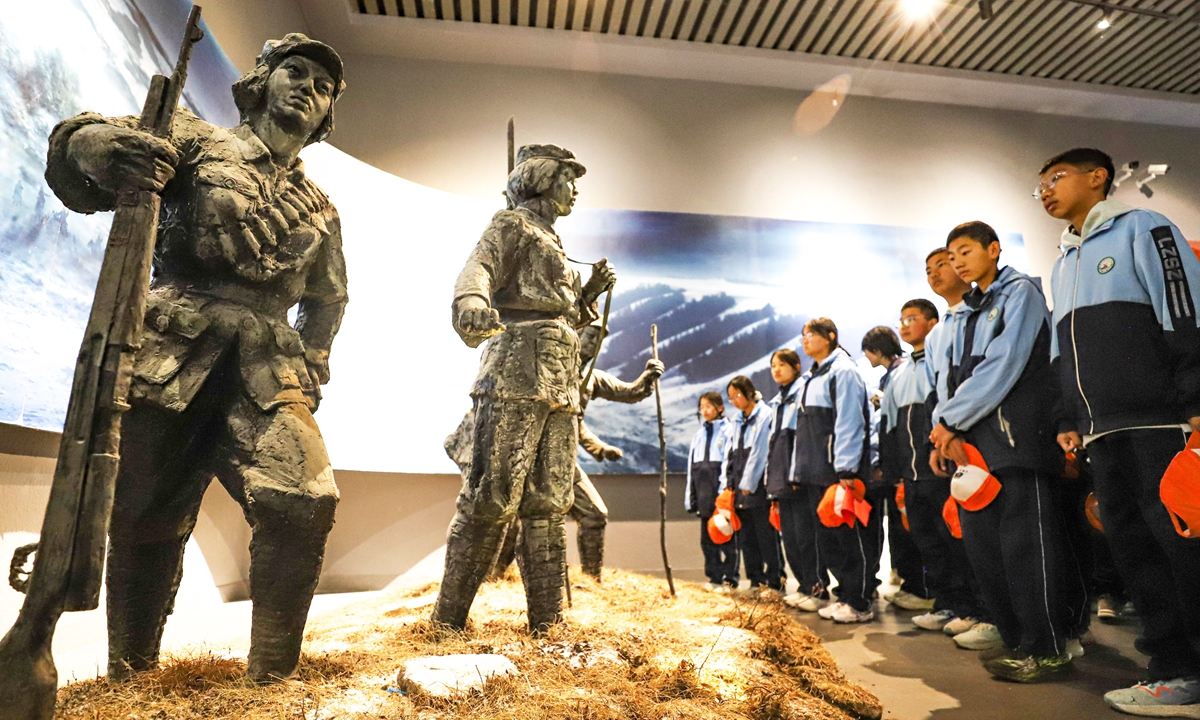
Students from Linze county No.4 Middle School listen to stories of the heroic Long March of the Red Army at a memorial hall in Zhangye, Northwest China's Gansu Province on October 21, 2026. Photo: VCG
A legacy renewed after 90 years
The anniversary has also prompted reflection on the lessons that reach beyond the equipment itself. An article published on the Ministry of National Defense website on Wednesday examined what the Long March can teach today's military, emphasizing Party leadership, the motivating power of political mobilization and lessons for national defense mobilization.
The article recalled the severe conditions confronting the Red Army: encirclement and interception while outnumbered greatly by enemy forces, harsh natural environments, scattered and limited local support, and acute shortages of supplies and equipment. Under the CPC's leadership, the Red Army adopted different mobilization strategies to secure personnel, material and financial resources, while winning support from the people.
That experience demonstrated that Party leadership is essential to keeping wartime mobilization on the right course, while political mobilization provides a powerful source of motivation for military victory, the article said.
It called for using the implementation of the newly revised National Defense Mobilization Law to further develop a framework in which the Party exercises overall leadership, the military identifies the requirements and the government implements them. Under unified Party leadership, military and civilian authorities should fulfill their respective responsibilities while coordinating closely, it said.
A Xinhua editorial on Tuesday described the Long March spirit as a precious legacy forged through the sacrifices of CPC members and Red Army soldiers. It placed the fundamental interests of the Chinese people and nation above all else, and stressed the willingness to confront hardship and make sacrifices to save the country and its people.
The editorial also highlighted independence, seeking truth from facts and acting according to actual conditions, as well as paying attention to the overall situation, strict discipline and unity, and close reliance on the people, sharing their hardships and persevering together.
For Li, firm ideals and convictions form the main part of what the Long March left to China's military. "Passed down through generations, this revolutionary heritage helps unite thought and action, purpose and strength, shaping a people's military defined by discipline, conviction and a sense of responsibility," he said.
From military organization to equipment development, each era adds to the meaning of the Long March spirit by applying it to new circumstances, Li said. The names remain familiar, but the task of carrying their legacy forward is renewed with each generation.
"Every era has its own understanding of the Long March," Li said. "What matters is drawing strength from it and continuing to move forward."
RELATED ARTICLES