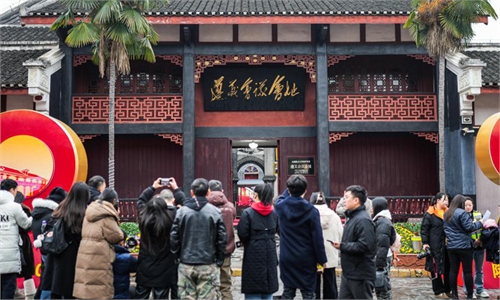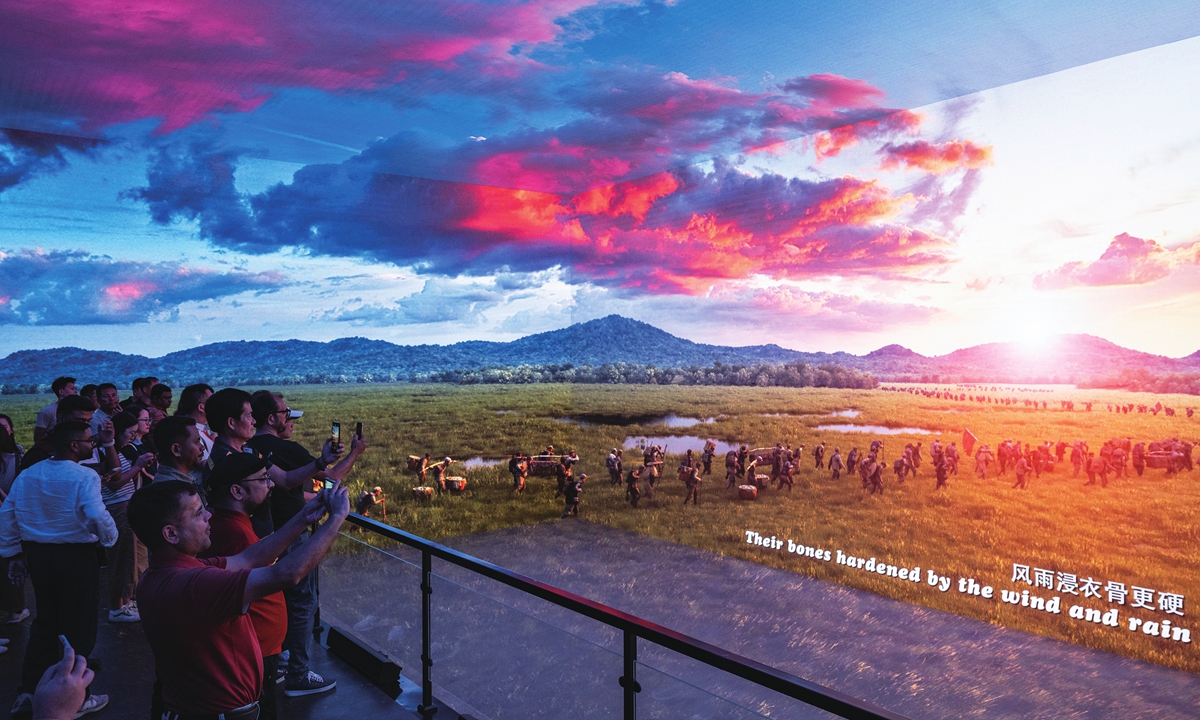
Foreign media representatives explore the history of the Long March of China's Red Army through multimedia displays at the Museum of the Communist Party of China in Beijing on June 24, 2026. Photo: VCG
Editor's Note:
This year marks the 90th anniversary of the victory of the Long March, a remarkable revolutionary feat achieved under the leadership of the Communist Party of China (CPC). The Long March spirit features firm revolutionary ideals and convictions, dauntless courage and a spirit of sacrifice, independence and truth-seeking, strict discipline and unity, and close ties with the people. Deeply embedded in the identity of the Chinese nation, this spirit also holds valuable lessons for the world today. The Global Times invited three foreign experts to share their perspectives on the Long March spirit and its enduring relevance in the modern era.
Mark Levine, an American professor at Minzu University of China
I first encountered the story of the Long March in the 1960s during my college years, and gained deeper insight in the mid-1970s after reading Edgar Snow's classic work Red Star Over China. At that time, I saw the Long March as a glorious chapter in Chinese history: a tough journey defined by persistent effort, extraordinary courage and firm faith forged through extreme hardship.
After more than two decades living in Chinese society, observing the country's dramatic changes, communicating with people from remote villages to modern cities, and visiting revolutionary sites including Zunyi, Xibaipo, Yan'an and most recently Jiajin Mountain in Sichuan Province, I have developed a richer and more personal understanding. The Long March is clearly not a closed chapter of history. From all the tremendous changes I have witnessed, I clearly see it as a living, evolving spirit for the new era. Facing harsh natural environments, wild terrain and constant military suppression, Chinese revolutionary leaders chose faith over despair, unity over division, and collective dedication over personal gain. As Chairman Mao explained in his essay "On Protracted War," victory would not come quickly, but it would surely come.
For a long time, Western narratives reduced this historic feat to an outdated legend, something of the past. My 21 years in China have demonstrated to me that this spirit has never faded. It has simply taken on new meaning and adapted to the needs and dreams of the new era.
I have seen the new Long March spirit in China's grassroots development. I traveled to remote western areas once isolated by poor transportation and trapped in long-term poverty, similar to the harsh landscapes the Long March revolutionaries endured. Today, local villagers, rural teachers, grassroots workers and engineering pioneers are undertaking a quiet yet persistent modern Long March. They have built mountain roads, connected isolated villages to the outside world, expanded education and medical resources across rural China, and lifted hundreds of millions out of poverty. There are no grand battles or dramatic heroics here. Yet every effort to change local fortunes and pursue shared prosperity embodies the perseverance and selflessness of the original Long March spirit.
I have come to understand that this spirit rejects stagnation and embraces continuous renewal. Western views once fixed the Long March as a distant, static historical story. But my years of immersive experience prove it is a living belief that shapes modern China. I see it in my students' growing sense of social responsibility, in the revitalization of rural communities I have documented over the years, and in Chinese innovators' courage to move forward amid external barriers. It lives in tech pioneers breaking limits, rural people reshaping their futures, and ordinary individuals choosing collective progress over personal comfort. This is not distant history, but a powerful, ongoing force driving China's new-era development and offering precious spiritual wisdom for today's troubled, interconnected world.
Ken Hammond, a professor of East Asian and global history at New Mexico State University
The history of the Long March is well known. As a student of Chinese history in the 1970s, I had read books and articles about it. After I first moved to Beijing in 1982, I learned about it in new ways over the following years, talking with friends, sometimes meeting their parents, who remembered the epic struggles of the revolution. Once I even met a veteran of the Long March. It was also a period during which Long March comrades were passing away as their generation grew older. I remember that each time one of them died, there would be headlines in the People's Daily and other papers and reverent coverage of funerals at Babaoshan. The Long March and those who had taken part were honored and respected. Perhaps more importantly, the spirit of the Long March lived on.
In the autumn of 1934, the Chinese Soviet Republic, established in Ruijin, Jiangxi Province, faced great adversity. Nationalist forces were pressing to destroy the base area and the Red Army. The leadership of the Soviet, including Zhu De, Zhou Enlai and Mao Zedong, decided to withdraw from their mountain stronghold and strike out to the west, to eventually reach the revolutionary base area in northern Shaanxi. This called for tremendous courage and tenacity, which the cadres of the CPC and the fighters of the Red Army displayed in abundance. Enduring incredible hardships and facing unknown obstacles, they remained resolute, fearing no sacrifice, and surmounting every difficulty. In late 1935, the first body of troops reached Shaanxi. A year later, on October 22, 1936, the Second and Fourth Front Armies of the Red Army met up with elements of the First in Gansu, and this finally brought the last stage of the Long March to a close.
Now we observe the anniversary of the Long March, not merely as an episode of historical interest, but as an inspiration for the spirit of profound commitment to the struggle to build a new socialist China, carrying on the heroic efforts of the past in the new era of the 21st century. Ninety years have passed since the end of the Long March, yet the legacy of that journey remains alive. The Long Marchers were ordinary Chinese people, called upon by history to undertake extraordinary tasks. They embodied the best qualities of Chinese society: The hard work, honesty, and solidarity that still animate the drive to create a more just, equitable and prosperous China and to face the existential crises of climate change, global development, and international peace and stability.
Not only in China, but among people around the world who share the work of fighting for a better future for all of us, the spirit of the Long March is a guiding light, reminding us of the need to persevere even in adverse times, to remain devoted to the path of socialist development and the fight for a bright tomorrow.
Thet Mon Tun, a deputy chief editor of Myanmar Nation Voice
Understanding the collective triumph and unity of the Long March of the Chinese Workers' and Peasants' Red Army 90 years ago would assist in understanding China today. Scholars and analysts in today's era are trying to figure out "why China is different." The best way to find out might be to explore the unimaginably harsh conditions of the Long March 90 years ago.
Resilience is the symbol of the Chinese people and the Chinese nation. The solidarity and tenacity of the older generation of Red Army soldiers led by the CPC still represent a psychological model for many generations fighting in the face of barriers and obstacles on the road to victory. The Long March was not just a retreat or a defensive strategy; it was a struggle against multiple hardships, including insufficient food supplies, lack of medical supplies, limited military resources, extreme weather, a very long journey, and the massive loss of comrades. Amid such adversities, hope and determination to bring about change were the only lighthouses in their march. This legacy is still alive for the Chinese people even in this new era.
When the Red Army left its bases in the southern parts of China in October 1934, it involved nearly 90,000 soldiers, most of them workers and peasants by background. However, documents suggest that only around 30,000 soldiers from different routes and columns completed the march in October 1936. Despite massive losses during the journey, the CPC-led Red Army consolidated its strength, established a theoretical political foundation, and revised its strategies for the fight against Japanese aggression so as to turn the revolutionary struggles into national success in founding the People's Republic of China in 1949. Those innovative theoretical political paradigms would go on to shape China's political visions today.
In recent decades, the world has witnessed the emergence of the "China Miracle" together with the remarkable rise of the Chinese economy and technology following Chinese modernization. In fact, if China's modernization is a development miracle in Chinese history, the Long March is a survival miracle in its revolutionary memory.
RELATED ARTICLES