Illustration: Liu Xidan/GT
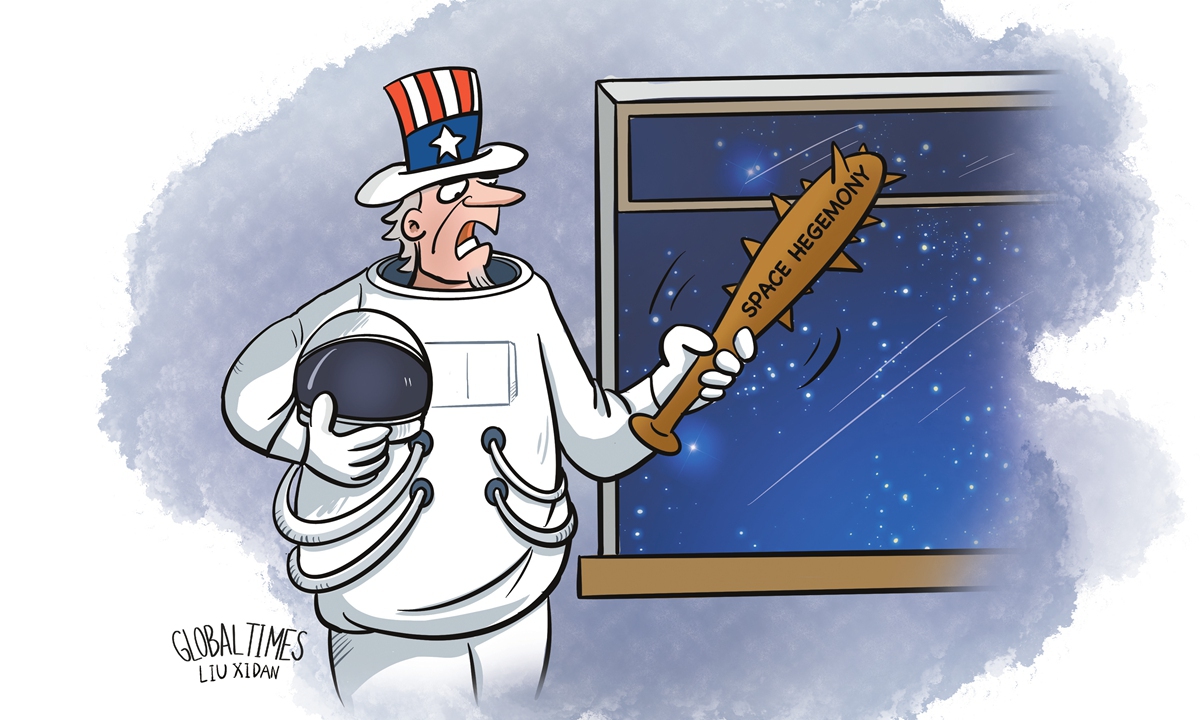
Preventing an arms race and the weaponization of outer space is the most urgent task in outer space security governance, China's Ambassador for Disarmament Affairs Li Chijiang stressed on Wednesday in a statement on outer space issues at the First Committee of the United Nations General Assembly.Li said that an arms race and the weaponization of outer space have become real threats, reported the Xinhua News Agency on Thursday. The US has designated outer space as an "operational domain" and openly acknowledged the deployment of space-control weapons in orbit, sending an extremely dangerous signal to the international community.
The contradiction between the aspirations of the vast majority of countries to safeguard outer space security and the ambition of one country to dominate outer space has become more acute than ever, Li said, adding that this is the greatest challenge facing outer space security.
Li outlined four proposals on behalf of China. First, preventing an arms race and the weaponization of outer space is the most urgent task in outer space security governance. Without addressing this fundamental issue, all other rules governing outer space will be undermined.
Li added that all countries should uphold the principle that "a war in outer space cannot be won and must not be fought," abandon strategies aimed at "dominating outer space," and refrain from engaging in great-power competition or bloc confrontation in outer space.
International efforts to negotiate and conclude a treaty on arms control in outer space should be strengthened, Li said. Experience has shown that voluntary rules cannot prevent the weaponization of outer space, per the report.
The Draft Treaty on the Prevention of the Placement of Weapons in Outer Space, the Threat or Use of Force against Outer Space Objects, jointly proposed by China and Russia, is currently the only proposed legal instrument on arms control in outer space. Its core provisions could fundamentally curb the weaponization and militarization of outer space. China welcomes discussions among all parties to further improve the draft text, the ambassador said.
Multilateral consultations should be upheld and double standards opposed, Li noted. Rules governing outer space should be formulated jointly by all countries, rather than through exclusive arrangements among small groups of states. International cooperation on the peaceful uses of outer space should be actively promoted.
"Turning a blind eye to the deployment of weapons in orbit while pursuing 'selective arms control' will do nothing to safeguard peace and security in outer space," Li said.
Li also emphasized that due attention should be paid to the governance of emerging issues. In-depth studies should be conducted into the legal controversies and practical challenges arising from the involvement of commercial space activities in armed conflicts in other countries. Feasible governance solutions should be explored on the basis of broad consultations.
Global Times
RELATED ARTICLES