Indian experts highlight AI, maritime cooperation with China, voice hope for progress on border issue
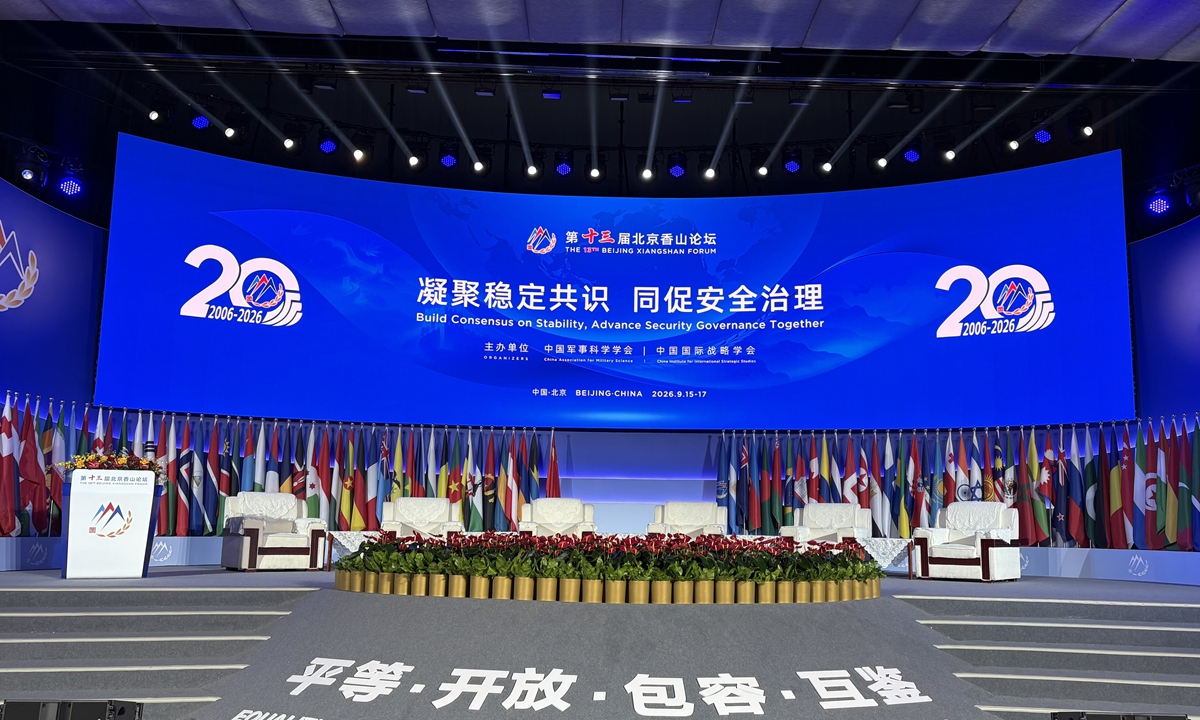
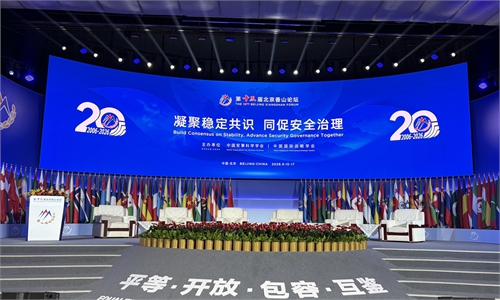
Under the theme "Build Consensus on Stability, Advance Security Governance Together," the 13th Beijing Xiangshan Forum runs from September 15 to 17, 2026 in Beijing, China. Photo: Feng Fan/GT
Indian experts attending the 13th Beijing Xiangshan Forum highlighted cooperation with China on AI governance and maritime security, expressing hope that continued dialogue would ease border tensions and gradually advance a settlement while allowing broader bilateral cooperation to move forward.
Several Indian military experts attended the forum, which concluded on Thursday, following frequent high-level interactions between China and India. Under the theme "Build Consensus on Stability, Advance Security Governance Together," the event brought together around 2,000 guests from more than 100 countries, regions, and international organizations, providing opportunities to exchange views on shared security concerns.
Retired Lieutenant General Ravindra Singh Panwar, a distinguished fellow at the United Service Institution of India, told the Global Times at the venue that all three Indian defense attachés had attended the forum for the first time in recent years.
He viewed their participation as a sign of a series of steps being taken by the two countries to improve relations. The aim was to maintain peace along the border and continue discussions toward a settlement, while also making progress in other mutually beneficial areas, including people-to-people exchanges, he said.
Panwar said both India and China share support for multilateralism and for multilateral platforms such as BRICS amid the changing geopolitical landscape.
Asked about potential security cooperation between China and India, Panwar said "there is a momentum in that direction." He also expressed the hope that it will continue.
That view was echoed by retired Vice Admiral Shekhar Sinha, a member of the Governing Council of the Indian Council of World Affairs. Resolving the border issue will be a long-term process, beginning with building mutual confidence and identifying areas where both sides share the same understanding of the border, he said.
Where differences in perception remain, more dialogue will be needed, he added.
Their comments followed the 25th round of talks between the special representatives of China and India on the boundary question, held in Beijing on August 25, 2026, which produced an eight-point consensus, according to the Chinese Foreign Ministry.
The two sides reiterated their commitment to following the consensus reached by the leaders of the two countries and maintaining peace and tranquility in the border areas, so as to create a favorable atmosphere for the sound and steady development of bilateral relations.
Alongside these diplomatic efforts, both experts described cooperation in their own professional fields.
Panwar, who served in the Indian Army's Corps of Signals and now focuses on AI, said he had been involved in Track 2 diplomacy for the past four years. He meets Chinese counterparts online every four to six weeks and holds in-person discussions at least twice a year.
At the Beijing Xiangshan Forum, he discussed AI governance with Chinese, US, and other international delegations, including risks involving nuclear issues, chemical weapons, and potentially existential threats.
Maritime security offered another area of cooperation. Sinha, who spoke at the forum's "Sea Lane Security and Maritime Security Governance" session, said the Chinese and Indian navies had cooperated on counter-piracy and escort operations.
Both experts expressed hope that continued exchanges would help the two countries expand cooperation while working through their differences.
RELATED ARTICLES