Beijing Xiangshan Forum concludes as experts hail platform for Global South, dialogue across divides
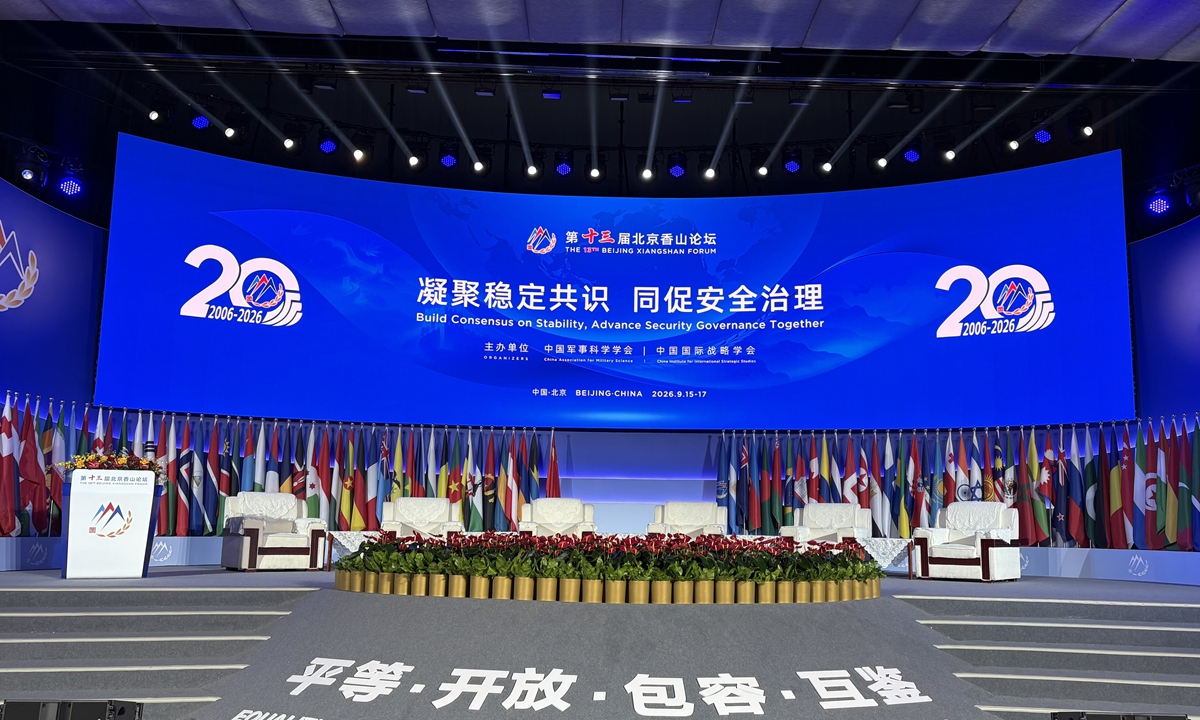
Under the theme "Build Consensus on Stability, Advance Security Governance Together," the 13th Beijing Xiangshan Forum runs from September 15 to 17, 2026 in Beijing, China. Photo: Feng Fan/GT
The 13th Beijing Xiangshan Forum concluded on Thursday afternoon, with participants praising its role in giving Global South countries a voice and bringing together parties with conflicting interests to discuss pressing security challenges.In his closing remarks, Yin Zhongliang, a senior adviser to the China Institute for International Strategic Studies and former Chinese military representative to the United Nations (UN), said participants had engaged in frank and practical exchanges in a spirit of equality, openness, inclusiveness and mutual learning.
The exchanges had deepened understanding, built consensus and helped manage differences, Yin said. The forum would keep its doors open as a shared platform for security dialogue and continue contributing ideas to world peace and regional stability, he added.
That openness was reflected in the range of participants. At Thursday's plenary sessions, Lieutenant General Kim Kang Il, vice minister of national defense of the Democratic People's Republic of Korea, addressed the forum. Jürg Lauber, vice-president of the International Committee of the Red Cross, also spoke.
Representatives from the Global South included Captain Sione Ongoleo Faingaanuku Lino, deputy chief of staff of His Majesty's Armed Forces of Tonga, and Air Marshal Martin Kambulu Pinehas, chief of the Namibian Defence Force.
Through 13 iterations, this forum has provided a platform for a global dialogue on peace and security, Lauber said during the morning session. "As armed conflicts proliferate and security challenges grow more complex, the forum provides a valuable space to examine emerging security challenges and consider avenues for greater stability."
Lauber's speech pointed to the breadth of topics discussed. According to organizers, the forum held four plenary sessions, eight parallel sessions and nine closed-door academic seminars. Topics included political settlements of regional conflicts, a constructive China-US relationship of strategic stability, international AI safety governance, global security governance, major-country relations and strategic stability, and international arms control.
Experts attending the forum told the Global Times that it offered countries large and small opportunities to express their views, while providing channels of communication for parties divided by conflict.
Koba Liklikadze, a coordinator in the Protocol and Public Relations Division of Georgia's State Service of Veterans Affairs, told the Global Times on Thursday that the international order grounded in the UN Charter was becoming "weaker and weaker."
"But China plays a peacekeeping role all over the world, which makes it the cornerstone of this meeting," he said.
For retired Lieutenant General Ravindra Singh Panwar, a distinguished fellow at the United Service Institution of India, the forum's value lay in allowing participants with sharply conflicting interests to engage with each other directly.
"You can have Russia and Ukraine in the same room and completely at loggerheads with each other. Yesterday, we saw in the second panel how Iran and Saudi Arabia were on the same panel," Panwar told the Global Times.
"So it's a unique forum where it allows diverse opinions to come on the stage and speak their minds," he said.
Those exchanges also extended to areas where countries face shared risks. Panwar, who is also an expert on AI, said he had discussed AI governance with Chinese, US and other international delegations at the forum and was pursuing cooperation.
Although AI competition is often viewed as a zero-sum game, its implications for nuclear security, biological weapons and potentially existential risks demand common attention, he said.
"These areas are of equal concern to all countries," Panwar said.
He also noted that all three Indian military attachés had attended the forum for the first time in recent years. He hoped to see greater participation by senior representatives from both India and China, allowing more consultation and better management of differences.
The need to sustain such exchanges beyond the meeting was also central to Yin's closing message.
"Although this forum is drawing to a close, our dialogue will not stop, nor will our cooperation," Yin said, expressing hope that participants could take the consensus reached during the forum back to their countries, maintain communication, resolve differences through consultation and respond to crises through cooperation.
RELATED ARTICLES