Injecting greater momentum into building a China-Indonesia community with a shared future
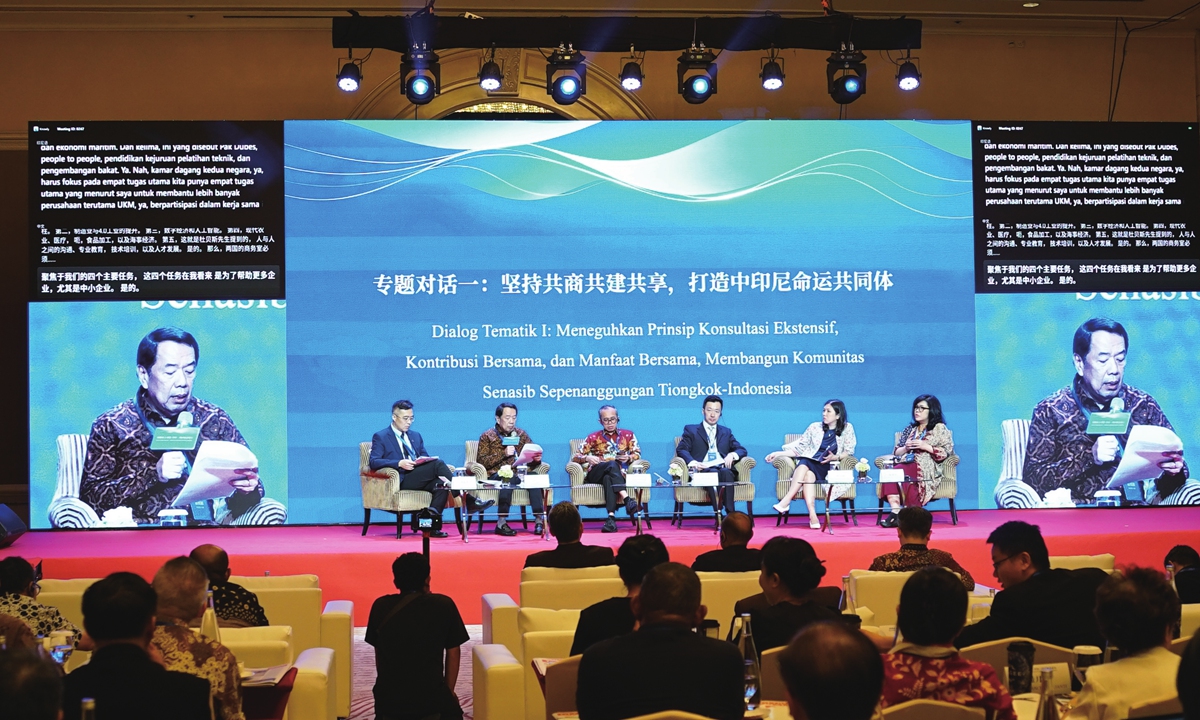
The Panel I of "Global South Dialogue: China-Indonesia Roundtable Forum" is held in Jakarta, Indonesia, on October 19, 2026. Photo: Wang Wenwen/GT
Editor's Note:
The "Global South Dialogue: China-Indonesia Roundtable Forum," hosted by the Global Times, was recently held in Jakarta, Indonesia. More than 150 guests from various sectors in China and Indonesia held in-depth discussions on topics such as building a China-Indonesia community with a shared future, strengthening China-ASEAN regional cooperation and promoting the common development of the Global South. These are the highlights from the discussions during the first expert panel.
People-centered development is essential
Niu Liangliang, head of the China Council for the Promotion of International Trade Representative Office in Indonesia: China has been Indonesia's largest trading partner for 13 consecutive years. From the perspective of Chinese companies, entering the Indonesian market and investing there involves two major considerations.
First, companies are concerned about the broader business environment and hope to see greater policy continuity and stability, as well as a favorable business environment. Market access rules, regulatory compliance procedures and transparency are also major concerns.
The second is about industrial and supply chains. Chinese companies in Indonesia operate across a wide range of sectors. Indonesia's emphasis on localization and downstream industrial development suggests that there may still be quite a few gaps among the upstream and downstream companies involved from a supply chain perspective. Securing local suppliers to mitigate disruptions to imported materials and international logistics is a key concern. Both countries' trade promotion organizations should help companies identify investment opportunities and foster bilateral business cooperation.
Jona Widhagdo Putri, special advisor to the Chairman of the National Economic Council of the Republic of Indonesia: Indonesia is currently pursuing industrial upgrading and economic transformation. From the perspective of the "triple helix" model of BIG- business, intellectuals and government - China and Indonesia can identify key areas for policy coordination and leverage their respective strengths to promote shared development.
At the government level, better strategic alignment and complementarity are essential. China has its own vision of modernization, while Indonesia has its Golden Indonesia 2045 vision. These agendas involve industrial development, innovation, productivity and public well-being - all core areas for both China and Indonesia.
At the business level, the two countries need to recognize their respective resources and develop them in complementary ways to create greater added value. For example, cooperation can evolve from individual projects into integrated value chains. This is not just about building value chains within Indonesia or China. It's about building global value chains.
In terms of technology and intellectual property, Indonesia has established numerous research institutions and joint laboratories. China and Indonesia can further strengthen industrial technology exchanges and expand their cooperation into new areas.
Sustainable, resilient and people-centered development is essential. People-centered development requires investment not only in physical infrastructure but also in soft infrastructure - and, above all, in people. This includes those who formulate policies, develop industries, and conduct research and technological innovation. Therefore, I strongly support investing in people rather than focusing exclusively on physical infrastructure. By bringing all these elements together, I believe that, together, China and Indonesia can achieve these goals.
Efa Yonnedi, rector of Andalas University in Indonesia: Educational cooperation between Indonesia and China, particularly in research and innovation, deserves in-depth discussion. Student exchanges and cooperation agreements between universities in the two countries have increased significantly. The two countries have also established partnerships in vocational education.
The next challenge lies in innovation. Potential areas of cooperation include agriculture, food security, energy security and AI. Disaster mitigation is another important area for China-Indonesia research cooperation. Universities in both countries urgently need to build on existing technologies to research, develop and deploy early warning systems.
First, I believe we can establish a university alliance to address societal and industrial challenges through practical innovation. Second, beyond research, closer cooperation in talent development and education is also important. We can consider developing dual-degree programs, allowing students to study in both countries. Third, we need to ensure that technology transfer facilitates knowledge sharing. Indonesian and Chinese universities can establish joint laboratories or collaborate on specific projects to share their research outcomes.
A model for Global South cooperation
Guo Yanjun, director and research fellow of the Secretariat of the Research Center on Building a Community with a Shared Future for Humanity: China and Indonesia are both major developing countries and key members of the Global South. Building on their comprehensive strategic partnership in recent years, the two sides have steadily advanced the development of a China-Indonesia community with a shared future. Focusing on aligning with China's modernization drive and Indonesia's Golden Indonesia 2045 vision, they have carried out extensive and in-depth cooperation across trade, investment, industrial upgrading, higher education, youth exchanges and green transition. Following the principle of extensive consultation, joint contribution and shared benefits, we now need to prioritize translating major cooperation outcomes into long-term collaboration that is more inclusive, sustainable and delivers tangible gains for communities, so as to inject stronger momentum into building the China-Indonesia community with a shared future.
Adi Harsono, chairman of the Indonesia-China Alumni Friendship Association and senior advisor to the Indonesian Chamber of Commerce and Industry: Going forward, China-Indonesia cooperation can center on five priority areas. First, green and new energy industries; second, the advancement of the manufacturing sector and the industrial sector as a whole; third, the digital economy and artificial intelligence (AI); fourth, modern agriculture, healthcare, food processing and the maritime economy; fifth, people-to-people exchanges, professional education, technical training and talent development.
For the growth of bilateral business ties, I believe four key tasks will help more enterprises, especially small- and medium-sized enterprises (SMEs), take part in bilateral cooperation. These are: providing suitable platforms for SMEs; lowering barriers to cross-border operations to facilitate business activities; fostering industrial chain collaboration, including larger-scale project cooperation; and expanding accessible financing for SMEs to support technology upgrading and human resource development.
I am convinced that China-Indonesia economic and trade cooperation means more than rising trade and investment volumes. It also boosts productivity, creates jobs, nurtures local talent, and builds sustainable industrial ecosystems, generating long-term value for societies in both countries.
Christine Susanna TJHIN, director of Strategic Communication and Research, Gentala Institute: Indonesia and China both play prominent roles on multilateral platforms including ASEAN and the BRICS cooperation mechanism. This is evident not only in navigating the current geopolitical landscape, but also in responding to evolving development challenges and governance reforms, especially within global governance. As comprehensive strategic partners, China-Indonesia cooperation can serve as a model for collaboration across the Global South.
At the regional level, ASEAN and BRICS countries are delivering ever more effective coordination, unlocking broader cooperation potential. As one of ASEAN's leading members, Indonesia is now a full BRICS member - the first Southeast Asian state to join the grouping. This puts Indonesia in a unique position: It can bring ASEAN's priorities into discussions within the "BRICS family," and also introduce global issues debated in BRICS to ASEAN forums. Expanded dialogue and joint problem-solving help the Global South respond to global challenges, starting at the regional level.
Broader prospects for cooperation between enterprises
Harsono: Major investment projects jointly undertaken by Indonesia and China have given the Indonesian people a tangible sense of the benefits of cooperation and made those benefits more accessible to them. The Jakarta-Bandung High-Speed Railway is a prominent example.
When it comes to this project, I believe we shouldn't view it solely from an infrastructure perspective. Through cooperation with China, the Jakarta-Bandung High-Speed Railway, the first high-speed railway in Indonesia and Southeast Asia, has given Indonesians access to public services on a scale they had never experienced before. Today, people living in Bandung can commute to Jakarta for work and return home in the evening, without worrying about getting stuck in Jakarta's traffic. Meanwhile, real estate and other commercial activities are gradually developing along the railway, creating more opportunities for micro, small- and medium-sized enterprises in the surrounding areas.
Although the Indonesian government faces debt challenges associated with the construction of the railway, providing the best possible services to the people is essential.
Niu: In recent years, China-Indonesia cooperation has developed rapidly in emerging fields such as the green economy and the digital economy. China's economy is accelerating its transformation and upgrading. Advanced technology sectors and high-value-added products, including new energy vehicles, semiconductors and photovoltaic products, are increasingly becoming prominent representatives of Chinese industries expanding overseas.
The green and digital economies represent a new trend toward deeper China-Indonesia cooperation. Many SMEs understand that they need to expand overseas, but they may lack sufficient knowledge of foreign markets and the ability to navigate local policy environments.
This is where trade promotion organizations should play a role, by providing businesses with clearer guidance and direction. For example, both China and Indonesia have industrial clusters, each with its own regional strengths. Where these strengths are complementary, cooperation between the two sides can open up more possibilities. This can help connect Chinese companies with local partners and create more opportunities for business discussions and cooperation.
Today, companies from a wide range of Chinese industries are expanding into Indonesia, while many Indonesian enterprises are also coming to China to explore business opportunities. Both countries have numerous special economic zones and industrial parks, creating broader prospects for cooperation between Chinese and Indonesian enterprises.
RELATED ARTICLES