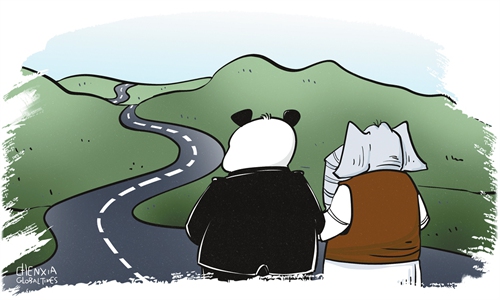
Turning a willingness to engage into action, neighbors would not remain strangers
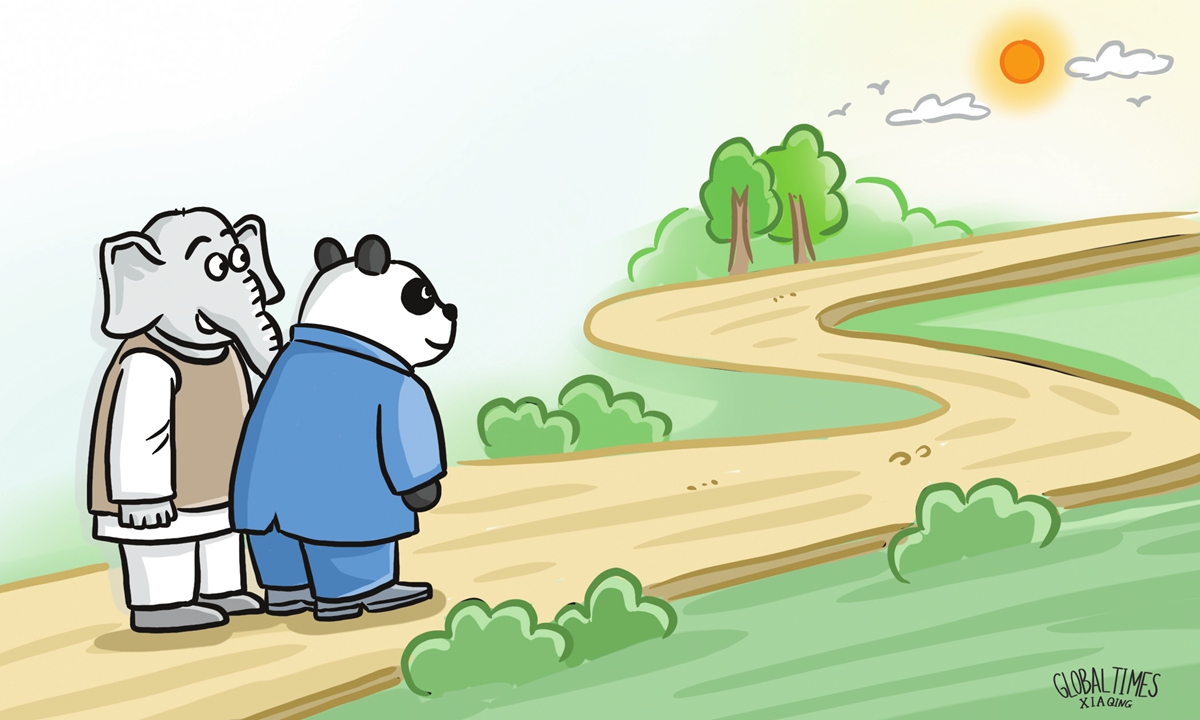
Illustration: Xia Qing/GT
In a recent interview, Indian journalist Pallavi Aiyar drew on her years in China to discuss how Chinese people view India. Her analysis prompted me to reflect: How much of our understanding of our neighbor comes from meaningful engagement, and how much from impressions repeatedly circulated within professional circles?Chinese views of India are shaped by historical memory and social experience, as well as current disagreements, personal encounters and sources of information. To understand these views, we must recognize how experiences and concerns differ across groups. More importantly, we need sustained contact with people from all walks of life to develop a fuller understanding of our neighbor.
Over years of academic exchanges, I have met many Indian scholars who have spent years studying China. Yet some of their assessments of Chinese people's lives and views of India are far removed from reality. I am well aware that my own understanding has similar limitations. I have made several brief visits to Mumbai and Delhi, but these are hardly enough for me to claim that I understand how the Indian public views China.
Aiyar's experience illustrates the value of sustained, firsthand observation. To better understand our neighbor, we must listen to different voices, and continually test and revise our judgments.
For Chinese and Indian scholars, the depth of research and the breadth of social engagement should reinforce each other. Only by grounding our study of each other's country in an understanding of their society can we gain a more accurate understanding of each other.
China and India share more than 2,000 years of civilizational exchange. When we see this broad historical context, the few conflicts in modern times do not form the central narrative through which Chinese people view India. Chinese history textbooks portray the relationship primarily through the spread of Buddhism, cultural exchanges and shared experiences of resisting colonial oppression. This historical narrative has encouraged Chinese people to see India as a partner in civilizational exchange and a fellow participant in the struggle for national emancipation.
Aiyar's reference to India's role in opium exports to China is a case in point. The Opium Wars are closely tied to Chinese memories of national suffering. Under British colonial rule, India was a major source of opium shipped to China, and some Indian merchants participated in the trade. Yet Chinese historical narratives place responsibility primarily on colonial aggression, without treating the involvement of some Indians as grounds for collectively blaming India and its people. This reflects a long view of history: remembering suffering without remaining locked in past antagonisms.
To reduce the influence of fragmented information and existing prejudices, we need to create opportunities for meaningful, sustained engagement across society. I would therefore like to ask India: What kind of India would you like the Chinese public to understand, and what are you prepared to do to make that possible?
If India believes Chinese people underestimate its development, it should give more of them the opportunity to see the changes firsthand. If it believes their understanding of India is too one-sided, it should make it easier for researchers, journalists and the public to explore different regions and engage with different groups. Likewise, if India hopes to develop a more accurate and independent view of China, it should support its scholars and journalists in engaging more deeply with Chinese society.
Whether the aim is to help Chinese people understand India or for Indian people to understand China, India has scope to take the initiative. Supporting long-term field research and providing consistent opportunities for exchange are practical steps. China, too, should facilitate exchanges, strengthen research on Indian society and help the public learn more about it.
Many gaps remain in the Chinese public's knowledge of India, and vice versa, leaving considerable scope for greater understanding through exchange. If we want our neighbor to understand us better, we must give its people opportunities to see the society as it really is. Only by turning a willingness to engage into sustained action can we bring our peoples closer together. Two neighboring countries should not remain worlds apart in each other's imagination.
The author is an associate professor at the China Center for South Asian Studies, Sichuan University. opinion@globaltimes.com.cn
RELATED ARTICLES